oHFM Standard Explained: Enabling Scalable FPGA System on Modules
March 27, 2026
Article
What if your FPGA prototype could scale into a full product without requiring a complete redesign? In many FPGA-based systems, designs are tightly coupled to specific devices, proprietary module formats, and fixed interfaces. As performance requirements evolve, this often forces engineers to redesign carrier boards, revalidate interfaces, and restart qualification cycles making scalability complex, time-consuming, and costly.
The Open Harmonized FPGA Module (oHFM) standard addresses this challenge. Defined by the Standardization Group for Embedded Technologies (SGeT), oHFM introduces a unified, open architecture for FPGA System on Modules (SoMs), enabling design reuse and seamless scalability across multiple performance classes, form factors, and applications.
Modern FPGA deployments in industries such as industrial automation, aerospace, defense, medical imaging, and communications demand long lifecycles, platform reuse, and supply-chain flexibility. By standardizing module interfaces and form factors, oHFM transforms FPGA design from a one-off implementation into a scalable, reusable platform.
What Is oHFM? A Unified Architecture for FPGA SoMs
The Open Harmonized FPGA Module (oHFM) is an open standard that defines a common architecture for FPGA-based System on Modules. Rather than prescribing a single device or vendor, oHFM focuses on standardization at the module level, allowing flexibility within a well-defined framework.
At its core, oHFM enables:
- Reuse of carrier boards across different FPGA modules
- Easy migration between FPGA density and performance levels
- Consistent mechanical and electrical interfaces
- Reduced redesign effort and validation time
This approach allows system designers to scale their platforms without sacrificing flexibility or long-term maintainability.
Two Module Types for Different Design Needs
A key strength of oHFM is its clearly defined size roadmap. The standard supports multiple scalable module sizes, allowing engineers to match compute density and I/O capability to application needs while maintaining architectural consistency. oHFM defines two complementary module variants to address different integration and deployment requirements:
oHFM.c – Connector-Based Modules
oHFM.c modules use high-speed board-to-board connectors, making them ideal for modular designs, development platforms, and systems that require flexibility or future upgrades. This approach supports rapid prototyping, field replaceability, and scalable product families built on a common carrier.
| Module Variant | Size-S Size-SE |
Size-M Size-ME |
Size-L Size-LE |
Size-XL Size-XLE |
|---|---|---|---|---|
| Module Dimensions | 75mm x 50mm 95mm x 50mm |
75mm x 70mm 95mm x 70mm |
75mm x 90mm 95mm x 90mm |
75mm x 120mm 95mm x 120mm |
| Connectors | 1 Connector (Size-S1) 2 Connector (Size-S) |
2 Connector | 3 Connector | 4 Connector |
| Description | Optimized for low-end FPGA devices with minimal high-speed IO requirements. Supports higher IO density while retaining compact dimensions. | Provides additional PCB area for larger devices while maintaining the same connector count as Size-S. | Adds an additional connector to increase high-speed interconnect support. | Enables maximum IO density and bandwidth scalability. |
| Remarks | Supports S1 (single) or dual-connector configurations based on application needs; up to 64 Gbps PAM4 per lane. | Same connector configuration as Size-S, with increased PCB area for higher component density. | Three connectors enabling higher I/O density and bandwidth; up to 112 Gbps PAM4 per lane. | Four connectors for maximum I/O density and bandwidth scalability; up to 112 Gbps PAM4 per lane. |

oHFM.s – Solderable Modules
oHFM.s modules are designed for solder-down integration, targeting applications that require compact footprints, low profiles, and high mechanical robustness. These are well suited for space-constrained or high-reliability environments where vibration resistance and long-term stability are critical.
The Solderable Open Harmonized FPGA Module™ is made up of four different sizes that build upon each other. The board outline tolerances shall be within ±0.1mm.
| Module Size | Dimension | Contacts |
|---|---|---|
| Size-S | 30mm x 30mm | 332 contacts |
| Size-M | 30 mm x 45 mm | 476 contacts |
| Size-L | 45 mm x 45 mm | 662 contacts |
| Size-XL | 45 mm x 60 mm | 875 contacts |

This structured size hierarchy enables true platform scalability, allowing the same system architecture to span from compact edge designs to high-performance FPGA systems by selecting the appropriate module size. By offering both connector-based and solderable variants, oHFM allows designers to choose the integration model that best fits their application without changing the underlying platform concept.
How oHFM Transforms FPGA System Design
By standardizing FPGA SoMs at the architectural level, oHFM delivers tangible benefits across the product lifecycle:
- Reduced time to market through carrier board reuse
- Lower development risk by avoiding repeated hardware redesigns
- Simplified validation and qualification across multiple products
- Improved supply-chain resilience with standardized module definitions
- Long-term scalability for evolving performance requirements
Instead of redesigning hardware for every new FPGA device or performance target, engineers can focus on application development and system differentiation.
iWave and the oHFM Ecosystem
As FPGA-based systems continue to grow in complexity and longevity, open standards like oHFM play a critical role in enabling scalable, future-ready designs. iWave is actively aligning its FPGA System on Module roadmap with the oHFM standard, supporting both connector-based and solderable module approaches across multiple size classes.
Strengthening this commitment, Sheik Abdullah, Vice President – FPGA at iWave Global, also serves as the Chairman of the oHFM Working Group, contributing directly to the development and evolution of the standard. This leadership position reflects iWave’s active role not only in adopting oHFM, but also in shaping its direction within the broader ecosystem.
As part of this effort, iWave has introduced the industry’s first System on Module in the oHFM form factor based on the AMD Artix™ UltraScale+™ FPGA, marking an important milestone in the adoption of this new open standard. This implementation demonstrates how oHFM can be applied to real-world FPGA platforms, enabling designers to leverage a harmonized module architecture while targeting cost-optimized, power-efficient, and industrial-grade FPGA applications.
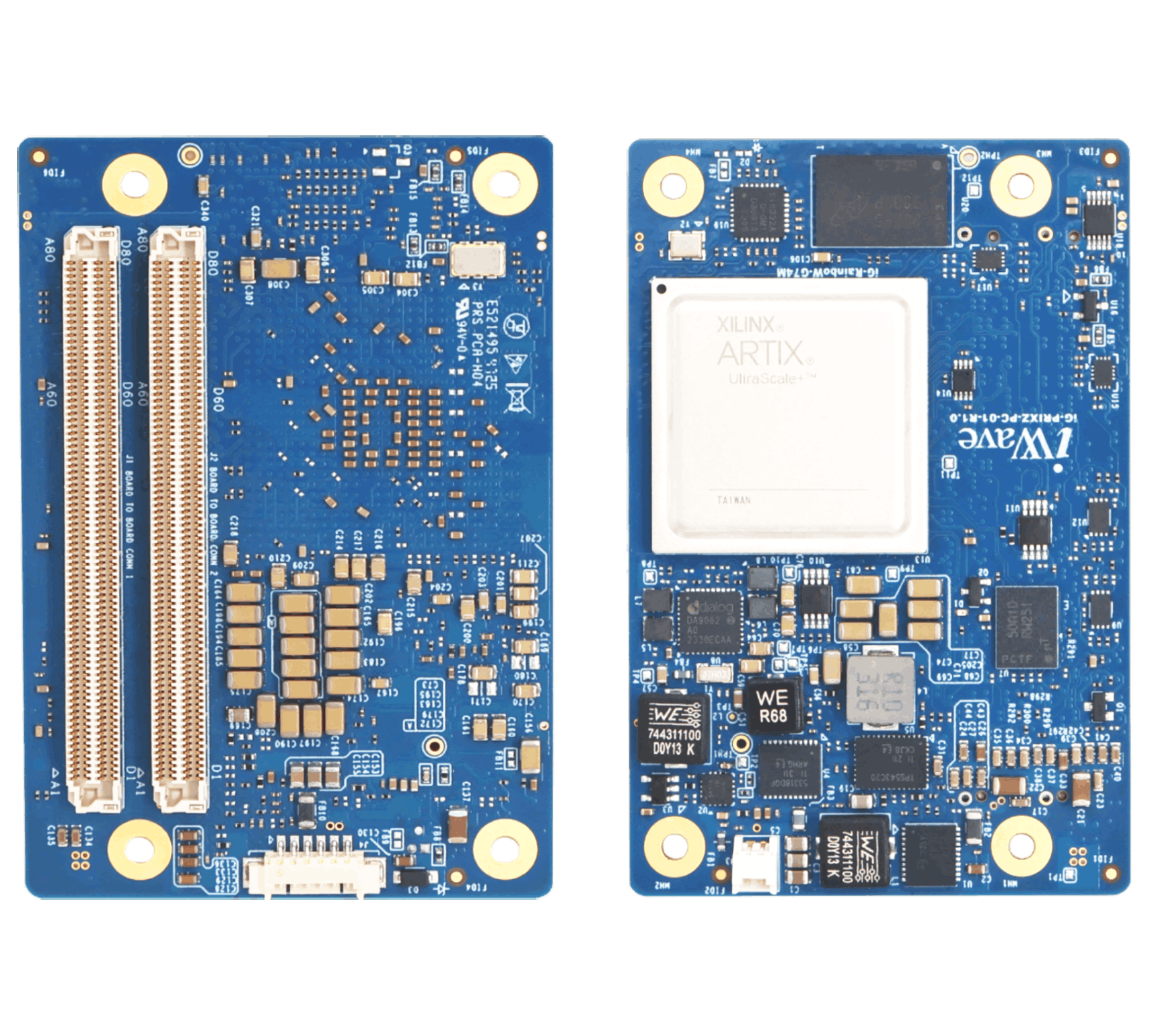
By adopting oHFM, iWave helps customers build FPGA platforms that scale efficiently from early prototypes to long-term, production-ready systems, while benefiting from standardized interfaces, reduced integration effort, and improved design reuse across product generations.
The Open Harmonized FPGA Module standard represents a fundamental shift in how FPGA systems are designed and scaled. By moving away from proprietary module formats and toward a harmonized, open architecture, oHFM enables FPGA designs that grow with application demands rather than being constrained by them.
For engineers looking to future-proof their FPGA platforms, reduce redesign cycles, and build scalable product families, oHFM offers a clear and compelling path forward.
For more information, reach out to us at mktg@iwave-global.com
