End-to-End PCB Design Considerations for High-Performance RF Systems
May 7, 2026
Article
Designing high-performance RF systems requires a holistic approach that spans schematic design, PCB material selection, layout implementation, and post-layout validation. With increasing integration and multi-gigahertz operation in platforms such as Versal RF Series and Zynq UltraScale+ RFSoC, PCB design plays a critical role in achieving target performance and reliability.
At iWave Global, RF system design is approached as an end-to-end engineering process, where each stage from power architecture to signal integrity validation is carefully optimized to meet stringent application requirements. This article outlines the key PCB design practices followed in developing high-performance RF systems.
RF Design Considerations at Schematic Level
Power Design Strategies for High-Performance RF Systems:
Power design is the first and most critical step in RF system development. Accurate power estimation is performed early in the design cycle using tools such as AMD’s Power Design Manager (PDM), enabling precise definition of power budgets and thermal requirements.
Depending on application requirements, we evaluate both minimal rail configurations and full power management approaches. While minimal rail designs help reduce board complexity and cost, we adopt full power management in performance-critical systems where finer control over power domains is required.
Our approach to power integrity includes careful planning of decoupling networks to ensure stable voltage delivery under dynamic load conditions. For sensitive RF domains, we prioritize low-dropout regulators with high PSRR and low output noise, while high-efficiency switching regulators are used where appropriate. Special attention is also given to output capacitor selection, including ESR and capacitance values, to ensure regulator stability.
Clock Distribution and Synchronization in High-Performance RF Systems:
Clocking architecture is a key focus area in our RF system design methodology, as it directly impacts overall signal performance. In our RF platforms, we leverage both internal capabilities and external RF sampling clocks depending on system requirements. For high-performance applications, external PLLs are carefully selected and placed near the SoC to minimize insertion loss and maintain signal integrity.
Where supported, we utilize internal clock forwarding features to distribute clock signals efficiently across tiles, ensuring uniform performance. We also ensure that RF clock signals are AC-coupled and that differential skew is tightly controlled to meet synchronization requirements.
For more detailed information, go through our joint webinar with AMD here.
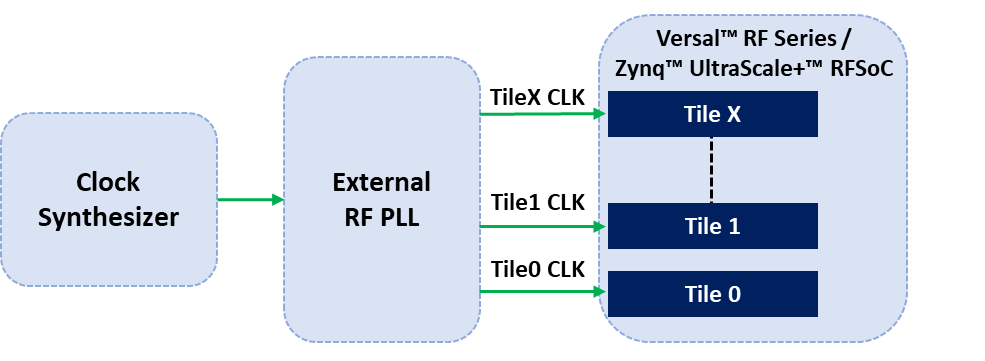
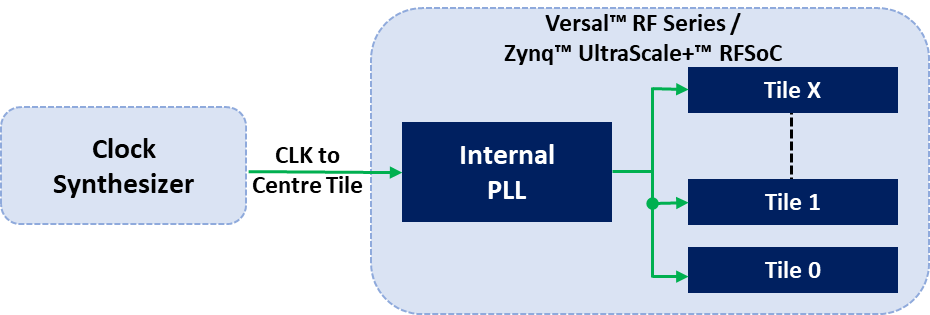
Figure 1a: External PLL
Figure 1b: Internal PLL
Pre-Layout Preparation
PCB Material Selection for High-Performance RF Systems:
PCB material selection is a critical factor in RF design, particularly for systems operating at frequencies up to 18 GHz in Versal RF platforms and 7.2 GHz in RFSoC devices.
Materials with low dielectric constant (Dk), typically in the range of 3 to 3.7, are preferred as they enable faster signal propagation and simplify impedance control. Similarly, a low dissipation factor (Df), typically between 0.001 and 0.005, reduces signal attenuation and power loss over high-frequency transmission paths.
Consistency of dielectric properties across frequency and temperature variations is equally important to ensure predictable performance. Copper surface roughness must also be carefully controlled. Low-roughness copper profiles (such as HVLP variants) reduce conductor losses caused by skin effect, which becomes increasingly significant at higher frequencies.
PCB Stack-Up Finalization:
Once the material is selected, the PCB stack-up must be defined in close collaboration with the fabrication vendor. Proper stack-up design ensures controlled impedance, signal integrity, and manufacturability.
The use of mechanically spread glass weave materials (such as 1035 or 1078) is recommended to minimize fiber weave effects. Variations in dielectric constant between glass fibers and resin can lead to differential signal skew if not properly managed.
RF signal layers should be sandwiched between ground planes to provide shielding and maintain impedance consistency. Differential RF signals, including ADC, DAC, and PLL clock lines, should be designed for 100-ohm impedance, with trace geometries validated by the fabrication vendor. For power distribution, thicker copper layers are recommended to support high-current FPGA power rails.
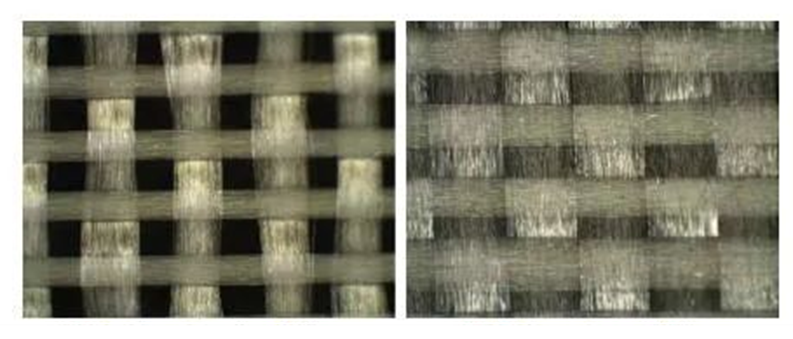
Figure 2a: 1080 Standard Glass Weave
Figure 2b: 1078 Spread Glass Weave
Signal Integrity and RF Layout Techniques for High-Performance RF Systems:
Pre-layout signal integrity (SI) analysis helps identify potential issues early in the design process. By modelling signal paths before layout, designers can validate impedance targets, loss characteristics, and routing constraints, reducing the risk of costly redesigns.
RF Isolation and Power Plane Planning:
Effective PCB layout begins with proper partitioning of analog and digital domains. Sensitive analog circuits must be physically separated from digital circuitry to minimize electromagnetic interference.
Power components should be placed strategically, with RF VRMs and associated capacitors located close to RF power rails, and digital VRMs positioned near digital loads. RF PLLs should be placed close to the SoC, with DAC and ADC PLLs located near their respective functional blocks.
RF signal routing must follow controlled impedance practices. Differential pairs should be implemented as weakly coupled 100-ohm strip lines, where spacing between traces is at least three times the trace width. This approach improves current distribution, reduces resistive losses, and enhances impedance stability compared to tightly coupled routing.
To minimize crosstalk, adequate spacing or guard structures should be used, along with ground stitching vias. RF traces should always be referenced to continuous ground planes above and below. Routing stubs must be avoided, and vias should be back-drilled to eliminate stub-induced reflections. Although analog and digital grounds are internally separated within the SoC, they should be connected on the PCB in a controlled manner without introducing discontinuities.

Figure 3a: Tightly Coupled

Figure 3b: Weakly Coupled
PCB Design for Synchronization:
Synchronization is essential in applications such as beamforming and multi-channel data acquisition, where phase alignment across channels, tiles, or boards is critical. Clock signals including RF ADC/DAC clocks, Analog SYSREF, PL SYSREF, and reference clocks must be distributed using a common timing reference across all devices. Precise skew control is required, with differential pair skew typically maintained below 1 ps for ADC/DAC signals and below 2 ps for RF PLL signals. Inter-pair skew must also be carefully controlled, considering both PCB and package-level variations.

Achieving such tight tolerances requires the use of 3D electromagnetic simulation tools, which account for dielectric properties, via effects, and discontinuities that cannot be captured through simple length matching.
Component placement must maintain symmetry. Resistors and decoupling capacitors associated with differential signals should be placed symmetrically and preferably on the same layer. Calibration components, such as precision resistors, should be located close to dedicated SoC pins to ensure accurate operation.
Post-Layout Validation in High-Performance RF Systems:
Post-layout validation is essential to ensure that the design meets performance requirements prior to fabrication. Signal integrity analysis must verify that parameters such as insertion loss, return loss, crosstalk (NEXT and FEXT), and impedance profiles are within acceptable limits. Time-domain reflectometry (TDR) analysis is commonly used to validate impedance consistency along signal paths.
Power integrity analysis focuses on the performance of the power distribution network (PDN). This includes evaluating voltage drops, ensuring stable power delivery, and minimizing noise. Optimization of decoupling capacitor placement and values is critical to maintaining low impedance across the operating frequency range.

Figure 4a: Insertion Loss

Figure 4b: Return Loss
The design of high-performance RF systems requires a holistic approach that spans schematic design, material selection, PCB layout, and post-layout validation. Careful attention to power architecture, clock distribution, material properties, controlled impedance routing, synchronization, and integrity analysis enables designers to meet the stringent requirements of modern RF applications. By adopting a structured design methodology, engineers can achieve reliable, high-performance systems even at multi-gigahertz operating frequencies. This end-to-end design methodology enables us to deliver high-performance, scalable RF solutions tailored to modern system requirements.
Check out our latest joint webinar with AMD where we discussed the key RF Design consideration in detail and the entire portfolio of iWave RF Boards & Solutions.
For more information, reach out to us at mktg@iwave-global.com
