OSM System on Module : A Compact, Rugged, and Future-Ready Embedded Computing Platform
August 5, 2023
Article
OSM System on Module technology is redefining embedded system design by offering a compact, reliable, and manufacturing-friendly alternative to traditional System on Modules. Developed by the Standardization Group for Embedded Technologies (SGET), the Open Standard Module (OSM) specification introduces a connector-less architecture in which the module is soldered directly onto the carrier PCB using Land Grid Array (LGA) technology. By eliminating board-to-board connectors, OSM modules reduce board space, enhance mechanical robustness, and simplify automated manufacturing, making them an ideal choice for next-generation embedded applications.
What is an OSM System on Module ?
An Open Standard Module (OSM) is a standardized, solderable System on Module designed for low-power embedded processors, including ARM®, x86, and MCU architectures.
The OSM specification outlines common module shapes, pin layouts, and interfaces, which allows different processor vendors to work together and simplifies hardware development. By removing mechanical connectors and using direct PCB soldering, OSM modules improve reliability, durability, and production efficiency.
Key Advantages of OSM System on Module
1.Direct PCB Soldering for Reliable Integration
A key feature of OSM is its connector-less design.
The module is directly mounted on the carrier board using standard Surface Mount Technology (SMT), making it suitable for automated assembly via pick-and-place methods.
This setup has several benefits:
- Minimizes connector-related failures
- Enhances long-term mechanical reliability
- Supports fully automated production
- Reduces assembly complexity and manufacturing costs
- Improves signal integrity through shorter electrical paths
The electrical interfaces are accessible through LGA contact points underneath the module, ensuring secure and dependable connectivity.
Enhanced Ruggedness for Demanding Environments
Embedded applications in industrial, transportation, defence, and mobile settings often face continuous shock and vibration. Since OSM modules are soldered directly to the PCB, they eliminate the mechanical issues typically associated with connectors.
The use of SMT assembly and LGA packaging creates a highly durable solution that can handle tough operating conditions while maintaining consistent performance.
Ultra-Compact Design
Space limitations remain a key challenge for embedded system designers.
OSM modules maximize functionality within a compact size by using high-density LGA technology. The compact form factor allows for:
- Higher input/output density
- Smaller overall device size
- Greater design flexibility
- Support for advanced embedded applications
This makes OSM especially suitable for compact edge devices, industrial controllers, medical equipment, automotive electronics, and IoT platforms.
OSM System on Module Sizes
The OSM specification includes four standardized sizes to meet different performance and interface needs:
- Size-0 – Designed for ultra-compact embedded applications
- Size-S – Suitable for basic multimedia and industrial systems
- Size-M – Offers more expansion and connectivity for more complex applications
- Size-L – Provides the highest input/output density and interface support for advanced embedded platforms
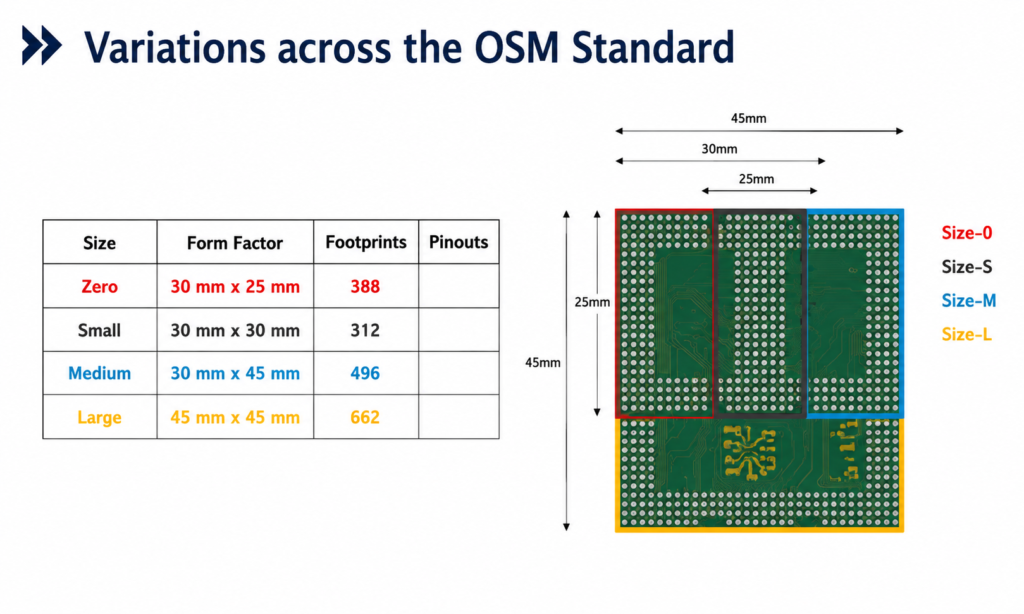
A major benefit of the OSM standard is its scalable size.
Carrier boards can support multiple module sizes, making it easier to upgrade without major hardware changes.
Interface Capabilities Across OSM Variants
Each OSM size supports various levels of connectivity depending on the application.
Starting with Size-S, modules support RGB display output, MIPI DSI, and MIPI CSI for display and camera integration. As module size increases, additional high-speed interfaces become available.
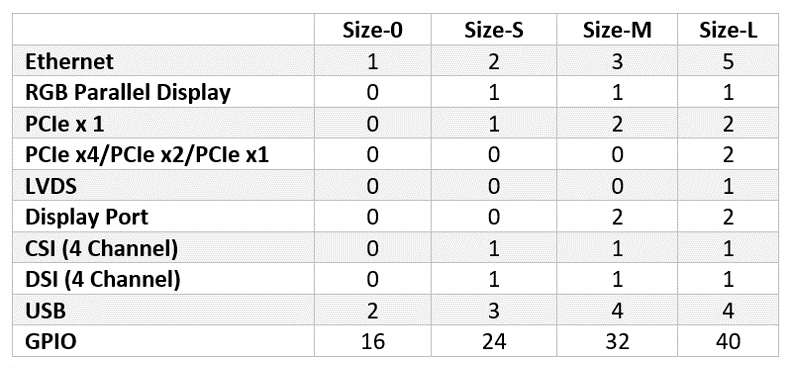
Size-L provides extensive connectivity features, including:
- LVDS for larger display panels
- Multiple PCIe lanes for high-speed peripheral expansion
- Up to five Ethernet interfaces for networking
- A large number of GPIOs for flexible peripheral integration
All OSM variants also include dedicated pins for wireless antenna connectivity, enabling support for technologies like Wi-Fi®, Bluetooth®, cellular, and other RF-based communication methods.
Additional manufacturer-specific pins are also available for custom configurations when needed.
OSM Compared with Traditional SoM Standards
Compared to older standards like SMARC® and Qseven®, OSM offers a significantly smaller physical size while providing higher pin density and better integration.
The connector-less design not only reduces the module size but also improves mechanical strength and allows for cost-effective automated manufacturing. These benefits make OSM a strong choice for applications where dependability, miniaturization, and scalability are key design factors.
iWave OSM System on Modules
iWave provides a growing range of OSM-based System on Modules built on industry-leading processors, helping customers speed up embedded product development in industrial, medical, automotive, and edge AI applications.
The portfolio includes OSM solutions based on:
These modules offer a compact design, comprehensive software support, and long-term product availability to help reduce development time and accelerate product launch.
The OSM standard represents a major step forward in embedded computing by combining a small size, connector-less design, and robust mechanical construction. With standardized interfaces, varying module sizes, and support for modern processors, OSM provides a dependable platform for building the next generation of embedded systems. Whether designing industrial automation equipment, smart edge devices, medical electronics, or transportation solutions, OSM System on Modules offer the flexibility, durability, and manufacturing efficiency needed to create future-ready products.
For more information, visit www.iwave-global.com or contact mktg@iwave-global.com
