Revolutionizing Radio Telescope Backend Receivers with RFSoC System on Module
August 25, 2025
Article
Modern radio astronomy demands the ability to capture, digitize, and process vast amounts of high-frequency data with exceptional precision and speed. As telescopes expand in scale and sensitivity, traditional digital backend systems—built using discrete ADCs, FPGAs, processors, and timing modules—are increasingly unable to keep pace with these rapidly evolving performance requirements.
To overcome these challenges, iWave introduces a powerful and integrated solution: the Zynq UltraScale+ RFSoC System on Module (SoM). This compact yet highly capable platform brings together high-speed RF data converters, programmable FPGA logic, ARM multi-core processing, and precision timing in a single module. For radio telescope designers, this integration enables drastic reductions in system complexity, power consumption, and development time.
This article explores how the RFSoC SoM redefines digital backend architectures for radio astronomy and offers a practical, scalable path for next-generation telescope technologies.
Why RFSoC Technology Is Transforming Radio Astronomy
Radio telescopes capture extremely weak signals originating from distant celestial objects such as pulsars, galaxies, quasars, and cosmic microwave background emissions. These analog signals must be digitized at high speed and processed in real time for beamforming, correlation, spectral analysis, and interference removal.
Conventional digital backends often require multiple components:
- Discrete high-speed ADCs and DACs
- FPGAs for DSP workloads
- Embedded processors for control
- Separate timing and synchronization modules
This approach increases PCB complexity, consumes more power, demands meticulous RF design, and requires extensive firmware development.
RFSoC changes this.
The Zynq UltraScale+ RFSoC architecture integrates the following onto a single chip:
- Multi-gigasample ADCs
- Multi-gigasample DACs
- High-performance FPGA fabric
- ARM Cortex-A53 application processors
- Dual-core Cortex-R5 real-time processors
- GTY high-speed serial transceivers
- Precision clocking resources
This unprecedented integration delivers:
- Direct RF sampling from the telescope front-end
- Reduced latencies for real-time DSP
- Lower hardware footprint and power consumption
- Flexible reconfigurable logic for custom algorithms
- Integrated multi-core processing for control and data management
- Simplified timing synchronization across array deployments
For radio astronomy, where signal integrity and timing accuracy are essential, RFSoC becomes an ideal platform for next-generation backend systems.
iWave’s RFSoC SoM: A High-Performance Building Block for Digital Backends
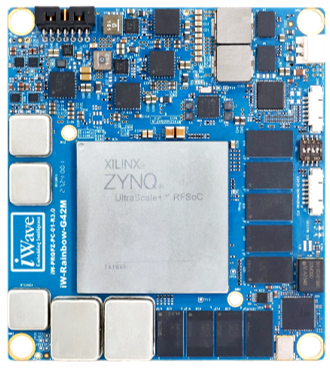
The iG-G42M is iWave’s production-ready SoM based on the Zynq UltraScale+ RFSoC (ZU49DR with compatibility for ZU39DR and ZU29DR devices). This SoM is engineered to meet the stringent requirements of RF-intensive domains, making it a natural fit for radio astronomy applications.

Key Features and Advantages
- High-Speed Data Converters
The SoM integrates:
- Up to 16 RF-ADC channels supporting ~2.5 GSPS
- Up to 16 RF-DAC channels supporting ~10 GSPS
These converters enable high bandwidth signal digitization, capturing wideband astronomical data directly from antenna feeds or analog front ends.
- Large On-Board Memory for Complex DSP
The module includes:
- 8 GB 64-bit DDR4 with ECC for the processing system
- 8 GB DDR4 dedicated to programmable logic
This enables large-buffer storage, multi-stage DSP pipelines, and high-throughput data streaming.
- Integrated RF Clocking & Precision Timing
The SoM supports:
- SyncE
- IEEE 1588 Precision Time Protocol (PTP)
- Ultra-low jitter programmable RF PLL
Such precise timing is essential for coordinated telescope arrays like interferometers.
- High-Speed Connectivity
With 16 GTY transceivers offering speeds up to 28.21 Gb/s, the SoM supports high-throughput streaming to servers, GPUs, or storage systems. This enables scalable processing architectures where compute loads can be distributed across clusters.
- Compact & Power-Efficient Design
By integrating multiple RF and digital functions into a single SoC, the SoM significantly reduces:
- PCB area
- Power consumption
- Design complexity
- Cooling requirements
This makes it well-suited for remote telescope installations where energy supply and physical space are limited.
Digital Backend Architecture Powered by RFSoC
A typical radio telescope backend designed with the iWave RFSoC SoM follows this data flow:

- RF Signal Acquisition
Analog signals from the telescope’s feed components (LNA, filters, mixers) are fed directly to the RF-ADCs. Direct sampling preserves signal quality and eliminates multiple down-conversion stages.
- Real-Time DSP in FPGA Fabric
Once digitized, the FPGA handles:
- Channelization
- Fast Fourier Transforms (FFT)
- Beamforming
- RFI mitigation
- Correlation and cross-correlation
- Polyphase filter bank (PFB)
- Pulsar search pipelines
The reconfigurable nature of the FPGA allows astronomers to customize algorithms as observation requirements evolve.
- Data Buffering and Local Storage
High-capacity DDR4 memory allows temporary buffering of high-bandwidth data during burst observations or during peak processing workloads.
- High-Speed Data Output
Processed or raw data can be streamed out using:
- 100GbE
- PCIe links
- GTY-based custom protocols
This enables seamless integration with downstream GPU servers, correlators, or centralized compute clusters.
Designed for Scalable Telescope Arrays
Large radio telescopes often deploy multiple synchronized backend units across a wide area. The RFSoC SoM simplifies this:
- SyncE/PTP ensures coherent time alignment.
- GTY transceivers support deterministic low-latency communication.
- FPGA-based logic allows tight synchronization across modules.
- Power-efficient design enables solar or remote power operation.
As a result, telescope arrays such as Very Long Baseline Interferometry (VLBI) systems can achieve higher precision and improved signal correlation.
PCIe-Based RFSoC Acquisition Card
To complement the SoM, iWave also offers the iG-G42P PCIe acquisition card featuring the same RFSoC device. This card enables:
- Multi-channel data capture (16 ADC / 16 DAC)
- High-speed PCIe Gen3 x8 connectivity
- SMA connectors with wideband baluns
- Support for NVMe or FMC+ expansion
This platform makes it easy to deploy RFSoC-based processing inside standard server systems, enabling large-scale compute nodes for correlation or beamforming clusters.

Benefits for Radio Astronomy Projects
Using iWave’s RFSoC SoM, designers gain:
- Accelerated development cycles with production-ready hardware
- Reduced risk due to integrated RF and digital capabilities
- Lower system cost and BOM complexity
- High scalability for single-dish or array-based telescopes
- Long-term availability and robust technical support
- Flexible customization for unique research algorithms
Conclusion
iWave’s Zynq UltraScale+ RFSoC System on Module presents a transformative approach to designing radio telescope digital backends. By unifying high-speed RF data conversion, signal processing logic, multi-core processing, and precise timing into a single compact module, it provides an ideal foundation for advanced astronomy systems.
Whether used for pulsar detection, spectrometry, FRB research, or large-scale interferometry arrays, the RFSoC SoM significantly simplifies system architecture while enabling exceptional performance.
iWave supports customers with production-ready modules, evaluation platforms, documentation, and engineering services — enabling research institutions and OEMs to accelerate their projects and push the boundaries of astronomical discovery.
Contact mktg@iwave-global.com to learn more about RFSoC System on Modules.
