Enabling Secure, Mixed-Criticality Systems with Xen Hypervisor on i.MX 95
February 3, 2026
Article
Modern embedded systems in automotive, industrial, and safety-critical domains are no longer single-function platforms. They must simultaneously support real-time control, secure system services, and feature-rich user experiences often on a single SoC. Achieving this level of consolidation without compromising safety, performance, or security is a major design challenge.
Xen Hypervisor on NXP i.MX 95, enabled on iWave’s production-ready System on Module (SoM), addresses this challenge by providing strong isolation, hardware-assisted virtualization, and a scalable foundation for mixed-critical workloads accelerating development while reducing system complexity.
Why Virtualization Matters in Embedded Systems
Embedded platforms increasingly need to run:
- Safety-critical Linux or RTOS workloads
- Rich HMI or Android Automotive environments
- Networking, diagnostics, and analytics stacks
Traditionally, these workloads required multiple processors, increasing BOM cost, power consumption, and validation effort. Virtualization enables multiple operating systems to run securely on a single processor, allowing OEMs to consolidate hardware while maintaining strict isolation between critical and non-critical functions.
Xen Hypervisor: Built for Embedded Isolation
Xen is a mature, open-source Type-1 (bare-metal) hypervisor that runs directly on hardware, offering near-native performance with minimal overhead.
Key Xen Advantages
- Strong hardware-level isolation between domains
- Hardware-assisted virtualization on Arm® platforms
- Fine-grained control of CPU, memory, and devices
- High reliability for safety-critical applications
Type-1 vs Type-2 Hypervisor Architecture Diagram

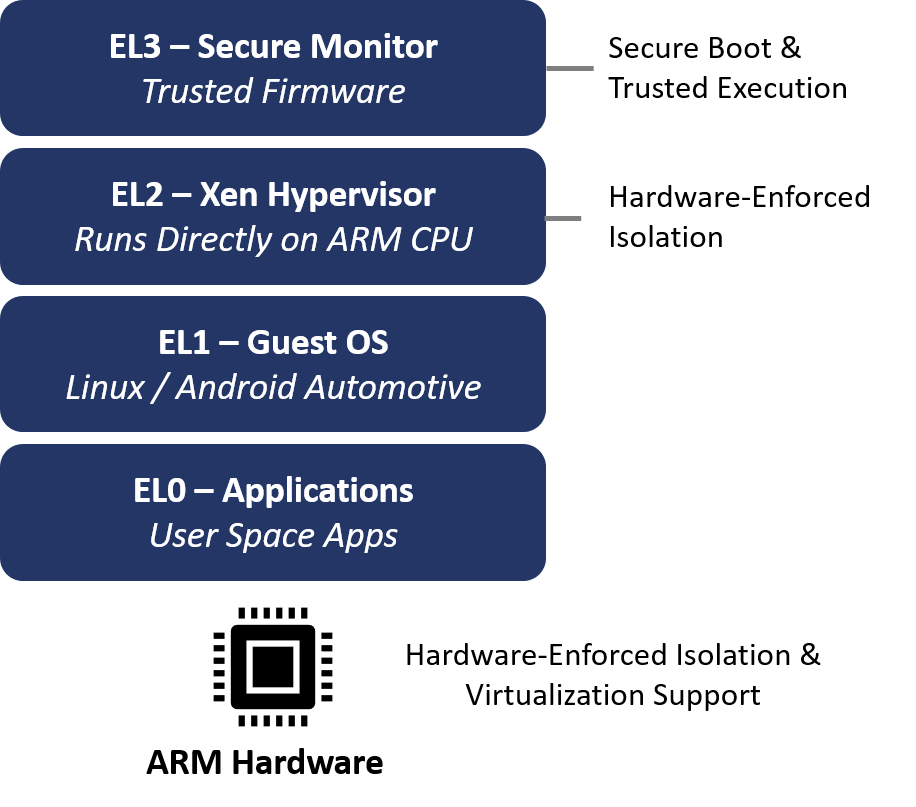
ARM Hardware Virtualization on i.MX 95
The NXP i.MX 95 processor is designed to fully support Arm hardware virtualization, making it an ideal platform for Xen.
Key architectural support includes:
- EL2 (Hypervisor mode) for Xen execution
- Isolated execution across EL1 (OS) and EL0 (Applications)
- Virtualized timers, MMU, and interrupt handling
This allows Xen to enforce strong separation between operating systems while maintaining deterministic behaviour for real-time workloads.
Why Xen on NXP i.MX 95?
The i.MX 95 platform combines performance, security, and scalability, making it well-suited for virtualization-driven designs.
Key Platform Benefits
- High-performance Arm® Cortex® cores with virtualization support
- Advanced security features (secure boot, trusted execution)
- Rich multimedia and high-speed I/O
- Optimized for automotive and industrial environments
Together, Xen + i.MX 95 enable platforms where safety-critical Linux workloads can coexist with feature-rich operating systems such as Android Automotive, without interference.
Reference Virtualization Architecture
In a typical iWave-enabled Xen deployment:
Dom0 (Control Domain)
- Runs Linux
- Has privileged access to hardware
- Manages system resources and guest domains
DomU (Guest Domains)
- Runs Linux, Android Automotive, or RTOS
- Fully isolated execution environments
- Dedicated CPU, memory, and device access
This architecture simplifies certification, improves fault containment, and allows independent software lifecycles.

Virtual I/O and Device Management
Xen supports multiple device access models to suit different use cases:
- Para virtualized I/O (Split Drivers)
- Shared access via frontend/backend drivers
- Ideal for shared resources
- Device Pass-Through (SMMU-based)
- Direct device ownership by a single guest
- Enables near-native performance
This flexibility allows system architects to balance performance, safety, and resource sharing
Real-World Use Cases
Automotive & Transportation
- Linux-based safety functions alongside Android Automotive infotainment
- Secure separation between vehicle control and user applications
Industrial Automation
- Real-time control isolated from networking and analytics
- Improved reliability and fault containment
Edge & IoT Gateways
- Secure multi-tenant systems
- Concurrent execution of networking, analytics, and management workloads
The iWave Advantage
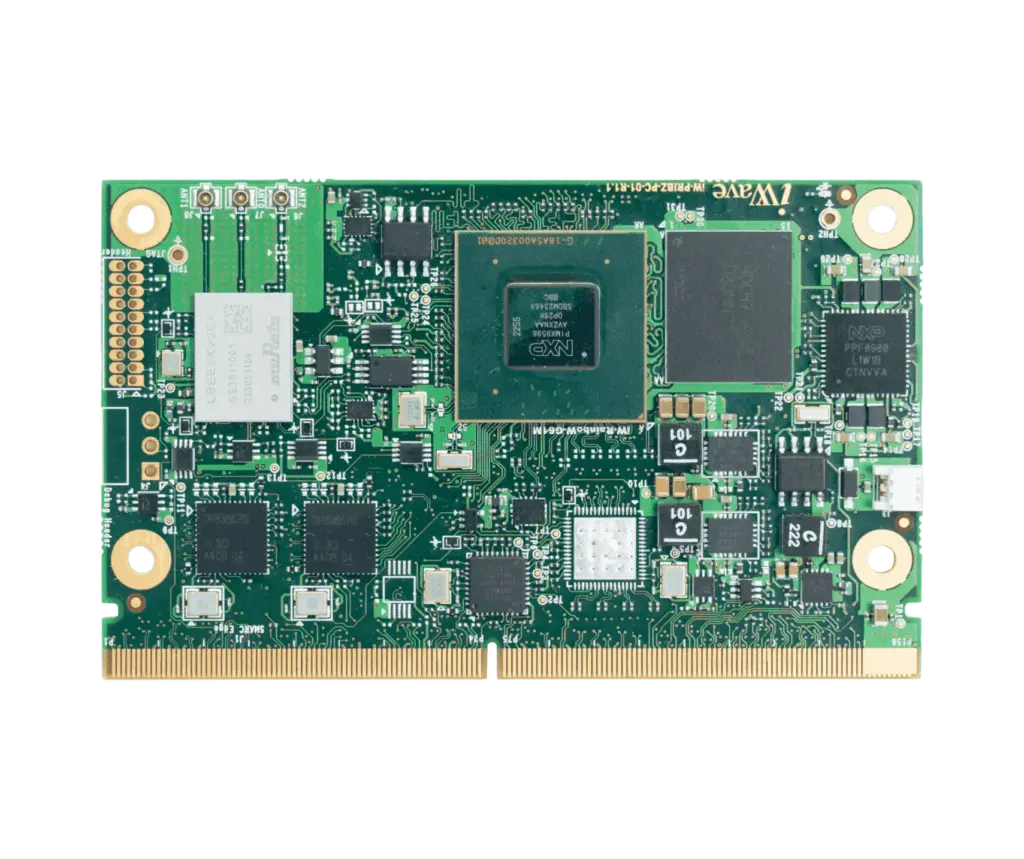
iWave delivers more than hardware, it provides a complete, virtualization-ready solution.
What iWave Brings
- Pre-validated Xen Hypervisor enablement on i.MX 95
- Production-ready Linux BSP and virtualization support
- Expertise in Linux + Android + RTOS coexistence
- Faster bring-up with reduced integration risk
- Customization and ODM services for production deployment
Key Benefits for OEMs and System Integrators
- Reduced BOM and power consumption
- Strong isolation for safety-critical workloads
- Faster time-to-market
- Scalable architecture for future features
- Lower lifecycle and maintenance cost
Conclusion
As embedded systems grow more complex, virtualization is no longer optional, it is essential. Xen Hypervisor on NXP i.MX 95, delivered on iWave’s production-ready SoM, provides a secure, scalable, and efficient foundation for running mixed-critical workloads on a single platform.
Whether you are building automotive domain controllers, industrial systems, or secure edge devices, iWave’s Xen-enabled i.MX 95 solution helps you innovate faster, without compromising safety, performance, or reliability.
Ready to simplify your system architecture with virtualization?
Visit www.iwave-global.com or contact mktg@iwave-global.com
