Embedded Telematics Solutions for Connected Automotive Applications
August 24, 2023
Article
Embedded Telematics Solutions are playing a key role in the automotive industry’s shift toward connected and software-defined vehicles by enabling intelligent systems to collect, process, and communicate vehicle data in real time. By connecting vehicles with cloud platforms, fleet management systems, and other connected services, embedded telematics solutions support seamless data exchange and connected mobility.
Combining vehicle connectivity, GNSS, CAN communication, wireless technologies, edge computing, and security, these solutions enable automotive OEMs and fleet operators to monitor vehicle performance, enhance safety, optimize operations, and deliver connected services.
What Are Embedded Telematics Solutions?
Embedded telematics solutions integrate computing, communication, and vehicle interfaces into an automotive platform to enable the exchange of information between the vehicle and external systems.
A typical telematics system collects data from vehicle ECUs, sensors, and communication interfaces such as CAN and CAN-FD. The system can process critical information locally and transmit selected data to a cloud or fleet management platform through cellular or wireless connectivity.
A typical embedded telematics architecture includes:
- Application processor
- Cellular connectivity
- GNSS receiver
- CAN/CAN-FD interfaces
- Wi-Fi and Bluetooth
- Vehicle and motion sensors
- Local storage
- Security hardware
- Cloud connectivity
This combination enables real-time vehicle monitoring and connected services without relying entirely on external computing infrastructure.
Embedded Telematics Solutions for Connected Vehicles
Connected vehicles continuously generate data related to vehicle location, speed, diagnostics, fuel consumption, driving behaviour, and operating conditions.
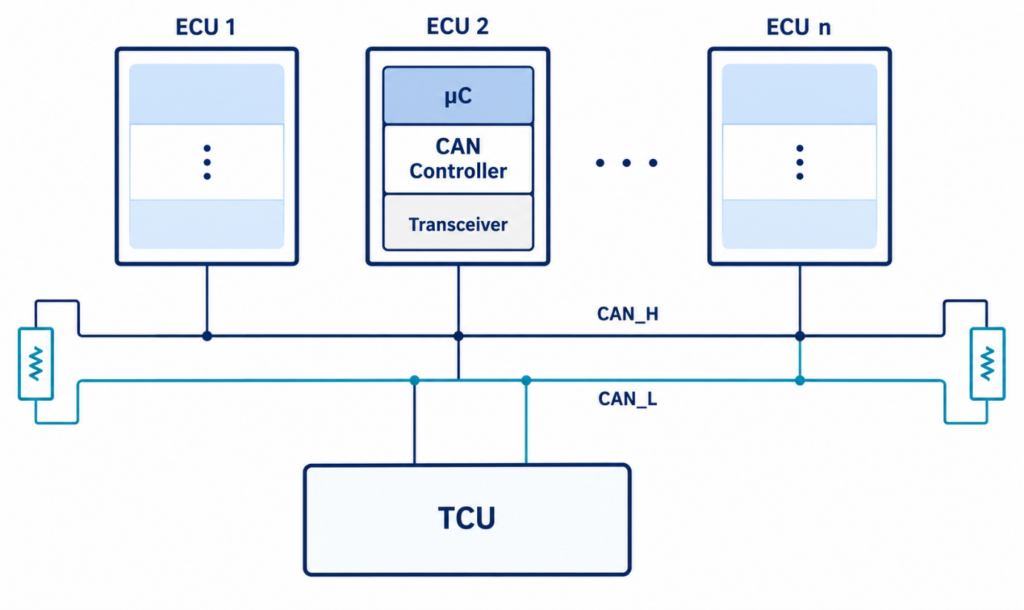
Embedded telematics solutions provide a centralized platform to collect and process this information. Critical parameters can be analysed at the edge, while selected information can be transmitted to the cloud for advanced analytics.
This approach helps reduce unnecessary data transmission while enabling faster responses to time-sensitive events.
For automotive OEMs, this architecture can support applications such as:
- Vehicle tracking
- Remote diagnostics
- Driver behaviour monitoring
- Predictive maintenance
- Fleet management
- Vehicle security
- Usage-based services
- Remote software updates
Embedded Telematics Solutions for Fleet Management
Fleet operators require continuous visibility into their vehicles to improve utilization, reduce operating costs, and maintain vehicle availability.
With GNSS and vehicle interface integration, embedded telematics solutions can provide real-time information about vehicle location, speed, distance, routes, idling, and operating conditions.
Vehicle diagnostic information collected through CAN interfaces can also help fleet managers identify potential faults and schedule maintenance proactively.
This enables organizations to improve fleet utilization while reducing unexpected downtime and maintenance costs.
Embedded Telematics Solutions for Vehicle Diagnostics
Modern vehicles contain multiple electronic control units that continuously generate diagnostic information. Accessing this information remotely allows vehicle manufacturers and fleet operators to identify abnormal conditions without requiring the vehicle to be physically inspected.
An embedded telematics platform can collect diagnostic data and transmit relevant parameters to a remote application.
When combined with edge analytics, the platform can identify critical events locally and send only the required information to the cloud. This helps improve response time and optimize network bandwidth.
Embedded Telematics Solutions with GNSS and Sensor Integration
Accurate positioning is essential for connected vehicle applications. Embedded telematics platforms can integrate multiple GNSS constellations such as GPS, GLONASS, Galileo, and BeiDou to provide reliable positioning.
Sensor integration further expands telematics capabilities. Accelerometers, gyroscopes, and other sensors can be used to identify events such as:
- Harsh braking
- Rapid acceleration
- Overspeeding
- Sudden impact
- Aggressive driving
- Vehicle movement or unauthorized usage
The collected information can be used to improve driver safety and vehicle monitoring.
Secure Embedded Telematics Solutions
As vehicles become increasingly connected, cybersecurity is an important consideration. A compromised telematics platform could expose sensitive vehicle and operational data or provide an entry point for attacks.
Secure embedded telematics solutions can incorporate multiple layers of protection, including:
- Secure boot
- Hardware-based security
- Secure communication
- Data encryption
- Authentication
- Secure storage
- Trusted software execution
- Secure firmware updates
These mechanisms help protect vehicle data and maintain a trusted communication path between the vehicle, telematics platform, and cloud.
Embedded Telematics Solutions with OTA Updates
Software updates are becoming an essential part of connected vehicle management. Over-the-Air (OTA) technology enables software and firmware to be updated remotely without requiring physical access to the vehicle.
A telematics platform can act as the communication gateway for receiving and deploying updates. Redundant system partitions and rollback mechanisms can help the system recover if an update is interrupted or fails.
Secure OTA therefore enables automotive OEMs and fleet operators to maintain software, introduce new features, and deploy security patches throughout the vehicle lifecycle.
iWave Embedded Telematics Solutions
iWave provides embedded hardware and software solutions for developing connected automotive and telematics platforms. Its telematics solutions combine processing, vehicle interfaces, wireless connectivity, GNSS, sensors, security, and software capabilities in an integrated platform.
iWave embedded telematics solutions can support features such as:
- Multi-CAN and CAN-FD connectivity
- Cellular connectivity
- Wi-Fi and Bluetooth
- Multi-constellation GNSS
- IMU and sensor integration
- Vehicle diagnostics
- Edge data processing
- Secure boot and hardware security
- Secure OTA updates
- Cloud connectivity
- SAE J1939 for heavy-duty vehicles
- Application-specific customization
The platforms can be adapted for passenger vehicles, commercial vehicles, heavy-duty vehicles, fleet management systems, and other connected mobility applications.
Why Choose Embedded Telematics Solutions for Connected Mobility?
The transition toward connected vehicles requires more than basic vehicle tracking. Automotive OEMs need scalable platforms capable of integrating vehicle data, connectivity, security, edge processing, and cloud services.
Embedded telematics solutions provide the foundation for building these connected vehicle capabilities while allowing manufacturers to develop differentiated applications on top of a flexible hardware and software platform.
With expertise in embedded hardware, automotive software, connectivity, vehicle interfaces, security, and cloud integration, iWave supports OEMs and system developers in accelerating the development of next-generation connected vehicle solutions.
For more information, visit www.iwave-global.com or contact mktg@iwave-global.com
