Telematics for Engine Fault Diagnostics: Enabling Remote Engine Monitoring
August 23, 2023
Article
Telematics for Engine Fault Diagnostics is becoming increasingly important for diesel engines that power critical equipment across construction, mining, agriculture, healthcare, power generation, utilities, and other industrial sectors. Unexpected engine faults can lead to equipment downtime, reduced productivity, and significant operational and financial losses.
Traditional engine monitoring often depends on manual inspections and periodic maintenance. While these methods can identify certain issues, they may not provide continuous visibility into engine health or allow operators to respond quickly to emerging problems.
Telematics for Engine Fault Diagnostics provides a smarter approach by collecting engine and machine data, transmitting it remotely, and making critical information available for real-time analysis. By combining vehicle or machine interfaces, sensors, wireless connectivity, and cloud-based monitoring, telematics enables operators to move from reactive maintenance toward proactive and predictive engine management.
Why Telematics for Engine Fault Diagnostics Is Important
Engine performance can change significantly depending on operating conditions, usage patterns, fuel consumption, temperature, pressure, and other parameters. Without continuous monitoring, abnormal conditions may remain undetected until they develop into serious failures.
Telematics for Engine Fault Diagnostics enables organizations to continuously monitor critical engine parameters and receive actionable information remotely. Instead of relying only on physical inspections, operators can access engine status and performance information from centralized web or mobile applications.
This approach can help organizations:
- Identify abnormal engine conditions at an early stage
- Reduce unexpected equipment downtime
- Improve maintenance planning
- Monitor engine operating hours and utilization
- Track fuel consumption and potential fuel theft
- Receive alerts when predefined fault conditions occur
- Improve visibility across geographically distributed equipment
- Support predictive maintenance strategies
How Telematics for Engine Fault Diagnostics Works
A typical Telematics for Engine Fault Diagnostics architecture connects the engine to a telematics gateway through automotive communication interfaces such as CAN. Additional sensors can be integrated when parameters are not available directly from the engine control system.
The telematics device collects information from the engine and connected sensors before processing and transmitting the data through wireless communication technologies such as cellular connectivity.
The overall data flow can be represented as:
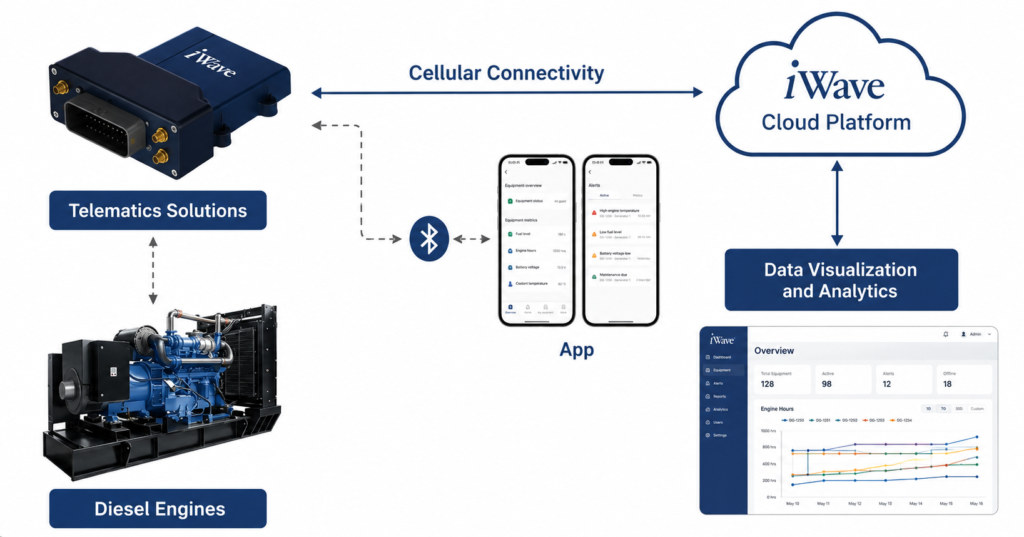
The collected information can then be converted into dashboards, reports, alerts, and analytics that help users understand equipment health and operating conditions.
Engine Parameters Monitored Through Telematics for Engine Fault Diagnostics
Telematics for Engine Fault Diagnostics can provide visibility into a wide range of engine and equipment parameters. Depending on the engine, ECU, sensors, and communication protocol, monitored information may include:
- Engine operating hours
- Fuel consumption
- Fuel level and refilling events
- Engine power and operating status
- Battery voltage
- Coolant temperature
- Pressure levels
- Engine health indicators
- Machine utilization
- Fault and diagnostic information
- Equipment location
- Abnormal operating conditions
Monitoring these parameters continuously provides a more complete picture of machine health than periodic manual inspection.
CAN and J1939 in Telematics for Engine Fault Diagnostics
CAN-based communication plays an important role in Telematics for Engine Fault Diagnostics, particularly in automotive and heavy-duty applications.
For diesel engines and heavy-duty equipment, SAE J1939 is widely used for communication between electronic control units and other vehicle or machine systems. A telematics gateway with J1939 support can acquire engine-related parameters from the network and make them available to remote monitoring platforms.
iWave provides J1939 protocol support designed for automotive and industrial applications. Its J1939 stack supports the relevant SAE J1939 protocol layers and enables integration with embedded telematics and gateway solutions.
This protocol-based approach allows telematics developers to build solutions that can collect and interpret engine information without relying entirely on additional external sensors.
Rugged Hardware for Telematics for Engine Fault Diagnostics
Engine monitoring systems are frequently deployed in demanding environments such as construction sites, agricultural machinery, mining equipment, industrial machines, and heavy-duty vehicles. These applications require telematics hardware that can withstand vibration, dust, moisture, temperature variations, and other environmental challenges.
Rugged Telematics for Engine Fault Diagnostics hardware can combine multiple CAN interfaces with RS232, RS485, Ethernet, cellular, Wi-Fi, Bluetooth, GNSS, and sensor interfaces.
For example, iWave’s rugged telematics portfolio includes devices with multiple CAN interfaces, LTE connectivity, Wi-Fi, Bluetooth, GNSS, sensor support, security features, and IP67-rated protection for demanding deployments.
This combination of rugged hardware and flexible connectivity enables reliable data collection from equipment operating in remote and harsh locations.
Remote Monitoring with Telematics for Engine Fault Diagnostics
One of the major advantages of Telematics for Engine Fault Diagnostics is remote access to equipment information.
Instead of sending technicians to every machine for routine inspection, operators can monitor multiple assets through a centralized platform. Real-time data can be visualized through dashboards, while configurable alerts can notify maintenance teams when a critical parameter crosses a predefined threshold.
For fleet operators and equipment manufacturers, remote monitoring can provide:
- Centralized visibility across multiple assets
- Faster identification of abnormal conditions
- Remote fault notifications
- Equipment utilization analysis
- Maintenance planning based on actual usage
- Reduced dependency on manual inspections
This is particularly valuable when equipment is deployed across multiple locations or in areas where physical access is difficult.
Predictive Maintenance with Telematics for Engine Fault Diagnostics
The data generated through Telematics for Engine Fault Diagnostics can also support predictive maintenance.
Historical engine data can be analysed to identify patterns associated with component degradation, abnormal operating conditions, excessive fuel consumption, or recurring faults. By combining real-time monitoring with analytics, organizations can identify potential issues before they lead to major equipment failure.
Predictive maintenance can help organizations transition from a fixed maintenance schedule toward a condition-based approach, where servicing decisions are supported by actual engine and equipment data.
Fuel Monitoring with Telematics for Engine Fault Diagnostics
Fuel management is another important application of Telematics for Engine Fault Diagnostics.
Continuous monitoring of fuel levels, consumption, refilling, and draining events can help identify unusual usage patterns. When combined with location and operating-hour information, telematics data can provide better visibility into fuel consumption and help identify potential fuel theft or unauthorized usage.
For equipment owners and fleet managers, this can contribute to better resource utilization and lower operating costs.
Benefits of Telematics for Engine Fault Diagnostics
Implementing Telematics for Engine Fault Diagnostics can provide several operational benefits:
Reduced Downtime: Early identification of abnormal engine conditions can help maintenance teams respond before a minor issue becomes a major failure.
Remote Visibility: Operators can monitor equipment performance without being physically present at the deployment location.
Improved Maintenance Planning: Real-time engine information can support condition-based and predictive maintenance strategies.
Better Fuel Management: Fuel consumption and fuel-related events can be tracked to identify inefficiencies or unauthorized usage.
Higher Equipment Utilization: Monitoring engine operating hours and machine usage helps organizations understand asset utilization.
Faster Response: Automated alerts can notify the appropriate personnel when critical engine events or faults are detected.
Scalable Fleet Monitoring: Multiple engines and machines can be connected to a centralized monitoring platform.
iWave Telematics for Engine Fault Diagnostics
iWave offers a portfolio of telematics solutions designed for automotive, industrial, and heavy-duty applications. Its telematics portfolio includes Telematics Control Units, OBD-II devices, rugged telematics devices, telematics gateways, and J1939-based solutions. These platforms support multiple CAN interfaces, wireless connectivity, sensors, security features, and Linux-based software environments.
For diesel engine applications, iWave’s telematics solutions can collect information from engines and connected sensors and transmit the data to remote platforms for monitoring and analysis. The solutions can be configured to support applications such as engine monitoring, fleet management, predictive maintenance, equipment tracking, and fuel monitoring.
The Future of Telematics for Engine Fault Diagnostics
As industrial equipment and connected vehicles become increasingly intelligent, engine monitoring is moving toward continuous, data-driven operation.
The combination of telematics gateways, CAN/J1939 communication, wireless connectivity, cloud platforms, edge processing, and analytics can create a connected ecosystem in which engine data is continuously captured and converted into actionable insights.
Telematics for Engine Fault Diagnostics therefore represents more than remote monitoring. It provides a foundation for proactive maintenance, improved equipment availability, better fleet visibility, and more efficient asset management.
For manufacturers and fleet operators looking to improve the reliability and operational efficiency of diesel-powered equipment, integrating telematics into engine monitoring systems can be an important step toward connected and intelligent asset management.
For more information, visit www.iwave-global.com or contact mktg@iwave-global.com
Explore Related Content
- Penetration Testing for Telematics Devices: Securing the Connected Automotive Edge
- Automotive Telematics Solutions in India: Opportunities and the Road Ahead
