Beyond the Cockpit: How ARINC 818 IP Cores Are Transforming Medical Imaging
August 31, 2026
Article
ARINC 818 IP Core was never designed with hospitals in mind. It was written for cockpits a point-to-point digital video protocol, built on the Fibre Channel Audio Video (FC-AV) backbone, created to move uncompressed, low-latency imagery from mission computers to head up displays, multi function displays, and helmet mounted displays on aircraft.
But strip away the aviation branding and what’s left is a protocol engineered around three properties that matter just as much in a hybrid operating room as they do at 35,000 feet: extremely low latency, deterministic and reliable delivery, and the ability to carry high resolution, uncompressed video over long cable runs without introducing artifacts. That combination is exactly what modern medical imaging endoscopy, surgical robotics, intraoperative displays has been chasing for years.
What the IP Core Actually Does
- Point to point, high speed, low latency video transmission, implementable on any transceiver-based FPGA usable for transmit only, receive only, or transmit and receive designs.
- Configurable ADVB video formats with a simple streaming interface, so the core can be connected directly to existing video and image processing IP already available from FPGA vendors.
- Link rates that scale with the transceiver, commonly from just over 1 Gbps up to 8.5 Gbps for ARINC 818-2 (8b/10b encoding) depending on the vendor implementation, over both optical and electrical (75/100-ohm copper) media. The newer ARINC 818-3 revision extends this further, up to 28.05 Gbps using 64b/66b encoding.
- Switching capability in more advanced variants some ARINC 818-2 IP switch cores support up to 12 channels with broadcast, unicast, multicast, and mixed switching modes, which matters once a system needs to route the same feed to multiple displays or merge several camera sources.
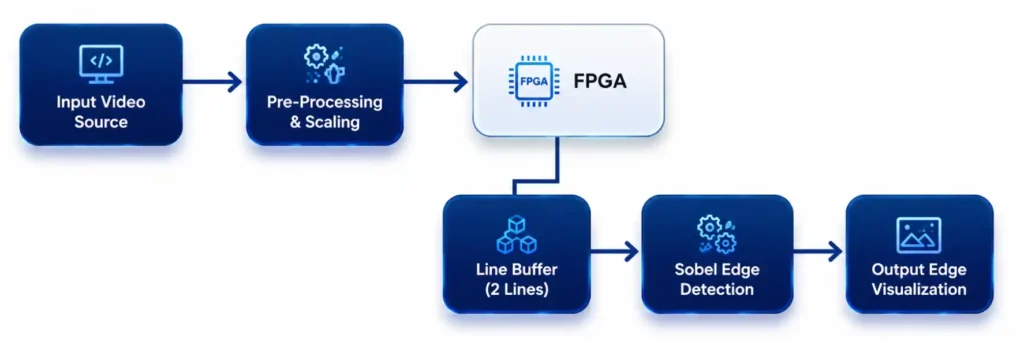
Representative ARINC818-2 Video Chain for a Medical Imaging Application
Video Resolution and Frame Rate Support
ARINC 818 IP Core does not hard code a single resolution or frame rate into the protocol itself. Because ADVB is format agnostic, every project defines its own video parameters resolution, frame rate, pixel format, and timing class in a project specific Interface Control Document (ICD), and the IP core is configured to match. That flexibility is what lets the same core carry a small endoscopic sensor feed or a full 4K surgical display feed without changing protocols. Within that framework, the specification and ARINC 818 IP cores define the following practical ranges:
| Parameter | ARINC 818 Support |
|---|---|
| Maximum resolution | Up to 4K @ 60 fps, per ARINC 818-2-compliant IP cores; ARINC 818-3 cores extend this toward 4K/8K at higher frame rates |
| Common resolution range | 720p, 1080p, and 4K are the most widely deployed; any custom resolution can be mapped via the ICD |
| Frame rate range | Commonly 20–120 fps will support. |
| Color / pixel format | Monochrome, RGB, RGBA, and YCbCr |
| Link rate ceiling (818-2) | Up to FC 12x (~10 Gbps, 8b/10b encoding) |
| Link rate ceiling (818-3) | FC 16x/24x/32x (up to 28.05 Gbps, 64b/66b encoding) to support higher resolutions and frame rates |
Why an Avionics-Grade Video Protocol Fits Medical Imaging
Medical imaging systems particularly in surgery have converged on almost the identical requirement set that drove ARINC 818’s original design:
- Latency is a patient safety issue: In laparoscopic and robotic surgery, the gap between a camera capturing a frame and a surgeon seeing it on the monitor has to be small enough that hand-eye coordination doesn’t break down; industry guidance for diagnostic endoscopy alone puts acceptable latency in the tens of milliseconds range, and surgical procedures push for closer to real time still. A protocol built to deliver cockpit video with sub frame delay transfers that advantage directly.
- Uncompressed video preserves diagnostic fidelity: Compression artifacts are a nuisance in an entertainment system and a liability in a diagnostic one. ARINC 818, like the fiber based medical video links now appearing in hybrid operating rooms, was designed to move full resolution, uncompressed frames, which matters when a surgeon is distinguishing between healthy and diseased tissue, or when fluorescence guided imaging is overlaid on white light video.
- Reliability and determinism matter when a picture cannot glitch: A dropped or corrupted frame on a heads up display is a flight safety problem; a dropped or corrupted frame on a surgical monitor is a patient safety problem. Both domains need deterministic, synchronous delivery rather than best effort streaming.
- Long cable runs, EMI heavy environments, and multi display routing are common to both an aircraft and a modern operating room, which is exactly why fiber capable, switchable video architectures this kind ARINC 818-2 already supports are being adopted in medical video over fiber systems today.
Where the IP Core Can Actually Be Used
- Endoscopy and laparoscopy imaging chains
An ARINC 818-2 receive core can sit downstream of an image sensor/FPGA video pipeline (demosaicing, HDR, noise reduction, edge enhancement) and hand off the finished frame for low-latency transport to the display console the same role it plays handing frames from a mission computer to a cockpit display.
- Surgical console and robotic surgery video distribution
Where a single camera feed (or a stereo/3D feed) needs to reach multiple monitors in an OR the primary surgical display, a secondary teaching or assist display, and a recording system an ARINC 818-2 switch core’s broadcast/multicast modes map directly onto that need.
- Intraoperative imaging and hybrid OR integration
Angiography suites, C arms, and other imaging modalities that feed a shared display wall benefit from the same deterministic multi source switching that ARINC 818-2 switches were built to handle for multi display cockpits.
- Telemedicine and remote proctoring links
The protocol’s support for both optical and copper transmission, plus its tolerance for extended, EMI heavy cable runs, suits video links between an OR and a remote viewing or consultation room.
- Legacy interface bridging
Because commercial cores are frequently paired with conversion modules (ARINC 818-to-DVI/HDMI and back), they can act as a bridge layer, letting a hospital integrate ARINC 818 based transport with conventional medical display interfaces without redesigning the whole video chain.
The move of ARINC 818 IP core into medical imaging is a good example of a broader pattern in embedded systems: protocols built for safety critical, latency intolerant environments tend to migrate into any other domain with the same constraints. Surgery, like flight, has very little tolerance for a video frame that arrives late, corrupted, or not at all and that’s precisely the problem this protocol was built to solve.
iWave is a global leader in the design and manufacturing of FPGA System on Modules and ODM Design Services. With over 25 years of diverse experience in the FPGA domain and a strong design to deployment competence, iWave strives to transform your ideas into time to market products with reliability, cost, and performance balance.
Looking for more insights? Contact us at mktg@iwave-global.com
Explore Related Content
- Advanced & Reliable High-Speed Video Capture with ARINC 818 Frame Grabber
- Accelerating Avionics System Development with ARINC 429 IP Core
