Aurora Capture Card for Low-Latency, High-Speed FPGA Data Acquisition
September 16, 2026
Article
Why Choose an Aurora Capture Card for High-Speed Data Acquisition?
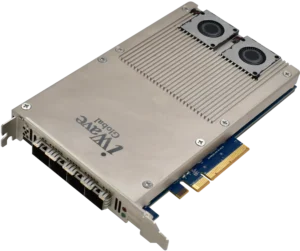
The Aurora Capture Card provides an efficient way to capture data streams from FPGAs and customized hardware connected via Aurora 64B/66B serial links.
Modern radars, software radio platforms, scientific digitizers, and FPGA based processing chains are all examples of systems that must capture continuous, high bandwidth data streams with minimum latency to a processing host. Transaction layer overheads in traditional PCIe based systems provide additional latency which can be prohibitive to such applications, especially when data rates exceed the capabilities of the host bus.
Aurora is a lightweight protocol which provides a point to point serial link, typically implemented in line cards utilizing transceivers. Designed to have minimal impact on the implementation, it provides a deterministic transport suitable for high speed streaming not easily provided by other means such as PCIe.
In order to provide such streaming in a system utilizing PCIe as the primary interconnect, PCIe Aurora capture card can be utilized, which provide FPGA based endpoints for Aurora links which can capture and buffer the data stream and transfer it to the host via DMA, thus providing a direct path from the FPGA link to the host memory and bypassing the overhead of traditional PCIe devices.
What Makes Aurora 64B/66B Suitable for High-Speed Data Capture?
Aurora is a self contained link layer protocol that runs on top of transceivers, handling channel bonding, byte alignment, clock compensation, and optional CRC based error detection without the addressing, routing, or arbitration overhead of a system bus. Two Aurora endpoints form a direct serial pipe: whatever enters one end exits the other, in order, at line rate.
As Aurora based acquisition becomes more common across radar, SDR, and scientific instrumentation platforms, native hardware support for high speed serial capture without introducing additional protocol stack latency has become essential.
How Does PCIe Improve Aurora Data Capture and Host Transfer?
Terminating an Aurora link is only half the job. Captured data still needs to reach the host system quickly and reliably for storage, display, or further processing and PCI Express (PCIe) remains the right interface for that hop, thanks to its bandwidth, driver ecosystem, and OS level support.
Key benefits of pairing Aurora with a PCIe host interface include:
- High Bandwidth: Sustains multi lane, multi gigabit Aurora streams into host memory without becoming the bottleneck.
- Low CPU Overhead: DMA based transfer moves captured data directly into system memory, freeing the host CPU for processing rather than data movement.
- Deterministic FPGA-Side Transport: Aurora’s point to point link keeps acquisition side latency low and predictable, independent of PCIe’s own transaction layer behavior.
- Straightforward System Integration: A standard PCIe card form factor drops into COTS servers, rugged mission computers, and embedded systems without custom host side hardware.
By combining Aurora’s lightweight link layer transport with a PCIe/DMA capable host interface, capture card architecture lets us acquire high bandwidth serial data streams without forcing every design decision through PCIe’s own protocol constraints.
Aurora Data Capture Card Architecture:
An Aurora based capture card is built around three functional blocks working together for reliable, real time acquisition:
- Aurora Physical and Link Layer: SFP+ and QSFP cages provide the physical Aurora connections. The FPGA implements the transceiver interface, channel bonding, clock compensation, CRC checking, and NFC/UFC flow control needed to recover a clean AXI4 Stream from the incoming serial link.
- Streaming Datapath and Buffering: Once data is recovered, on-board logic handles any necessary width conversion and buffering to absorb short term rate mismatches between the Aurora link and the downstream DMA path without requiring full frame storage that would add unnecessary latency.
- PCIe Host Interface and DMA Engine: A PCIe hard IP core connects the FPGA fabric to the host. A DMA engine streams captured data into host memory with minimal CPU involvement, so integrators can build acquisition, recording, or analysis software on top of the hardware without managing transfers by hand.
Aurora Data Capture Card Key Highlights:
- 4× SFP+ and 2× QSFP high speed interfaces supporting multi lane Aurora capture and transmission.
- Supports both Aurora 8B/10B and 64B/66B line encodings up to 10 Gb/s per lane on 64B/66B, with aggregate payload bandwidth up to 77.6 Gb/s across QSFP lanes.
- Multi lane bonding across up to 16 lanes for scalable bandwidth.
- PCIe Gen3 x8 host interface with a maximum theoretical bandwidth of 64 Gbps.
- Built-in 16/32-bit CRC data integrity checking, automatic link initialization, and NFC/UFC flow control.
- DRP support for real time transceiver optimization and link diagnostics.
- Full-duplex communication with SFP loop through support for reference distribution across multi-card systems.
- Full Height Half Length (FHHL) PCIe form factor; compatible with Windows and Linux.
Key Applications:
Aurora based capture cards are used across applications that demand reliable, deterministic acquisition of high-bandwidth serial data:
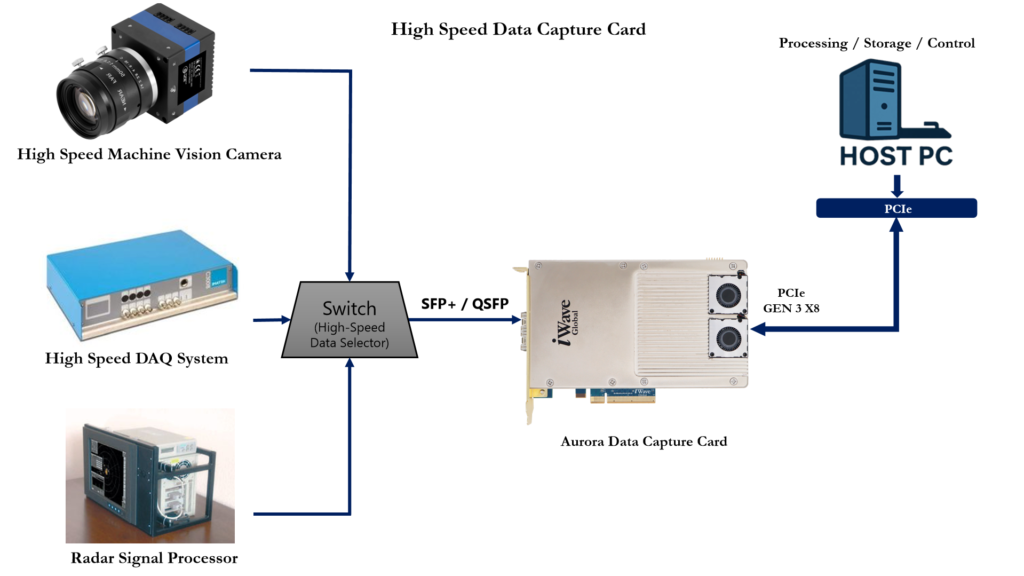
- Radar and SDR IQ Data Logging — continuous IQ streams captured with low, predictable latency for real time or offline analysis.
- Scientific Instrumentation — detector and digitizer front ends requiring deterministic delivery to a host for real time processing.
- FPGA to FPGA Deterministic Transport — point to point links between processing stages where PCIe’s transaction layer variability at the sensor hop would be undesirable.
- High-Speed Multi-Channel DAQ — aggregating several Aurora linked sources into a single host-visible acquisition path.
Selecting the Right Aurora Capture Solution:
The right Aurora capture card is key to building a reliable, high performance acquisition system that scales with future bandwidth needs. When evaluating a solution, consider:
- Line Rate and Lane Count — ensure the card supports the Aurora line rates and lane bonding your source FPGA requires, at both 8B/10B and 64B/66B encoding if flexibility matters.
- Host Bandwidth Match — confirm the PCIe generation and lane width can sustain your aggregate Aurora data rate without becoming the system bottleneck.
- Flow Control and Reliability — built in NFC/UFC and CRC checking reduce the risk of silent data loss during sustained, long-duration captures.
To learn more about iWave embedded solutions and design services, visit www.iwave-global.com or contact us at mktg@iwave-global.com
