NVMe-oF over RoCEv2: FPGA-Based Disaggregated Storage Solution
September 17, 2026
Article
Storage and compute have been drifting apart for a decade. Hyperscale data centres, AI training clusters, and high performance computing systems no longer want storage locked inside a single chassis they want a pool of NVMe drives that any compute node can reach at near local latency. NVMe over Fabrics (NVMe-oF) is the protocol that makes this possible, and RDMA over Converged Ethernet v2 (RoCEv2) is one of the most widely deployed transports for carrying it. iWave’s FPGA based RoCEv2 and NVMe Host IP cores are built specifically to implement this stack in hardware, where software based initiators and targets run out of headroom.
Why NVMe over Fabrics Is Needed
Local NVMe drives are fast hundreds of thousands of IOPS and microsecond class latency but that performance is trapped behind the PCIe slot it’s plugged into. NVMe-oF extends the NVMe command set and queueing model across a network fabric, so a remote drive looks, to the host software stack, almost identical to a local one. Instead of the SSD being physically connected to the host, the host can access an NVMe namespace located in a remote storage subsystem.
The two most common transports for this are:
- NVMe/TCP — runs over standard TCP/IP, easy to deploy, but pays a latency and CPU tax for the TCP/IP stack.
- NVMe/RoCEv2 — maps NVMe commands onto RDMA verbs, bypassing the host CPU for data movement and cutting latency dramatically. This is the transport most performance sensitive deployments converge on.
Among these, NVMe over RDMA using RoCEv2 is particularly attractive for FPGA based systems because it combines the high bandwidth of Ethernet with RDMA’s low latency, low CPU overhead data movement.
FPGA Offload for NVMe over Fabrics
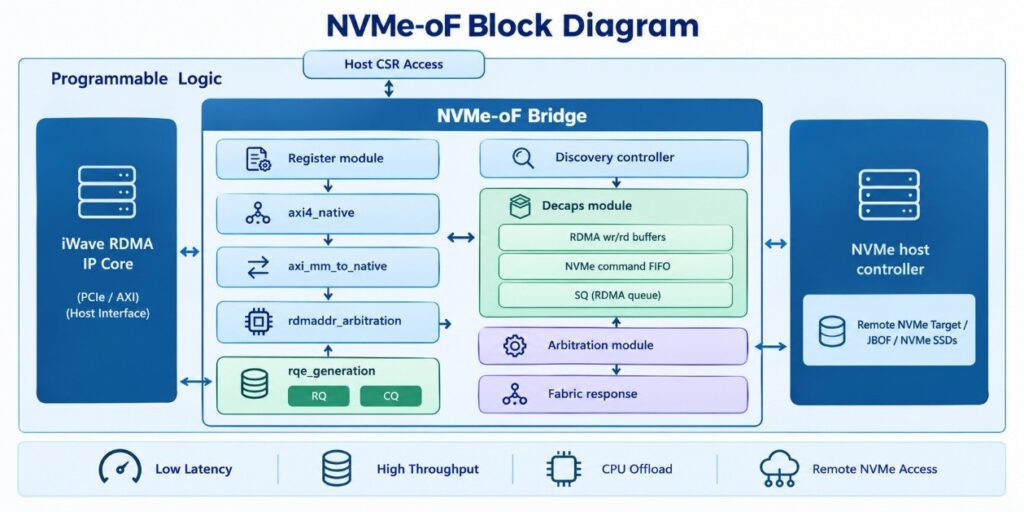
This is where iWave’s FPGA IP cores bridge the performance gap. Instead of relying on host CPU software to process the network and storage stack, key transport and initiator functions can be implemented directly in the FPGA fabric. This creates a hardware accelerated end-to-end data path, reducing CPU overhead while enabling low-latency, high-throughput access to remote storage resources.
| IP Core | Purpose | Major Capabilities |
|---|---|---|
| RoCEv2 IP Core | FPGA-based RDMA networking | RDMA transport, QP/CQ, segmentation/reassembly, retransmission, integrity checking, AXI4 DMA, up to 800G |
| NVMe-oF Bridge Core | Local-to-remote NVMe storage bridge | NVMe command processing, RDMA, buffering, arbitration, multi queue support, remote NVMe/JBOF connectivity |
| NVMe Host IP Core | Hardware NVMe initiator | NVMe SQ/CQ, command processing, local PCIe NVMe, remote NVMe-oF, unified storage interface |
Together, these cores enable an FPGA platform to implement NVMe-oF without routing every I/O operation through the general purpose CPU’s network and storage stacks.
NVMe over Fabrics for Disaggregated Storage
The practical deployment model looks like this:
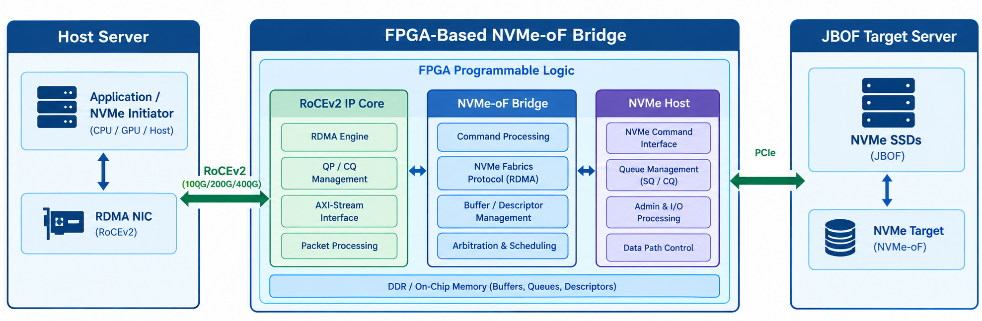
- Compute nodes run the iWave NVMe Host IP core (paired with RoCEv2) on a PCIe attached FPGA card, presenting remote NVMe namespaces to the host OS as if they were local block devices.
- Storage nodes expose their NVMe drives as NVMe-oF targets, reachable over the same RoCEv2 fabric.
- A lossless Ethernet fabric with PFC and ECN configured carries RDMA traffic between the two, typically at 100G per link.
- Because the RDMA and NVMe transport logic lives in the FPGA rather than host software, CPU cycles that would otherwise go to network/storage stack processing are freed up for the actual application a meaningful win in GPU dense AI training racks where every host CPU cycle not spent on infrastructure is a cycle available for data loading and orchestration.
Key Benefits of the iWave Solution
- High Throughput: RoCEv2 enables high speed Ethernet based RDMA communication, making the architecture suitable for 25GbE, 50GbE, 100GbE and potentially up to 800G depending on the FPGA and IP implementation.
- Low Latency: RDMA reduces software involvement in data movement, making NVMe/RDMA suitable for latency sensitive storage applications.
- CPU Offload: A significant portion of the packet-processing and data-movement workload can be implemented in FPGA hardware, reducing CPU overhead.
- Flexible FPGA Platform: This solution is FPGA vendor agnostic and supported in both AMD and Altera devices and the architecture can be integrated into FPGA based Storage systems, Data acquisition systems, HPC platforms, AI/ML acceleration platforms and Disaggregated storage platforms etc
- Hardware Customization: Because the solution is implemented in FPGA fabric, additional functions can be inserted directly into the data path. This creates opportunities for inline data processing without requiring the data to pass through the CPU.
NVMe-oF over RoCEv2 addresses the need to separate storage resources from individual compute systems while maintaining high speed data access. By implementing RDMA transport and storage initiator functions directly in FPGA fabric, iWave’s IP cores reduce host CPU involvement and provide an efficient hardware data path from the network to host memory.
The architecture supports current high speed Ethernet deployments and provides a flexible foundation for future storage fabrics and emerging technologies such as UEC/UET.
To learn more about iWave embedded solutions and design services, visit www.iwave-global.com or contact us at mktg@iwave-global.com
Explore Related Content
- Synergizing Host and Flash: Maximizing NVMe Performance through Precise Write Alignment
- Unlocking High Speed NVMe SSD Access on FPGAs
