Why Aurora is a Powerful Choice for Low-Latency FPGA Data Transfer
October 27, 2026
Article
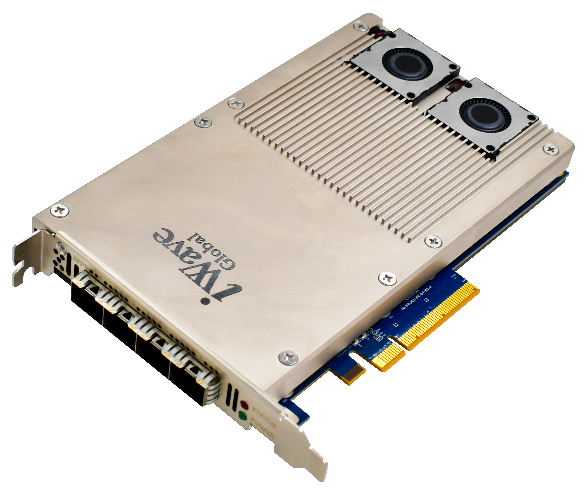
The Aurora capture card from iWave enables high-speed, low-latency data transfer from FPGA-based systems to host PCs through PCIe. Designed for demanding data acquisition and recording applications, iWave’s Aurora Capture Card family supports Aurora 8B/10B and 64B/66B links, multi-lane data transfer, and high-throughput streaming for radar, software-defined radio (SDR), machine vision, and scientific instrumentation.
From Parallel Buses to Aurora
Chip to chip links once relied on parallel LVDS buses, where every extra bit meant another trace to route and keep aligned to a shared clock, and skew grew harder to control as rates rose. Multi Gigabit Transceivers (MGTs) solved that by putting serialization, clock recovery and equalization on a single differential pair. But a bare transceiver moves bits, not meaningful data.
AMD created Aurora to fill that gap: a lightweight, link-layer protocol that sits directly on the transceivers. Its first version used 8B/10B encoding, which spends 20% of the line rate on overhead. Aurora 64B/66B later reclaimed most of that bandwidth while keeping the protocol simple
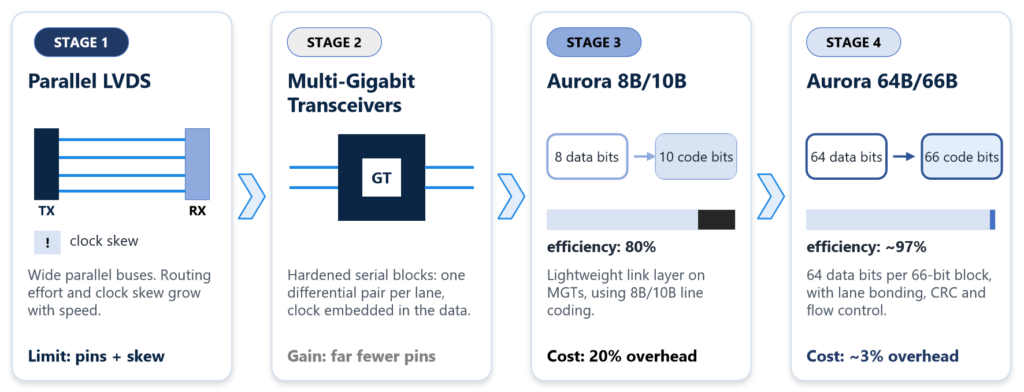
Figure 1: Evolution Timeline
Why Aurora is Different?
Aurora’s defining trait is how little sits between the transceiver and the user’s data: no IP addressing, no negotiation phase and no multi-layer stack. Data enters through an AXI4-Stream interface, is framed and encoded, and leaves the far end through another AXI4-Stream interface
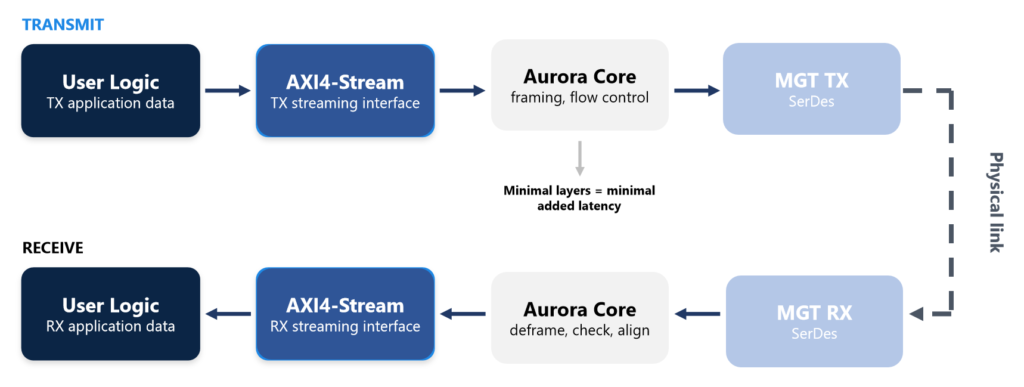
Figure 2: Aurora Low-Latency Data Path
Different protocols solve different problems. Ethernet with TCP/IP routes traffic across networks, which needs addressing, switching and buffering that add latency. PCIe connects a host to its devices through transaction and data-link layers. Aurora simply moves data between two endpoints with as little processing as possible.
| Aurora | Ethernet (TCP/IP) | PCIe | |
|---|---|---|---|
| Primary use | Direct point-to-point serial links | Networked communication across systems | Host-to-device I/O within a system |
| Latency characteristics | Low; thin protocol layer over the transceiver | Variable; switching and queuing add delay | Low; transaction and data-link layers add some processing |
| Protocol overhead | Minimal: thin framing only | Higher: addressing, routing, framing | Moderate: transaction and data-link layers |
| FPGA-to-FPGA suitability | Purpose-built for this case | Possible, but heavier than needed | Possible, but not its primary role |
Note: Aurora doesn’t replace Ethernet or PCIe. It covers the case neither was designed for, and it often works alongside them: Aurora carries data between devices, while PCIe connects the system to a host.
The Role of Aurora 64B/66B in Data Capture
Aurora 64B/66B encodes 64 data bits into a 66-bit block, giving roughly 97% encoding efficiency against 80% for 8B/10B, so more of the same transceiver’s line rate carries real data. Channel bonding combines several lanes into one logical link, so bandwidth can grow while user logic still sees a single aligned stream, and clock compensation absorbs small reference-clock drift between the two ends. An optional CRC check detects corrupted frames, and Native Flow Control (NFC) lets a receiver ask the transmitter to halt or pause before a downstream buffer overflows
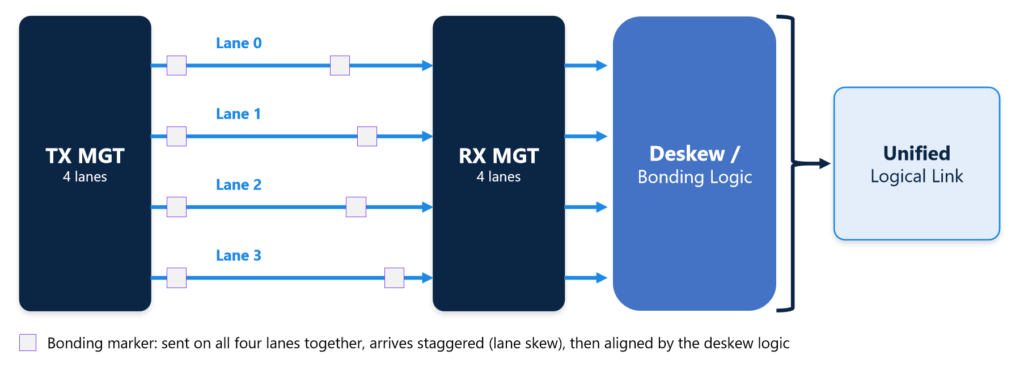
Figure 3: 4-Lane Aurora Channel Bonding
Bringing Aurora Capture Cards to iWave Data Acquisition Systems
The iWave Aurora data Capture Card family turns these protocol advantages into working acquisition hardware and serves as the front end of high-speed recorder systems. Each card terminates an Aurora link on one side and delivers the data into host memory over PCIe on the other. The family comes in three variants, sized for different bandwidth needs.
| Aurora Capture Card 8B/10B | Aurora Capture Card 40G | Aurora Capture Card 100G | |
|---|---|---|---|
| Aurora link | Aurora 8B/10B, 4 bonded lanes × 6.6 Gb/s | Aurora 64B/66B, 4 bonded lanes × 10.3125 Gb/s | Aurora 64B/66B, 8 bonded lanes × 12.5 Gb/s |
| Link connector | 4× SFP+ | 4× SFP+ | QSFP-DD |
| Host interface | PCIe Gen3 x8 | PCIe Gen3 x8 | PCIe Gen3 x16 |
| Measured card-to-host throughput | 2.6 GB/s | 4.7 GB/s | 11.7 GB/s |
| Share of link payload capacity | ~98% of 2.64 GB/s | ~94% of 5.0 GB/s | ~96% of 12.1 GB/s |
How an Aurora Capture Card Transfers Data to Host Memory ?
All three cards follow the same path. Data arrives over optical fiber as an Aurora stream, channel bonding merges the lanes into one aligned flow, and the host receives a single coherent stream rather than separate lanes to reassemble. Flow control lets the card ask the source to pause if its buffers are about to fill, and the optional CRC check flags corrupted frames when it is enabled. Measured on a PC host, each card delivers 94–98% of what its link can carry after encoding. Sustaining that rate over long recordings also depends on the host platform and storage
Aurora Capture Card Status and Diagnostics
The card reports link status to the host, including lane up/channel up, soft/hard errors and CRC errors. Built-in test patterns verify the link end to end before live data is connected, and adjustable transceiver settings (TX pre-/post-cursor emphasis and output swing) help tune the signal when a new cable or optical module is installed
Which Card Fits?
The Aurora Capture Card 8B/10B suits sources already built on Aurora 8B/10B, so existing designs can be captured without significant changes. Because Aurora 8B/10B and 64B/66B are not interoperable, the card must match the encoding the source uses. The Aurora Capture Card 40G brings 64B/66B efficiency to sources producing tens of gigabits per second, and the Aurora Capture Card 100G targets the most demanding streams, with eight bonded lanes on a single QSFP-DD connector and a PCIe Gen3 x16 host link
Conclusion
iWave Global is a leading embedded solutions provider specializing in System on Modules, FPGA platforms, and ODM product development. With more than two decades of engineering expertise, iWave delivers scalable hardware solutions powered by leading semiconductor technologies, supporting applications across industrial, communication, medical, transportation, and aerospace and defence markets.
For information and inquiries, please write to us at mktg@iwave-global.com
