Advancing Electronic Warfare Systems with Agilex® 9 Direct RF
August 20, 2026
Article
Agilex 9 Direct RF enables advanced Electronic Warfare (EW) capabilities by providing high-performance RF processing for dynamic and contested electromagnetic spectrum environments. Modern battlefields increasingly rely on radar systems, communication networks, and electronic sensors that require rapid sensing, analysis, and response to emerging threats. At the heart of EW systems, Electronic Countermeasures (ECM) use intelligent receiver and transmitter coordination to deliver real-time spectrum awareness, threat identification, and adaptive countermeasure responses. This enables EW platforms to disrupt, deceive, or suppress adversary radar and communication systems while protecting critical assets with exceptional speed and precision.
Despite these advanced capabilities, modern EW systems face several significant challenges. These systems must detect and process signals across wide frequency ranges in real time. Traditional RF architecture uses multiple discrete components, increasing system complexity, latency, power consumption, and overall size. Therefore, high-speed processing, low latency, precise synchronization, and efficient RF performance are critical requirements for modern EW applications.
To address these challenges, the RF industry is transitioning toward Direct RF architectures, where high-speed RF data converters and FPGA processing are integrated into a single computing platform. By digitizing RF signals closer to the antenna, Direct RF significantly simplifies the signal chain while enabling higher bandwidth, improved synchronization, lower latency, and reduced system complexity.
The Evolution of RF Architectures: From Superheterodyne to Direct RF
The increasing demand for wider bandwidths, lower latency, and higher processing performance has driven the evolution of RF architecture. As shown in Figure 1, RF system design has progressed from Superheterodyne to Direct IF, and finally to Direct RF architecture, with each generation reducing hardware complexity while improving overall system performance.
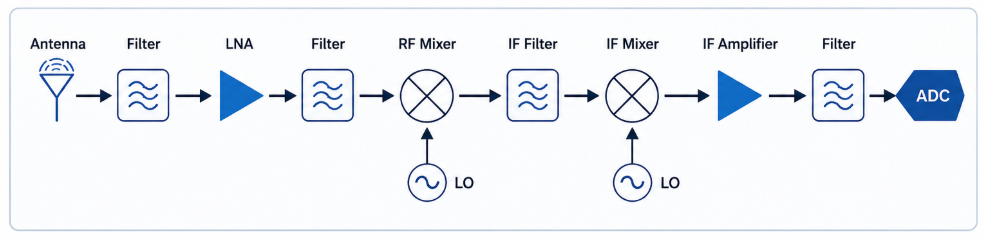
Figure 1. Traditional Superheterodyne RF Architecture
Traditional Superheterodyne architectures process incoming RF signals through multiple frequency conversion stages before digitization. The RF signal is typically mixed with a local oscillator and converted to an intermediate frequency (IF) for filtering and further processing. While this architecture provides good selectivity and sensitivity, it requires multiple discrete components, such as mixers, filters, and local oscillators, which can increase system complexity, size, power consumption, and latency.
In Direct IF architecture simplifies the signal chain by reducing the number of analog conversion stages and integrating RF data converters and more processing within the FPGA, closer to the RF path. However, the RF signal still requires frequency translation to an intermediate frequency (IF) before digitization, which limits scalability for extremely wideband applications. While this approach improves system efficiency and lowers latency compared to traditional Superheterodyne designs, intermediate-frequency processing is still required. In contrast, the wideband RF processing capability of Agilex® 9 Direct RF enables direct digitization of wider-band RF signals, eliminating the need for IF frequency translation and further simplifying the RF signal chain.
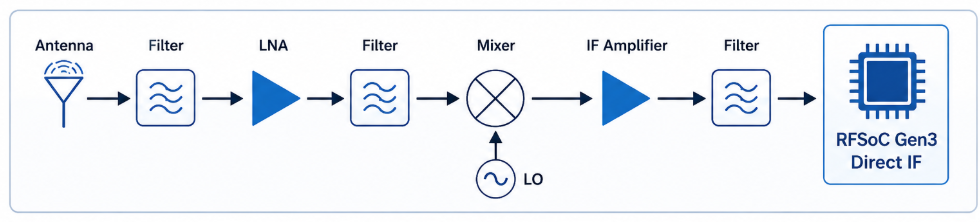
Figure 2. Direct IF RF Architecture
The latest Direct RF architecture takes integration a step further by directly combining high-speed RF data converters with FPGA processing. By eliminating intermediate frequency stages and reducing external components, it delivers higher bandwidth, lower latency, improved signal integrity, reduced power consumption, and a smaller hardware footprint. These advantages make Direct RF architecture ideal for next-generation applications such as Software Defined Radio (SDR), Electronic Warfare (EW), radar, spectrum monitoring, and satellite communications.

Figure 3. Direct RF Architecture with Integrated Data Converters
Architecture overview for Efficient ECM Processing:
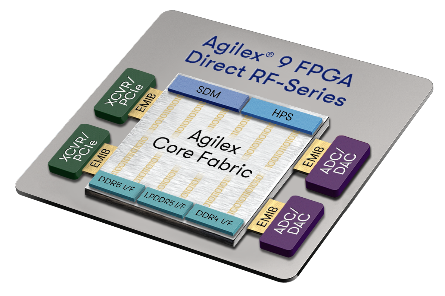
Image credits: Altera
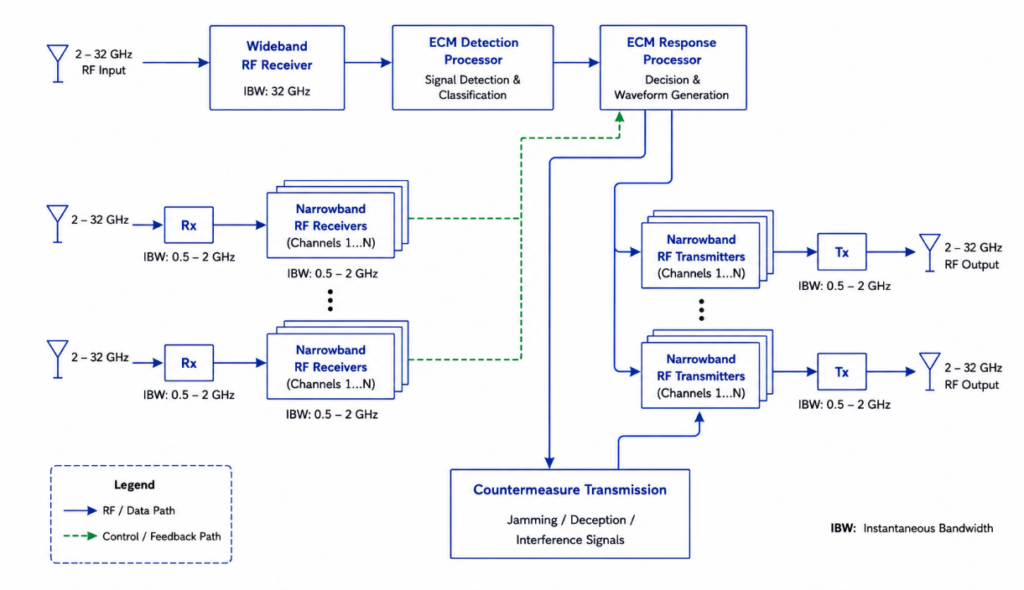
As illustrated in Figure below, the Agilex® 9 Direct RF SoM enables streamlined Electronic Countermeasure (ECM) architecture by combining wideband RF monitoring with high-performance FPGA based signal processing. The Wideband Receiver continuously scans the RF spectrum to detect radar and communication signals over a broad frequency range. Once a signal of interest is detected, the ECM Detection Processor, implemented within the Agilex® 9 FPGA fabric, analyzes key signal characteristics such as frequency, bandwidth, pulse width, & modulation to accurately identify potential threats.
After threat identification, the selected signal is routed to the appropriate Narrowband Receiver for detailed analysis. By focusing on a smaller bandwidth, the system improves signal quality, reduces interference, and optimizes digital signal processing resources. Based on the analyzed threat, the ECM Response Processor generates the required countermeasure waveform, which is transmitted through the Narrowband Transmitter. Leveraging the programmable DSP resources and low-latency architecture of the Agilex® 9 Direct RF SoM, the system enables rapid generation of jamming or deception signals, providing a scalable and efficient solution for next-generation Electronic Warfare applications
Agilex® 9 Wide band Key Highlights:
- Agilex® 9 SoC FPGA (AGRW014) in R17B package
- Up to 1,437,240 Logic elements
- 16 x FGT Transceivers up to 58Gbps PAM4
- 4× ADC and 4× DAC channels with sampling rates up to 64Gsps
- Quad-core 64-bit ARM® Cortex®-A53 up to 1.4GHz
- Form factor 82mm x 111mm with -40°C to +85°C (Industrial)
Key Advantages of Agilex® 9 Direct RF Architecture for EW Systems:
The integration of wideband high-speed RF & FPGA processing within a single platform eliminates multiple RF conversion stages and significantly improves Electronic Warfare system performance.
- Wide Instantaneous Bandwidth (IBW) for Real-Time Spectrum Awareness Enables rapid monitoring and analysis of wide RF spectrum environments.
- Ultra-Low Latency Signal Processing Supports faster threat detection and immediate countermeasure response.
- Rapid Frequency Agility Enables dynamic adaptation to changing RF threats.
- Multi-Channel Coherent Processing Supports synchronized processing for advanced EW and radar applications
iWave Agilex® 9 Direct RF-Series Portfolio:
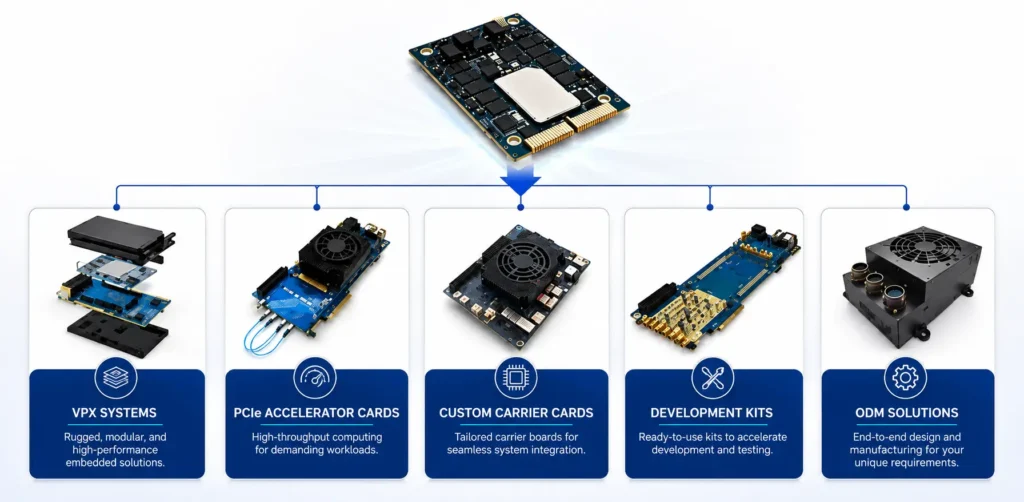
Building on the advantages of Direct RF architecture, iWave offers a comprehensive portfolio of Agilex® 9 Direct RF platforms designed for high-performance SDR, Electronic Warfare, radar, and spectrum monitoring applications. Available in multiple form factors, the portfolio enables engineers to rapidly develop and deploy next-generation RF systems.
| Variant | Agilex® 9 Device | RF Category | Available Platforms | RF Data Converters | Maximum RF Input Frequency |
|---|---|---|---|---|---|
| MCP 1 | iG-G67 (R17B) AGF027 | Wide-Band | SoM, 3U VPX, PCIe Card | 4 ADC / 4 DAC @ 64 GSPS | 36 GHz |
| MCP 2 | iG-G82 (R28A) AGRW027 | Wide-Band | SoM, 3U VPX, PCIe Card | 8 ADC / 8 DAC @ 64 GSPS | 36 GHz |
| MCP 3 | iG-G78 (R31D) AGRM027 | Mid-Band | SoM, 3U VPX, PCIe Card | 20 ADC @ 4 GSPS / 16 DAC @ 12 GSPS | 7.125 GHz |
Why Choose iWave Agilex® 9 Direct RF Production-Ready Platforms:
- Dedicated RF Balun Daughter Card
Separates the RF balun and matching network from the main SoM, enabling greater design flexibility and easier RF customization.
- Flexible RF Customization
Adapt to different RF frequency bands or connector types by replacing only the daughter card, eliminating the need to redesign the complete hardware platform.
- Integrated Direct RF Architecture
Eliminates external RF transceivers and JESD204 interfaces, reducing latency, board complexity, power consumption, and overall system cost.
- Protect your Hardware Investment
Reuse the same Agilex® 9 SoM and carrier board across multiple RF variants, reducing development cost and accelerating product reuse.
- Accelerate Time-to-Market
Quickly develop new RF product variants by replacing only the RF daughter card, significantly reducing design effort and development time.
The Agilex® 9 Direct RF FPGA SoM simplifies Electronic Warfare system design by integrating multiple EW functions into a Single SwaP-C Direct RF architecture. With wideband RF processing, low-latency performance, and flexible FPGA programmability, it is well suited for next-generation EW applications
iWave Global is a leading provider of embedded computing solutions specializing in System on Modules, FPGA platforms, and ODM services. With deep expertise in high-performance and RF systems, iWave enables customers to accelerate product development and time to market.
For more information, please write to mktg@iwave-global.com
