Bringing Intelligence to RF Signals: Machine Learning Based Waveform Classification on the iWave Agilex® 9 Direct RF FPGA SoM
October 26, 2026
Article
The Agilex 9 Direct RF FPGA SoM from iWave Global enables advanced RF signal analysis and waveform classification in increasingly complex RF environments. Communication, radar, and other RF signals often occupy the same spectrum, making fast signal identification essential. From spectrum monitoring and software-defined radio (SDR) to cognitive radar, signal intelligence, and electronic warfare, waveform classification helps systems analyze and respond to changing RF conditions.
Machine learning offers a way to automate this process by learning waveform characteristics and identifying signal types from acquired data. By combining Direct RF technology with FPGA-based processing & AI inference, developers can explore new approaches to intelligent RF signal analysis.
The iWave Agilex® 9 Direct RF FPGA SoM demonstrates this capability through a machine learning-based waveform classification design. Using ADC data and a trained neural network, the design classifies seven waveform types: AM, CW, FM, No Signal, OFDM, QPSK, and Ramp, based on the EagleNet dataset.
A MATLAB-based graphical user interface (GUI) provides a convenient way to program the FPGA, connect to the hardware, configure waveform inputs, and view classification results
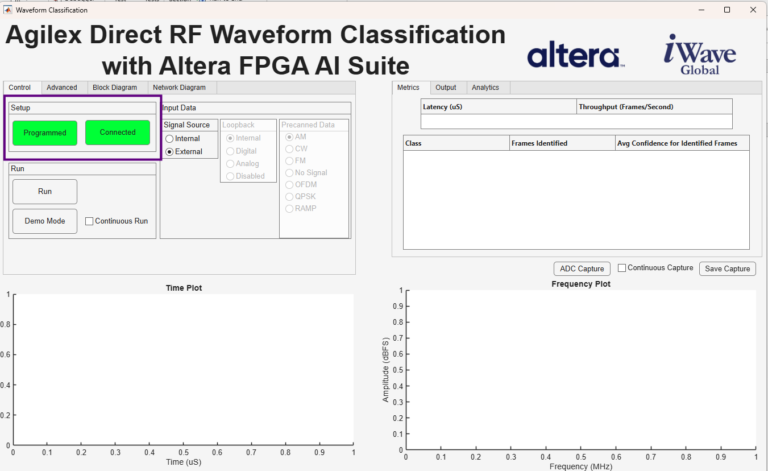
Figure 1: MATLAB-Based GUI for RF Waveform Classification
Flexible Waveform Input for RF Signal Evaluation
The Pre canned Data panel allows users to select any of the seven supported waveform classes as input stimuli.
The reference design supports two input modes:
1. External Signal Mode
In External Signal Mode, an external signal generator is connected to ADC Port 0 of Tile 0 to provide the waveform input to the design.
2. Internal Signal Mode
Internal Signal Mode allows the Waveform Classification demo to run without an external signal generator. The design uses a built-in signal source and operates in playback mode, where waveform data stored in playback memory is provided to the preprocessing front-end subsystem through four loopback modes
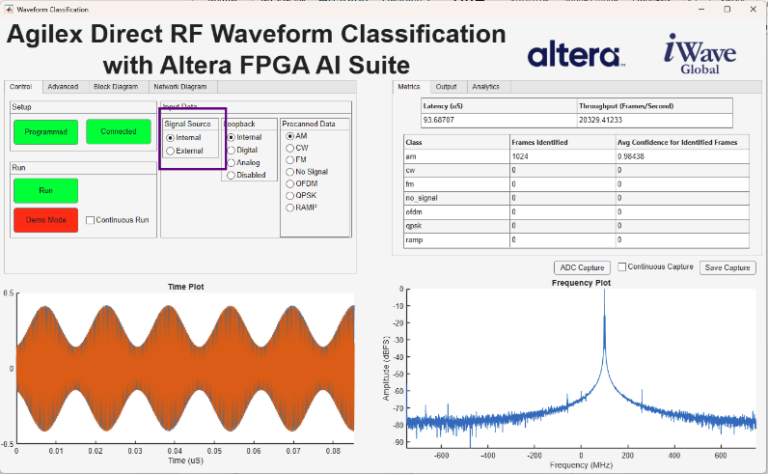
This mode allows users to evaluate the classification design with preloaded waveform data without requiring external RF signal generation equipment
Automated Classification and Results Visualization
Using the Agilex 9 Direct RF FPGA SoM, developers can evaluate classification results across seven waveform types and analyze prediction confidence through graphical performance metrics.
The GUI provides multiple views of the results:
- Metrics: Presents classification results for 1,024 frames per inference run and displays the average confidence score across the classified frames.
- Output: Shows confidence scores for individual frames, allowing users to examine prediction confidence at a more granular level.
- Analytics: Displays a confusion matrix comparing the actual waveform class with the predicted class, helping users assess classification performance across the seven categories.
Together, these views provide insight into both overall classification behavior and individual prediction results
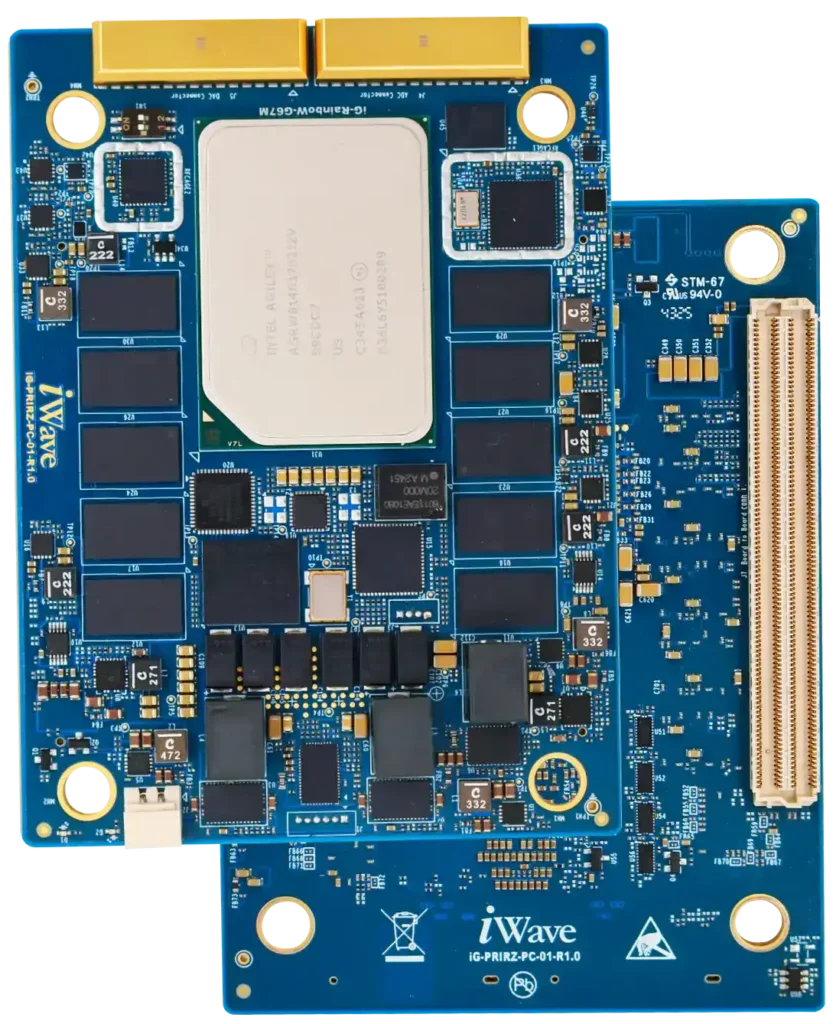
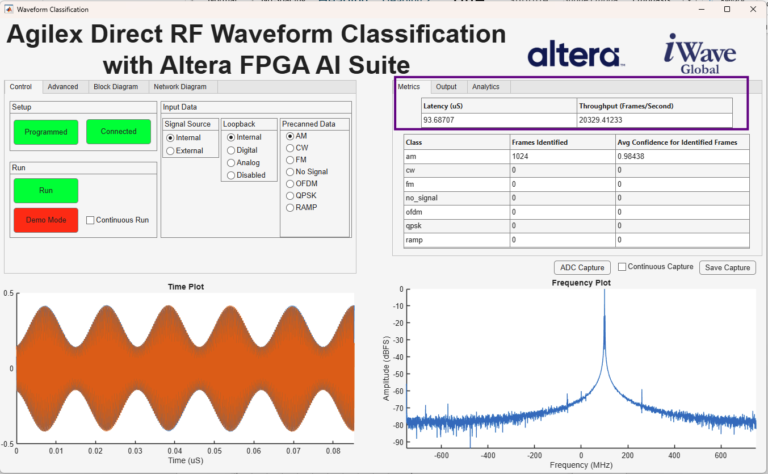
Figure 1: Metrics
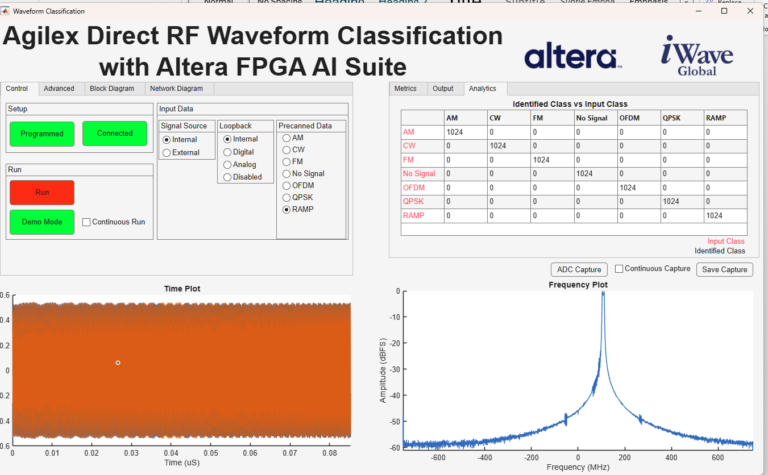
Figure 2: Analytics
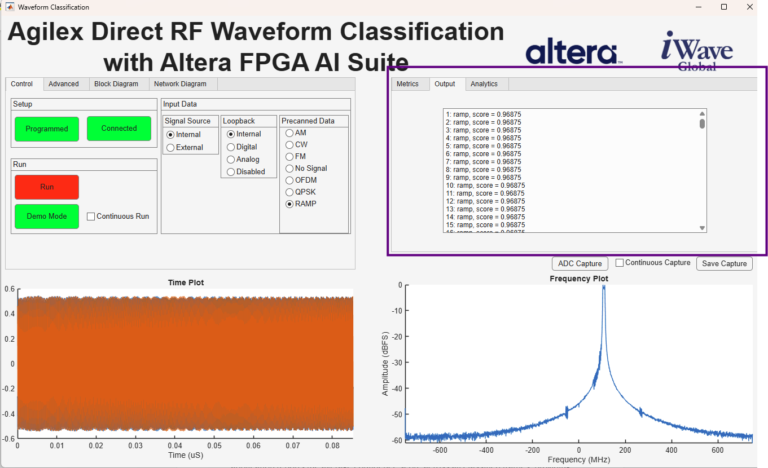
Figure 3: Output
Low-Latency AI Inference on FPGA
The Agilex 9 Direct RF FPGA SoM demonstrates how FPGA based AI inference can support low-latency RF waveform classification by combining signal acquisition and neural network processing on a single platform.
By bringing signal acquisition and neural network inference together within the Direct RF FPGA platform, the design provides a practical example of how programmable hardware can support low-latency RF analysis.
Powered by the EagleNet Dataset
The waveform classification demo uses the EagleNet dataset, generated using a specific A Tile configuration with predefined Coarse NCO and Fine NCO settings. The dataset supplies waveform data for developing and evaluating the classification model across the seven supported signal classes.
This defined dataset and configuration provide a basis for demonstrating the classification workflow and examining its results through the GUI
Enabling Intelligent RF Applications
Automated waveform classification can support a range of RF applications. Spectrum monitoring systems can use classification to help identify signal activity, while software defined radios can benefit from recognizing incoming modulation types. Cognitive radar and signal intelligence systems can also use waveform analysis to help characterize the surrounding RF environment.
By combining Direct RF signal acquisition, high speed data converters, FPGA processing, and machine learning inference, the iWave Agilex® 9 Direct RF FPGA SoM provides a platform for exploring intelligent RF processing with low latency inference.
The result is a practical demonstration of how AI and programmable hardware can work together to help developers build more responsive and adaptable RF systems.
