Telematics Control Unit with CAN FD: Enabling Faster and Smarter Vehicle Communication
September 9, 2023
Article
CAN FD is transforming in-vehicle communication by enabling faster data transfer, higher bandwidth, and improved network efficiency for connected vehicles. As vehicles become increasingly connected and software-defined, the demand for faster, more reliable in-vehicle communication continues to grow. Advanced Driver Assistance Systems (ADAS), autonomous driving technologies, electric vehicles (EVs), predictive diagnostics, and Telematics Connect Hub solutions generate significantly more data than traditional automotive networks were designed to handle.
Understanding CAN FD
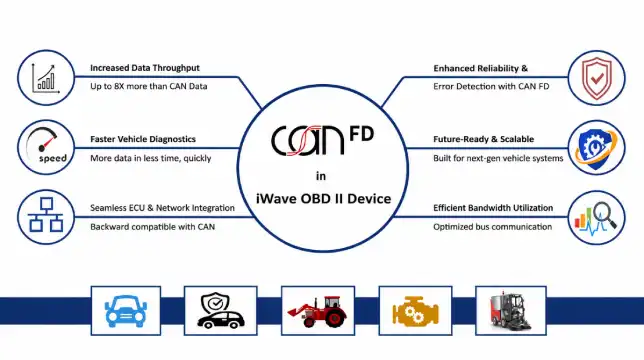
CAN FD is an enhanced version of the Classical CAN protocol originally introduced by Bosch. Standardized under ISO 11898-1, CAN FD technology was developed to overcome the bandwidth limitations of the original CAN bus while maintaining backward compatibility.
Unlike Classical CAN, which supports up to 8 bytes of data per frame, CAN FD allows payloads of up to 64 bytes and significantly increases data transmission speed. This enables Electronic Control Units (ECUs) to exchange more information with lower communication overhead, improving overall system performance
Why was CAN FD Developed?
Modern vehicles contain dozens of interconnected ECUs managing functions such as engine control, braking, infotainment, battery management, advanced safety systems, and vehicle diagnostics.
As these systems became more complex, the limitations of Classical CAN became apparent:
- Limited payload size
- Restricted bandwidth
- Longer transmission times
- Increased bus utilization
CAN FD addresses these challenges by delivering faster communication while preserving the simplicity and robustness that made Classical CAN the industry standard.
Key Benefits of CAN FD
Larger Data Payload
CAN FD supports payloads of up to 64 bytes per frame, compared to only 8 bytes in Classical CAN.
This reduces protocol overhead and enables more application data to be transmitted within a single message.
Higher Communication Speed
One of the biggest advantages of CAN FD is its flexible bit-rate architecture.
During arbitration, communication continues at the traditional CAN speed, while the data phase operates at much higher bit rates—typically up to 5 Mbps, depending on the system implementation.
The result is significantly faster communication between vehicle ECUs.
Improved Reliability
CAN FD introduces enhanced error detection mechanisms, including an improved Cyclic Redundancy Check (CRC) and protected stuff-bit counting.
These enhancements improve communication integrity and make CAN FD suitable for safety-critical automotive and industrial applications.
Enhanced Security
Higher bandwidth enables secure communication mechanisms such as Secure Onboard Communication (SecOC), helping authenticate messages and improve protection against unauthorized access and data manipulation.
CAN FD vs. Classical CAN
| Feature | Classical CAN | CAN FD |
|---|---|---|
| Maximum Payload | 8 Bytes | 64 Bytes |
| Data Rate | Up to 1 Mbps | Up to 5 Mbps* |
| Communication Efficiency | Standard | Higher |
| CRC Protection | Standard | Enhanced |
| Support for Secure Communication | Limited | Improved |
| Suitable for High-Data Applications | Limited | Yes |
How CAN FD Works
CAN FD uses a modified communication frame while preserving the familiar arbitration mechanism used in Classical CAN.

Communication begins with arbitration at the standard CAN bit rate. Once arbitration is complete, the protocol switches to a higher data bit rate during payload transmission.
This flexible approach combines reliable bus arbitration with significantly faster data transfer, increasing network throughput without compromising communication stability.
CAN FD for Vehicle Diagnostics and Edge Analytics
Vehicle diagnostics depend on fast and reliable communication between ECUs, sensors, and diagnostic tools.
CAN FD enables diagnostic devices to retrieve larger volumes of real-time information, supporting applications such as:
- Engine diagnostics
- Battery management
- Predictive maintenance
- Vehicle health monitoring
- Fleet management
- Emission analysis
- Performance optimization
The higher bandwidth also allows faster software updates and improved data logging.
iWave Telematics Solution
iWave’s Telematics Control Unit leverages CAN FD technology to provide secure, high-speed vehicle diagnostics and edge data processing.
Powered by the NXP i.MX 6ULL processor, the platform supports multiple automotive communication protocols, including:
- CAN FD
- High-Speed CAN (HS-CAN)
- Low-Speed CAN (LS-CAN)
- Single-Wire CAN (SW-CAN)
- Raw CAN
- SAE J1939
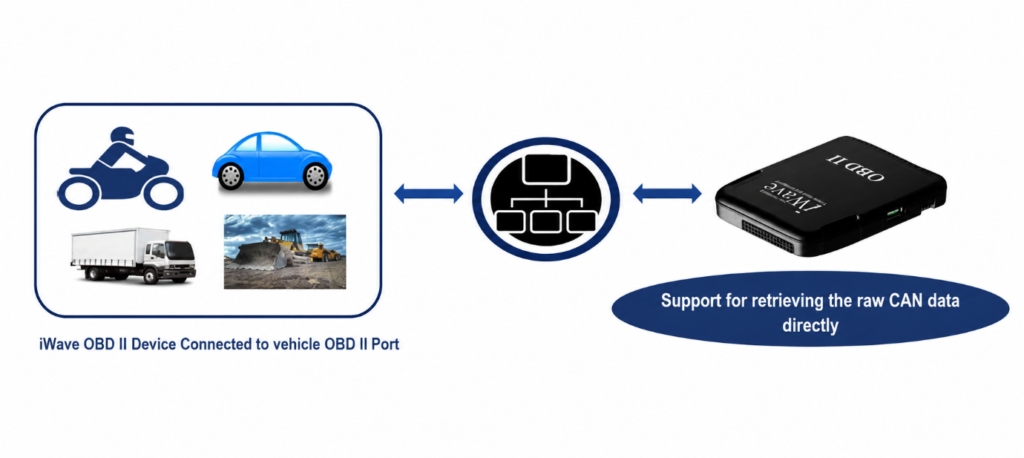
The ability to operate multiple CAN interfaces simultaneously enables compatibility with a broad range of passenger vehicles, commercial vehicles, agricultural machinery, and heavy-duty equipment.
iWave’s CAN FD Expertise
iWave enhances automotive connectivity by integrating CAN FD support even with processors that do not natively support the protocol.
Key capabilities include:
- Flexible support for multiple CAN interface combinations
- Simultaneous operation of multiple CAN ports
- Software APIs for CAN frame handling
- High-speed data acquisition from vehicle ECUs
- Support for real-time diagnostics and edge analytics
- Global certifications including CE, FCC, E-Mark, KOMINFO, and GCF
These capabilities enable OEMs and solution providers to accelerate the development of connected vehicle applications while maintaining high reliability and interoperability.
As connected vehicles continue to generate larger volumes of data, CAN FD has become the preferred communication protocol for high-speed, reliable, and secure in-vehicle networking.
With larger payloads, faster transmission rates, improved reliability, and enhanced security, CAN FD enables next-generation automotive applications ranging from intelligent diagnostics to autonomous driving and predictive maintenance.
Combined with iWave’s embedded automotive expertise and advanced OBD II solutions, CAN FD provides a scalable foundation for future-ready connected mobility platforms.
For more information, visit www.iwave-global.com or contact mktg@iwave-global.com
