EV Charging Station: HMI Using Scalable System on Module Solutions
September 14, 2023
Article
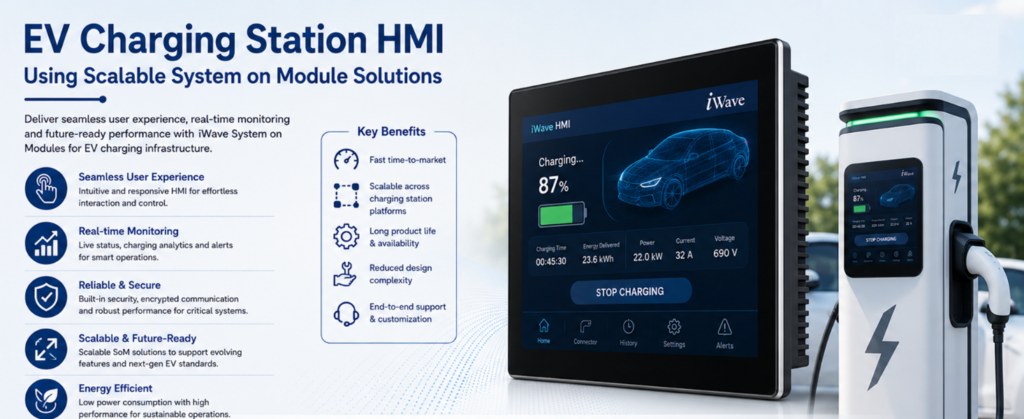
EV Charging Station technology is evolving rapidly as electric vehicle (EV) adoption drives the expansion of charging infrastructure worldwide. Modern charging stations are moving beyond basic charging functions to deliver intuitive user interfaces, real-time information, secure payment, connectivity, and intelligent monitoring. An EV Charging Station HMI plays a key role in this evolution by providing the interface through which users interact with the charging system.
From displaying charging status and energy consumption to enabling authentication and payment, the HMI directly influences the overall charging experience. iWave offers scalable System on Module (SoM) platforms that enable developers to build feature-rich HMI solutions for EV charging stations, with options supporting different levels of processing performance, graphics capabilities, connectivity, and I/O flexibility to address a wide range of EVSE requirements.
Role in EVSE Systems
The Human-Machine Interface is a key component of an Electric Vehicle Supply Equipment (EVSE) system. It enables users to interact with the charger and access important information such as charging status, battery level, energy consumption, charging time, and transaction details.
Depending on the application, an EV Charging Station HMI may also support secure user authentication, payment processing, remote monitoring, cloud connectivity, and graphical dashboards.
A suitable embedded platform must therefore provide sufficient processing performance, graphics capabilities, connectivity, and software flexibility to support these functions reliably.
EV Charging Station HMI: System on Module Platform
iWave’s System on Module platforms provide a compact and integrated computing solution for developing EV charging station HMI systems. The SoMs combine processor cores, memory, connectivity, and essential interfaces into a ready-to-integrate platform.
The platforms can support graphical interfaces ranging from basic displays to advanced 2D/3D user interfaces, enabling OEMs to select the appropriate processing platform according to their HMI requirements.
For higher-end applications, the platform can also support communication with the EV Battery Management System (BMS), enabling the HMI to collect and process battery and charging information.
Scalable Processing Options
Different EV charging stations have different performance requirements. iWave offers SoM platforms that can be selected based on processing performance, graphics requirements, interfaces, and application complexity.
For entry-level HMI applications, the NXP i.MX6ULL-based SoM provides an ARM Cortex-A7 processing platform suitable for cost-sensitive embedded interfaces.
For applications requiring greater processing and graphics performance, the NXP i.MX8M Mini-based SoM, featuring Cortex-A53 and Cortex-M4F processors, provides enhanced computing capabilities.
For applications requiring programmable logic and flexible I/O, the Xilinx Zynq-7000 SoC FPGA-based SoM combines ARM Cortex-A9 processing with FPGA resources. This architecture enables developers to implement customized I/O, hardware acceleration, and application-specific functionality.
Graphics and Connectivity
An effective EV Charging Station HMI needs to provide a responsive and intuitive user experience. iWave’s SoM platforms support different display and graphics requirements, allowing developers to create interfaces suitable for various charging station designs.
The platforms can also provide the connectivity and interfaces required to communicate with the charging system, BMS, peripheral devices, and cloud infrastructure.
For advanced EVSE applications, this enables the HMI to display real-time charging information, monitor battery-related parameters, and provide access to remote diagnostics and analytics.
Customization and Scalability
The Zynq-7000 SoC FPGA-based platform offers additional flexibility through its combination of ARM processing and programmable logic. Developers can implement application-specific interfaces, serial communication, hardware acceleration, and other customized functions.
This flexibility is particularly useful when the HMI needs to interact with different backend systems or support additional functionality over the product lifecycle.
iWave also provides customizable HMI platforms with configurable options for:
- Processor and computing performance
- Memory capacity
- Display size and resolution
- Operating system
- GUI framework
- Driver development and porting
- Hardware and I/O configuration
iWave Development Expertise
iWave brings extensive experience in System on Module development, embedded hardware, software, and ODM solutions for automotive and industrial applications.
The company can support the complete HMI development cycle, from selecting the appropriate SoM and designing the carrier board to software integration, BSP development, driver development, and system customization.
iWave’s long-term product support, custom SoM configurations, carrier board review, software assistance, reference designs, and technical documentation help OEMs accelerate product development and deployment.
Building the Next Generation of EVSE
As EV charging infrastructure becomes increasingly connected and intelligent, the HMI is becoming an important part of the overall charging experience. A scalable embedded platform allows manufacturers to develop charging interfaces that can evolve with changing customer expectations and system requirements.
iWave’s System on Module platforms provide a flexible foundation for developing EV Charging Station HMI solutions ranging from cost-effective basic interfaces to advanced, connected and graphics-intensive systems.
For more information about iWave’s HMI and embedded solutions, For more information, visit www.iwave-global.com or contact mktg@iwave-global.com
