i.MX 8M Mini-Based Multi Drop Bus (MDB) Integration for Smart Vending Machines
August 25, 2026
Article
At the core of this seamless operation is the Multi Drop Bus (MDB) protocol – the industry standard communication interface that enables the vending machine controller to communicate reliably with peripherals such as coin acceptors, bill validators, cashless payment terminals, and product dispensers. Its standardized architecture ensures reliable communication, simplifies system integration, and enables interoperability across devices from different manufacturers.
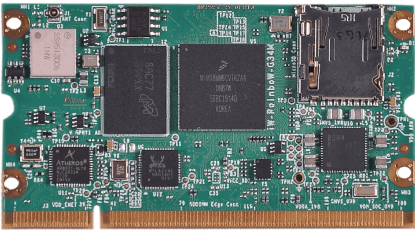
As smart vending systems continue to embrace digital payments, IoT connectivity, and Linux-based embedded platforms, implementing a robust MDB interface has become essential. Powered by the NXP i.MX 8M Mini processor, the iWave i.MX8M Mini SoM delivers the processing performance, Linux ecosystem, and peripheral connectivity required to accelerate the development of next-generation vending and unattended payment solutions.
Solution Highlights:
- i.MX 8M Mini: Quad
- Up to 4 x Cortex-A53 @1.8GHz & 1 x Cortex-M4
- 2GB LPDDR4
- 16GB eMMC Flash
- Wi-Fi 5 and Bluetooth 5.0 Connectivity
Multi Drop Bus (MDB) Protocol Architecture:
MDB follows a Master-Slave communication architecture. In this configuration, the Vending Machine Controller (VMC) acts as the Master, while all connected including the coin acceptor, bill validator, cashless payment terminal, and other peripherals, all of which operate as Slave devices.
Unlike conventional serial communication where devices may transmit data independently, MDB communication is always initiated by the VMC. The controller continuously polls each peripheral on the bus to check its status or request data. A peripheral only responds when it is addressed by the controller, preventing communication conflicts on the shared bus. This polling mechanism allows a single controller to manage up to 32 peripherals reliably over one communication interface.
How MDB Communication Works in Vending Machine:
Communication begins when the vending machine powers up and initializes the MDB bus. Each peripheral is assigned a predefined MDB address and waits for commands from the controller.
The communication sequence typically follows these steps:
- The VMC initializes the MDB communication interface.
- The VMC polls each peripheral sequentially.
- The addressed peripheral returns its status or requested information.
- The VMC processes the received data.
- Appropriate control commands are transmitted back to the corresponding peripheral.
Behind that simple transaction, MDB is the protocol making it possible
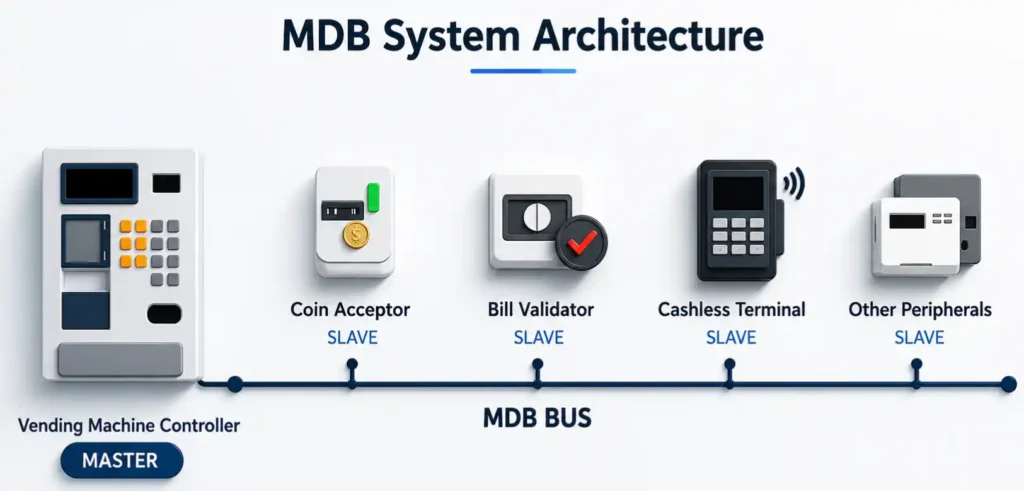
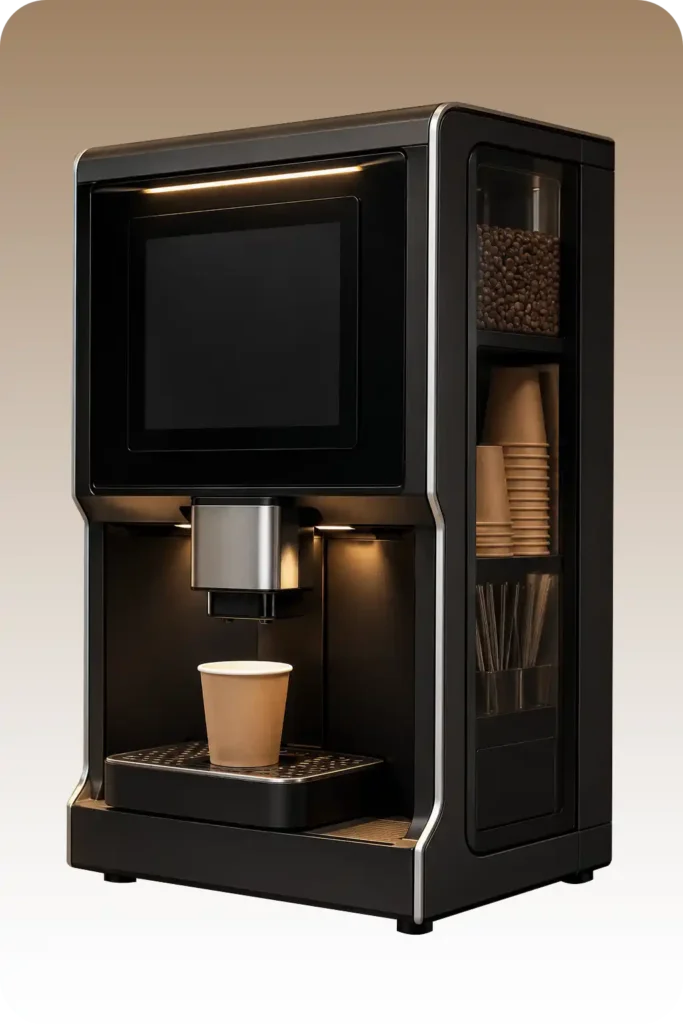
Figure 1: Real-Time MDB Communication (Behind that simple transaction, MDB is the protocol making it possible)
Consider a practical vending machine transaction. When a customer inserts a coin, the coin acceptor detects the event internally but does not immediately transmit data. Instead, it waits until the VMC polls its address. During the next polling cycle, the coin acceptor reports the inserted coin value. The controller updates the available credit, validates the selected product, and issues a dispense command once sufficient credit has been received.
This deterministic communication model ensures synchronized operation while preventing communication conflicts on the shared bus.
Advantages of MDB protocols:
MDB has become the preferred communication protocol for vending systems because it provides several important advantages:
- Standardization: Enables peripherals from different manufacturers to operate together.
- Simplified Integration: New devices can be added without redesigning the communication interface.
- Scalability: Multiple peripherals can share a single communication bus.
- Reliable Communication: Master-controlled polling minimizes communication conflicts and improves system reliability.
- Error Detection: Checksum validation and retransmission improve communication robustness.
- Future Expandability: The protocol supports different functional levels and optional features, allowing newer peripherals to remain compatible with existing vending machine controllers.
MDB Hardware Interface Implementation and Validation:
Integrating the MDB protocol with a modern embedded platform requires more than software implementation. Available MDB interface differs from the standard UART interface available on the processor, a dedicated hardware interface is required to ensure reliable communication between the iWave NXP i.MX 8M Mini SoM and MDB compliant peripherals.
To address these challenges, iWave implemented an MDB hardware interface using a custom level shifting circuit that converts the processor’s UART signals to the electrical characteristics required by the MDB bus. This interface enables seamless communication while protecting the processor and maintaining signal integrity.
Before connecting external peripherals such as coin acceptors, bill validators, or cashless payment terminals, the hardware interface was validated through a loopback configuration. This validation approach isolates the communication interface and verifies the complete transmit and receive path without introducing peripheral-specific variables.
Hardware Validation Setup:
The validation setup was implemented by connecting the MDB TX (Transmit) line directly to the MDB RX (Receive) line after the level-shifting circuit. In this configuration, data transmitted from the iWave NXP i.MX 8M Mini SoM travels through the UART interface, passes through the level-shifting circuit, and is received back by the processor. This verifies the complete communication path, including the UART controller, level-shifting hardware, PCB routing, and signal integrity.
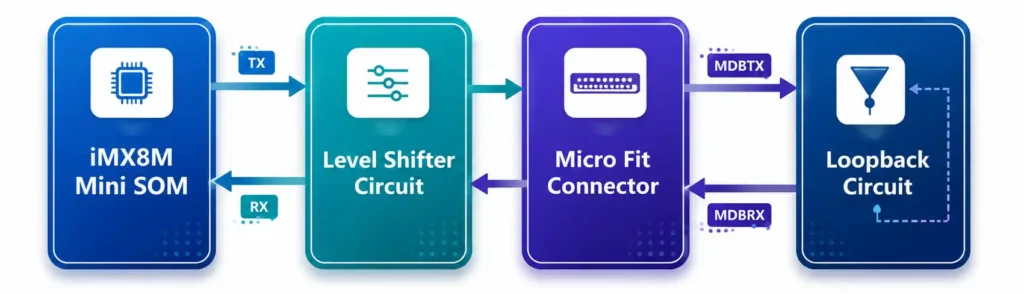
Figure 2: MDB Hardware Loopback Validation Setup
Communication Validation:
The UART interface was configured according to the MDB communication requirements, operating at 9600 baud. A predefined sequence of data packets was transmitted from the processor and monitored at the receive interface to verify communication integrity throughout the hardware path.
The validation confirmed:
- Reliable transmission and reception of UART data.
- Correct operation of the custom MDB level-shifting circuit.
- Stable communication at the MDB operating speed of 9600 baud.
- No packet loss or data corruption during continuous communication.
- Successful verification of the complete hardware communication path.
MDB Interface: Key Communication Specifications
The successful validation of the MDB hardware interface demonstrates the readiness of the iWave NXP i.MX 8M Mini SoM for next-generation vending and unattended payment applications. By providing reliable communication with MDB compliant peripherals including coin acceptors, bill validators, cashless payment terminals, and product dispensers—the platform simplifies system integration and accelerates product development. Combined with Linux support, high-performance processing, and rich peripheral connectivity, the iWave SoM enables OEMs and solution providers to build scalable, secure, and feature-rich smart vending machines with reduced development time and faster time-to-market.
To learn more about iWave embedded solutions and design services, visit www.iwave-global.com or contact us at mktg@iwave-global.com
