NAND Flash Controller IP for Efficient NAND Flash Memory Interface
September 13, 2023
Article
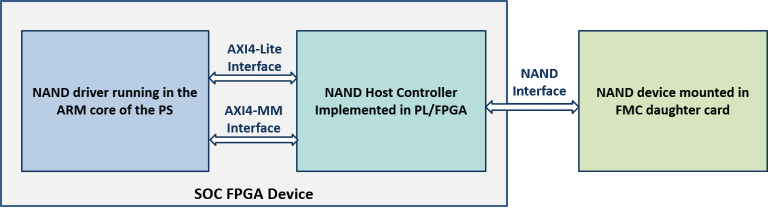
NAND Flash Controller IP provides the hardware logic required to connect an embedded processing or FPGA-based system with NAND flash memory. It manages essential flash memory operations such as device initialization, block erase, page programming, data read, and other mandatory commands required for reliable NAND flash access.
iWave’s ONFI 2.0-compliant NAND Flash Controller IP is a synthesizable and configurable solution designed for integration into both SoC and non-SoC FPGA platforms. Supporting SLC NAND flash memory, the controller provides asynchronous and synchronous interfaces for high-performance data transfer while reducing the complexity of developing a NAND interface from scratch.
Simplifying NAND Flash Integration
Implementing NAND flash functionality typically requires dedicated controller logic to manage device commands, data transfers, timing, error correction, and memory management.
iWave’s NAND Flash Controller IP provides these essential functions as a reusable hardware block. This allows developers to integrate NAND flash storage into their FPGA or SoC designs without developing the complete controller architecture independently.
By using a proven IP solution, product developers can reduce development effort, shorten time to market, and minimize design risks.
Key Features of NAND Flash Controller IP
The iWave NAND Flash Controller IP provides the following capabilities:
- ONFI specification-compliant architecture
- Support for SLC NAND flash memory
- 8-bit or 16-bit asynchronous and synchronous NAND interfaces
- Configurable page size up to 16 KB
- Support for mandatory NAND commands
- Dedicated chip select, write enable, read enable, and ready/busy signals for each die
- Hamming and BCH ECC support with correction of up to 8-bit errors per 512 bytes
- Support for software ECC, controller-based ECC, and on-die ECC
- 16 KB read/write data buffer
- AXI4-Lite interface for processor register access
- AXI4 memory-mapped interface for high-speed data transfer
The combination of configurable interfaces, ECC support, buffering, and standard processor interfaces makes the IP suitable for a wide range of FPGA-based storage architectures.
Flexible FPGA and SoC Integration
The IP can be deployed across different FPGA architectures depending on the availability of an integrated processor.
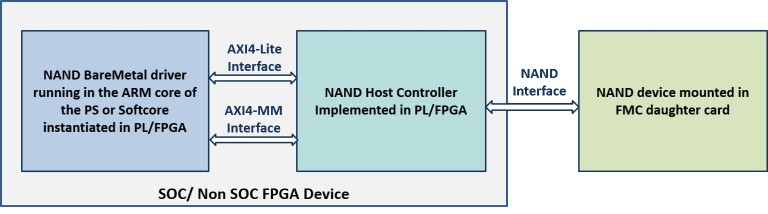
For SoC FPGA devices, a Linux or bare-metal driver running on the processor communicates with the NAND controller through AXI interfaces. The controller then manages communication with the NAND flash device according to the ONFI protocol.
For non-SoC FPGA devices, the IP can be controlled using a soft processor or a dedicated test driver, allowing developers to perform NAND initialization, erase, program, and read operations.
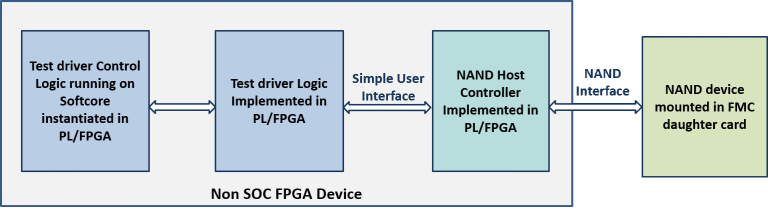
This flexible architecture enables the same NAND Flash Controller IP to be adapted to different system configurations.
Linux and File System Support
For SoC-based implementations, iWave provides a Linux driver that communicates with the NAND controller through the AXI4-Lite interface for register configuration and the AXI4 memory-mapped interface for data transfers.
The solution supports commonly used flash file systems and memory management frameworks, including:
- JFFS2
- UBI
- NAND-specific Linux storage workflows
This enables NAND flash to be integrated into embedded Linux systems for persistent storage, boot environments, application data, and other storage requirements.
ECC and Data Reliability
NAND flash memory can experience bit errors during data storage and retrieval. Error correction is therefore an important part of a reliable NAND storage architecture.
The iWave NAND Flash Controller IP supports Hamming and BCH-based ECC mechanisms. Depending on the system architecture, ECC can be implemented in software, through the controller, or using the NAND device’s on-die ECC functionality.
These capabilities help detect and correct errors and improve the reliability of stored data.
Zynq 7000 Demonstration
iWave has demonstrated the NAND Flash Controller IP on the Zynq 7000 Development Platform using an FMC daughter card containing a Micron NAND flash device.
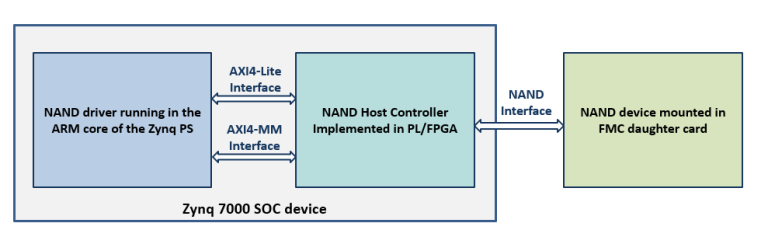
The demonstration covers the complete NAND data path, including:
- NAND device detection and initialization
- Block erase operations
- Page programming
- Data read operations
- NAND partitioning
- JFFS2 file system operations
- UBI-based storage operations
In the demonstration, the Linux driver running on the Zynq 7000 ARM processor communicates with the NAND controller through AXI4-Lite and AXI4 memory-mapped interfaces. The FPGA-based controller then communicates with the NAND device using the ONFI-defined protocol.
This provides a practical reference for integrating NAND storage into SoC FPGA designs.
NAND Flash Controller IP: Validated FPGA Platforms
The NAND Flash Controller IP has been validated across multiple FPGA technology platforms, including:
- AMD/Xilinx
- Intel
- Lattice
- Microchip
This cross-platform validation provides flexibility for developers selecting FPGA devices based on processing, performance, power, or system requirements.
The IP is particularly suitable for embedded systems requiring reliable and high-performance NAND flash storage, including defense, aerospace, avionics, and industrial applications.
Available Configurations
iWave provides different implementation options based on the target FPGA architecture:
SoC FPGA with ARM Processor:
The ARM processor runs the Linux or bare-metal NAND driver while the FPGA fabric implements the NAND controller.
Non-SoC FPGA with Soft Processor:
A soft processor can configure and control the NAND controller through the AXI interfaces.
Non-SoC FPGA with Test Driver:
A dedicated test driver can directly control the IP to validate NAND erase, program, and read operations.
This flexibility allows the IP to be integrated into a variety of embedded FPGA architectures.
Benefits of NAND Flash Controller IP
The iWave NAND Flash Controller IP provides several benefits for embedded system developers:
Faster Integration:
A ready-to-integrate controller reduces the effort required to develop NAND interface logic.
Reduced Development Risk:
A validated IP solution helps minimize design and verification challenges.
Flexible Architecture:
Configurable interfaces and multiple implementation options support different FPGA and SoC platforms.
Reliable Data Storage:
ECC capabilities help detect and correct NAND flash errors.
Scalable Design:
The controller can be adapted to different NAND configurations and application requirements.
Complete iWave Solution
iWave provides a complete NAND Flash Controller IP package that includes RTL source code or applicable implementation files, synthesis scripts, test environments, documentation, and technical support.
With expertise spanning FPGA design, embedded software, SoC platforms, and memory interfaces, iWave supports customers in integrating NAND flash functionality into application-specific embedded systems.
The NAND Flash Controller IP provides a proven foundation for building reliable, scalable, and efficient NAND storage solutions across SoC and non-SoC FPGA platforms.
For more information, visit www.iwave-global.com or contact mktg@iwave-global.com
