Enabling Native RTOS on Cortex-A for Real-Time Edge Performance
October 27, 2025
Article
Achieve real-time precision and low latency on high-performance NXP i.MX processors.
Bringing Real-Time Precision to High-Performance Application Processors
As embedded systems evolve toward intelligent, connected edge devices, developers are seeking real-time performance without compromising processing power or flexibility. Traditionally, real-time operating systems (RTOS) were confined to microcontrollers, but advancements in processor architecture now make it possible to achieve deterministic real-time behavior directly on Arm® Cortex-A cores.
Running a native RTOS on Cortex-A—without a hypervisor layer—delivers lower latency, faster context switching, and higher predictability. This makes it an ideal solution for time-critical applications in industrial automation, robotics, and medical devices.
Native RTOS vs. Hypervisor-Based Systems
Conventional real-time solutions on Cortex-A often rely on hypervisors such as Jailhouse to partition hardware resources. While this approach ensures isolation, it also introduces privilege-level transitions that add latency.
In contrast, native RTOS deployment runs directly on the Cortex-A core, eliminating hypervisor overhead and enabling:
- Superior deterministic performance
- Reduced interrupt latency
- Simplified software stack and maintenance
This native approach is crucial for low-latency industrial systems, motor control, and safety-critical applicationsrequiring microsecond-level responsiveness
FreeRTOS and NXP’s Real-Time Edge
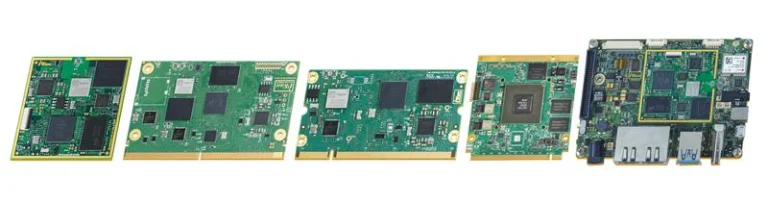
iWave leverages NXP’s Real-Time Edge platform to enable robust RTOS solutions on i.MX93, i.MX95, and i.MX8MP processors. The Real-Time Edge stack offers a complete software framework that bridges the gap between microcontrollers and application processors, supporting deterministic real-time behavior, heterogeneous multicore operation, and Time-Sensitive Networking (TSN).
By porting FreeRTOS natively on Cortex-A cores, iWave unlocks capabilities such as:
- Preemptive, priority-based scheduling for predictable task execution
- Minimal memory footprint (<100KB) for efficient edge deployment
- Support for bothSymmetric (SMP) and Asymmetric Multiprocessing (AMP) configurations
- Integration withTSN, security APIs, and inter-core communication frameworks
These optimizations allow real-time workloads to coexist seamlessly with Linux in mixed-core environments, ensuring high performance across industrial and IoT edge applications.
RTOS Deployment Modes on Cortex-A
There are two modes in which a real-time kernel can run on Cortex-A cores:
- Jailhouse RTOS: Leverages the Jailhouse hypervisor to run RTOS in isolated inmate cells.
- Native RTOS: Runs directly on the Cortex-A core without any hypervisor, similar to bare-metal operation.
While Jailhouse provides strong isolation by partitioning hardware resources (memory, peripherals, etc.), the runtime privilege-level switches between EL1 and EL2 introduce additional latency. Native RTOS eliminates that overhead by running without a hypervisor layer, offering superior real-time performance for latency-critical applications.
In mixed deployments—where Linux and an RTOS coexist—peripherals reserved for the RTOS must be disabled or removed from the Linux device tree to avoid resource conflicts.
iWave’s Expertise in Real-Time Edge Solutions
iWave offers end-to-end support for RTOS integration across NXP i.MX93, i.MX95, and i.MX8MP platforms — from BSP customization to performance tuning and long-term support.
Key benefits of iWave RTOS platform solutions:
- 10+ years of product longevity
- Proven RTOS and middleware integration expertise
- Industrial-grade hardware and software customization
- Complete manufacturing and lifecycle management services
With Native RTOS running on Cortex-A, iWave enables customers to achieve real-time precision on high-performance application processors—reducing latency, enhancing reliability, and accelerating time to market.
Whether for smart industrial systems, automotive control units, or edge gateways, iWave’s RTOS-enabled i.MX platforms deliver the determinism of microcontrollers with the performance of application processors—redefining what’s possible at the edge.
