Beyond Connectivity: Intelligent Power and Thermal Management for Next-Generation Telematics
September 30, 2026
Article
Automotive telematics systems are designed to keep vehicles connected, monitored, and responsive across different operating conditions. From vehicle tracking and diagnostics to fleet management, remote monitoring, and connected vehicle applications, telematics devices continuously process data and communicate through multiple interfaces.
But reliable connectivity comes with its own challenges. When a vehicle is parked or the ignition is switched off, the telematics device may still need to remain partially active. At the same time, continuous processing and communication can consume power and generate heat. Managing these factors effectively is essential for maintaining system reliability and protecting the internal backup battery.
iWave addresses these requirements with an integrated approach to Power Saving, Battery Management, and Thermal Management, supported by APIs and sample applications that customers can use as a reference and customize for their vehicle architecture and application requirements.
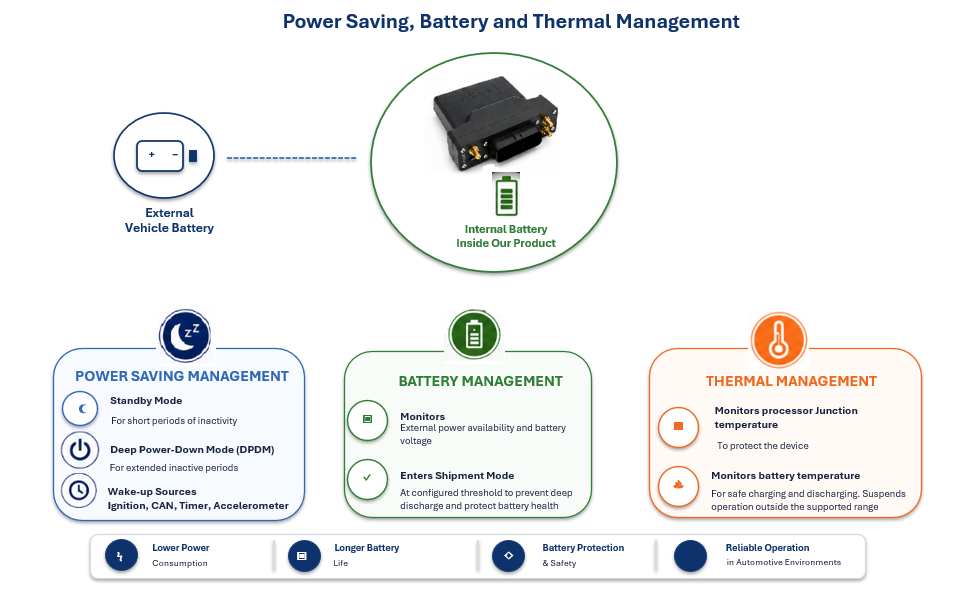
1. Low-Power Management for Automotive Telematics
A telematics device does not always need to keep its processor and communication interfaces fully active. During long periods of vehicle inactivity, maintaining unnecessary hardware resources can increase power consumption and place additional load on the vehicle or internal backup battery.The challenge is to minimize power consumption while ensuring that the system can quickly return to normal operation when a vehicle or application event occurs.
Keeping the System Ready When Needed
- iWave telematics devices support Standby Mode and Deep Power-Down Mode (DPDM) to reduce power consumption during periods of inactivity.
- During DPDM, the main processor and associated peripherals can be powered down while an integrated low-power MCU remains operational. The MCU manages the system power state and monitors configured wake-up sources.
- When a wake-up event occurs, the system can resume normal operation based on Ignition, Accelerometer, or Timer-based events.
- This approach allows the telematics device to minimize unnecessary power consumption while remaining ready to respond when required.
2. Battery Management for Telematics Devices
When external vehicle power is unavailable, the telematics device may operate from its internal backup battery. If battery only operation continues for an extended period, the battery voltage can gradually decrease and may eventually result in excessive discharge or repeated restart attempts.This becomes particularly relevant during vehicle storage, transportation, manufacturing, or extended parking, where external power may not be available for long periods.
Intelligent Battery Monitoring
- iWave provides APIs and sample applications for monitoring the external power supply and battery voltage.
- When external power is removed, the system switches to battery operation and monitors the battery condition. If the battery voltage reaches a configured threshold, the device can automatically enter Shipment Mode.
- Shipment Mode helps minimize further power consumption and prevents excessive battery discharge, helping protect the backup battery during extended periods without external power.
- This approach allows the system to manage its available energy more intelligently rather than allowing the battery to continue discharging until the device can no longer operate reliably.
3. Keeping Thermal Performance Under Control
Telematics devices can operate continuously while processing application data and communicating through interfaces such as Cellular, GNSS, CAN, Ethernet, Wi-Fi, and Bluetooth. These activities generate heat during normal operation. Thermal management becomes particularly important in an IP67 enclosure, where natural airflow and convection are limited. The system must therefore monitor its thermal conditions and take appropriate action when temperatures approach defined limits.The internal Lithium-ion Polymer backup battery also requires controlled charging and discharging within its specified temperature range.
Proactive Thermal Monitoring for Automotive Telematics Systems
iWave provides APIs and sample applications for monitoring the processor junction temperature and internal device temperature.
A configurable processor temperature limit can be defined to protect the system. If the processor temperature exceeds the specified limit, the device can initiate a controlled shutdown to prevent operation beyond the intended thermal range.
Temperature based battery protection is also supported. Battery charging can be disabled when the temperature moves outside the specified charging range. During discharge, internal device temperature can be monitored through the application, allowing battery discharge to be disabled when the temperature exceeds the defined operating range.
For example, a typical Lithium-ion Polymer battery may support charging from 0°C to 50°C and discharging from -20°C to 60°C, depending on the selected battery and manufacturer specifications.
One Framework, Multiple Operating Conditions:
Power, battery, and thermal management are closely connected in a telematics system. Reducing unnecessary activity helps lower power consumption. Lower power consumption can extend backup battery operating time. Battery monitoring helps prevent excessive discharge, while thermal monitoring helps protect the processor and battery during continuous operation.
By bringing these capabilities together, iWave provides a framework that can help telematics devices adapt to different operating conditions from active vehicle operation to parking, transportation, and long term storage.
Key Advantages
- Lower power consumption during vehicle inactivity
- Extended backup battery operating time
- Protection against excessive battery discharge
- Improved battery protection during storage and transportation
- Continuous thermal monitoring
- Processor protection through configurable temperature limits
- Temperature-based battery charging and discharge control
- Improved overall system reliability
Designed for the Vehicle’s Changing Needs
A telematics device does not operate under one fixed condition throughout its lifecycle. It may spend hours communicating and processing data on the road, enter a low-power state when the vehicle is parked, operate from its backup battery during a power interruption, or remain inactive during transportation and storage.
Managing these changing conditions requires more than simply reducing power consumption. It requires coordination between power states, battery condition, and system temperature.
iWave’s integrated Power Saving, Battery Management, and Thermal Management capabilities provide the building blocks to address these requirements. With APIs and sample applications available as reference implementations, customers can adapt these capabilities to their specific vehicle architecture and end application needs.
Explore the Complete iWave Telematics Portfolio
Discover iWave’s telematics solutions for connected vehicles, vehicle monitoring, event data recording, fleet management, edge processing, and other automotive applications.
Explore Related Content
- Event Data Recorder (EDR): Black Box for Modern Vehicles
- Telematics for Engine Fault Diagnostics: Enabling Remote Engine Monitoring
