RFSoC Bare Metal Software for Direct Hardware Control
October 1, 2026
Article
RFSoC Bare Metal Software provides direct hardware control for modern RFSoC platforms, which combine high-speed RF Data Converters, programmable logic, and embedded processing in a single device. These integrated capabilities enable applications such as software defined radio, radar, communications, instrumentation, and high-speed data acquisition.
However, effectively using these resources requires software that can configure RF Data Converters, manage data movement, interact with programmable logic, and control the processing system.
For applications requiring a focused software environment and direct hardware interaction, bare-metal development provides an alternative to a general purpose operating system. Using AMD Vitis, iWave provides bare-metal development support for its RFSoC platforms, helping developers move from hardware bring up and RFDC validation to application development.
Direct Hardware Control Using RFSoC Bare-Metal Software
Bare metal applications run directly on the processor without a general purpose operating system. This reduces software layers and provides greater application level control over resources such as memory, interrupts, RF Data Converters, DMA, and programmable logic interfaces.
For RFSoC applications, this enables functions such as RFDC configuration, ADC/DAC control, data movement, waveform generation, programmable logic interaction, and hardware validation
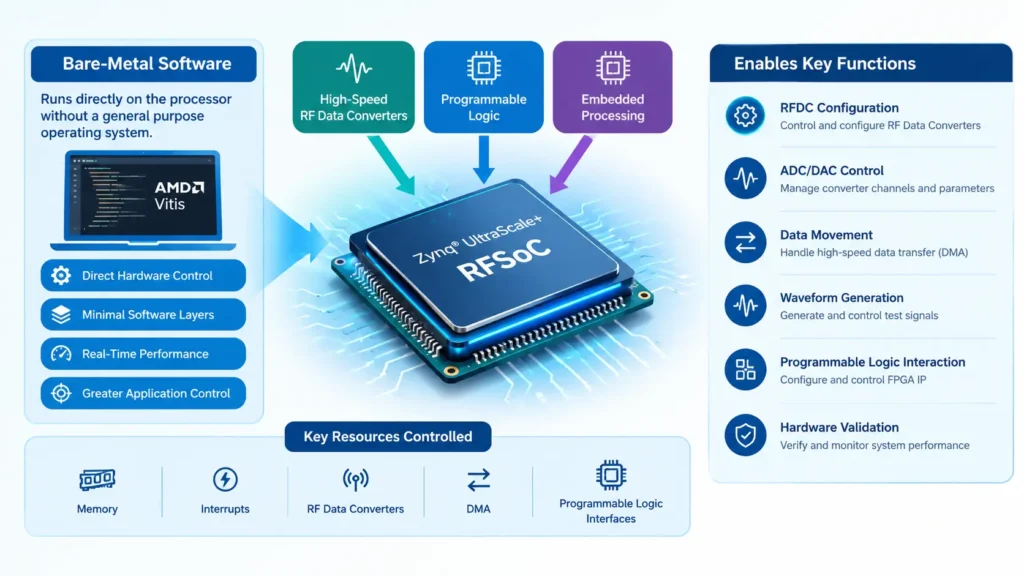
Developing RFSoC Bare-Metal Applications with AMD Vitis
iWave’s bare-metal development flow uses AMD Vitis to connect the RFSoC hardware platform with application software. The hardware design can include the processing system, RF Data Converters, programmable logic IP, AXI interfaces, DMA, clocks, and interrupts.
Once the hardware platform is exported to Vitis, developers can create standalone applications using the required drivers, libraries, and APIs. This provides a practical path from hardware configuration to software development, deployment, debugging, and validation.
Connecting Software with Programmable Logic
The real value of RFSoC lies in the close integration of processing and programmable logic. Software running on the processor can control hardware implemented in the programmable logic, creating a flexible hardware/software architecture for demanding applications.
A bare-metal application can configure programmable logic IP through AXI memory mapped interfaces, while DMA can handle high-throughput data transfers between processor accessible memory and programmable logic processing blocks.
For example, a custom DSP accelerator implemented in programmable logic can receive configuration parameters from the processor. The processor can configure the accelerator, initiate processing, monitor its status, and access the resulting data. Meanwhile, computationally intensive and highly parallel operations can remain in programmable logic rather than being handled entirely by the processor.
This division of responsibilities allows the processor to manage control, configuration, sequencing, and monitoring, while programmable logic handles parallel processing and hardware acceleration.
RF Data Converter Control: From Configuration to Validation
For RFSoC applications, software control of the RF Data Converters is just as important as the underlying hardware.
iWave’s software support provides application variants for different RFDC configurations, data-transfer requirements, and synchronization use cases.
| Capability | Purpose |
|---|---|
| DMA-based data transfer | High-throughput data movement between memory and programmable logic |
| BRAM-based data transfer | Local buffering and FPGA-side data handling |
| Multi-Tile Synchronization (MTS) | Synchronization of RFDC tiles |
| Non-MTS operation | RFDC operation without MTS |
| Multi-board MTS | Synchronization across multiple RFSoC boards |
| ADC/DAC configuration | Control of converter channels for acquisition and generation |
| Mixer/NCO configuration | Digital frequency translation and signal control |
| RFDC diagnostics | Monitoring configuration and converter status |
| Data capture | Acquisition and inspection of ADC data |
| Waveform generation | DAC-based signal generation and testing |
Through these software capabilities, developers can configure RFDC operating parameters, control ADC and DAC channels, configure digital mixers and NCOs, perform synchronization operations, and validate converter functionality.
This creates a software layer that supports the RFSoC development journey from initial board bring-up and RFDC validation to laboratory testing and application development.
iWave Bare-Metal Software Support
iWave provides bare-metal software support for Zynq UltraScale+ RFSoC platforms, including ZU48DR, ZU49DR, ZU47DR, and ZU43DR. Built around the AMD Vitis development environment, the software support enables developers to create standalone applications for configuring RF Data Converters, managing high-speed data movement, interacting with programmable logic, and validating RFSoC hardware.
The software portfolio supports key RFSoC functions including ADC/DAC configuration, mixer and NCO control, RFDC monitoring and diagnostics, data capture, waveform generation, MTS and non-MTS operation, and multi-board synchronization. Together, these capabilities provide a practical software foundation for moving from initial board bring-up and RFDC validation to application-specific RF processing.
Key Development Capabilities
- RFDC Control: Configure and monitor ADC/DAC resources, mixers, NCOs, and RFDC status.
- High-Speed Data Movement: Support DMA- and BRAM-based data transfer between memory and programmable logic.
- RFDC Synchronization: Support MTS, non-MTS, and multi-board synchronization configurations.
- Application Integration: Enable data acquisition, waveform generation, hardware validation, and FPGA IP integration.
iWave’s bare metal software support can be used across a range of RF, signal-processing, and embedded applications, including:
Software-Defined Radio | Radar | Communications | High-Speed Data Acquisition | Electronic Instrumentation | Signal Processing | Embedded Control | Hardware Prototyping | Multi-Board RF Systems
By combining AMD Vitis with iWave’s RFSoC hardware and software support, developers can follow a streamlined path from:
Hardware Bring-Up → RFDC Validation → Data Movement → Hardware/Software Integration → Application Development
The appropriate software architecture ultimately depends on system requirements. Bare-metal development is well suited to hardware focused applications requiring direct control of RFSoC resources, while operating system based architectures can be considered when broader services such as networking, filesystems, multitasking, and security are required.
For more information, please write to mktg@iwave-global.com
