RFSoC Synchronization: Building Network-Synchronized Platforms with Hardware Timestamping
September 17, 2026
Article
RFSoC synchronization is critical for distributed RF systems that require precise timing across network interfaces, RF converters, FPGA processing, and trigger logic. Hardware assisted IEEE 1588/PTP timestamping helps RFSoC platforms reduce software induced timing variation while maintaining synchronized system time across multiple processing and acquisition nodes.
RFSoC Synchronization for Distributed RF Applications
RFSoC synchronization is important for engineers designing distributed RF platforms for 5G and O-RAN, radar, electronic warfare, software-defined radio, test and measurement, and scientific data acquisition.
Why RFSoC Synchronization Matters in Distributed RF Systems?
Modern distributed RF systems often combine Ethernet networking, RF ADCs and DACs, FPGA processing, high-speed data movement, and external timing references. Maintaining a common and deterministic time base across these elements is essential for repeatable RF acquisition, signal generation, processing, and triggering.
In these cases, timing directly affects system performance. If packet timing, sampling timing, and processing timing drift apart, the RFSoC platform may lose phase alignment, trigger consistency, or measurement repeatability.
- Software timestamps may be captured after packets pass through queues, drivers, and operating-system scheduling.
- CPU load, interrupts, and background tasks can add variable latency.
- Software-only correction can make it harder to maintain tight alignment between Ethernet timing, RF converters, DSP, and trigger logic.
The issue is not only accuracy. The bigger requirement is repeatable timing behavior under real operating conditions
Hardware Assisted PTP Synchronization for RFSoC:
A stronger RFSoC timing design captures IEEE 1588/PTP timestamps close to the Ethernet MAC/PHY boundary and performs time correction in deterministic programmable logic. Software still plays an important role, but it should configure, monitor, and report status rather than sit in the critical timing loop.
- Capture packet timing near the network edge to reduce timestamp uncertainty.
- Use a hardware Time of Day clock to maintain synchronized platform time.
- Run phase and frequency correction in programmable logic for predictable behavior.
- Distribute synchronized time to RF converter alignment, DSP pipelines, frame counters, data movement, and trigger logic.
- Use the Arm processing system for control, diagnostics, logging, and host side integration.
RFSoC Timing Architecture with IEEE 1588/PTP
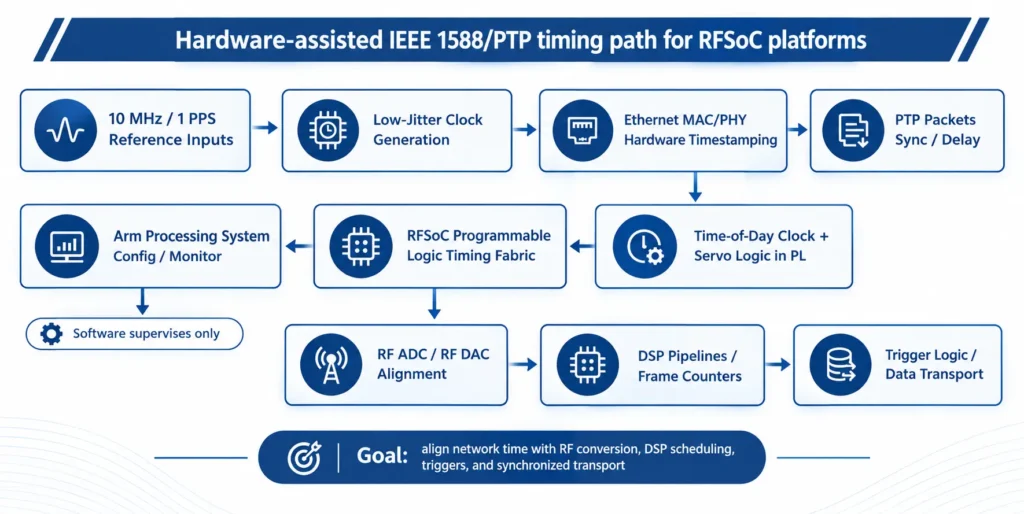
Figure 1. Hardware-assisted IEEE 1588/PTP timing architecture for synchronized RFSoC systems.
Benefits of Hardware-Assisted RFSoC Synchronization
- Reduced timing jitter: Hardware timestamping captures timing events independently of software scheduling.
- Deterministic synchronization: Programmable logic based timing reduces variation caused by CPU and operating system activity.
- Lower CPU overhead: Time critical timestamping and correction can be performed in hardware.
- Improved RF alignment: Synchronized time can be distributed to RF converters, DSP pipelines, frame counters, and trigger logic.
- Scalable multi node synchronization: A common timing architecture can support distributed RF nodes and instruments.
Software-Based vs Hardware-Assisted RFSoC Synchronization
| Aspect | Software-only timing | Hardware-assisted RFSoC timing |
|---|---|---|
| Timestamp capture | Taken later in software; sensitive to queues and scheduling | Captured close to MAC/PHY or FPGA timestamping logic |
| Clock correction | Depends on OS timing and software execution | Handled in deterministic programmable logic |
| CPU load | Consumes CPU cycles for time sensitive tasks | Offloads critical timing work from the CPU |
| Jitter | More exposed to interrupts and packet-processing variation | Lower variation because timing is tied to hardware events |
| RF alignment | Harder to link network time with RF converter and DSP timing | Better suited for converter, DSP, and trigger alignment. |
| Scaling | Precision becomes harder to maintain across many endpoints. | More practical for distributed RF nodes and instruments. |
RFSoC Synchronization Applications:
- 5G and O-RAN
Synchronize packet transport timing with RF sampling, radio frame timing, and distributed radio processing. - Phased-Array Radar
Maintain timing relationships across multiple RF channels for coherent signal acquisition and processing. - Electronic Warfare
Coordinate sensing, signal processing, and response events across distributed RF processing nodes. - Software-Defined Radio
Synchronize Ethernet data streaming, FPGA processing, RF conversion, and trigger events. - Test and Measurement
Improve timestamp consistency and triggering across connected RF instruments. - Scientific Data Acquisition
Maintain timing relationships for distributed acquisition, signal correlation, and data fusion.
iWave RFSoC Platforms for Synchronized RF Systems
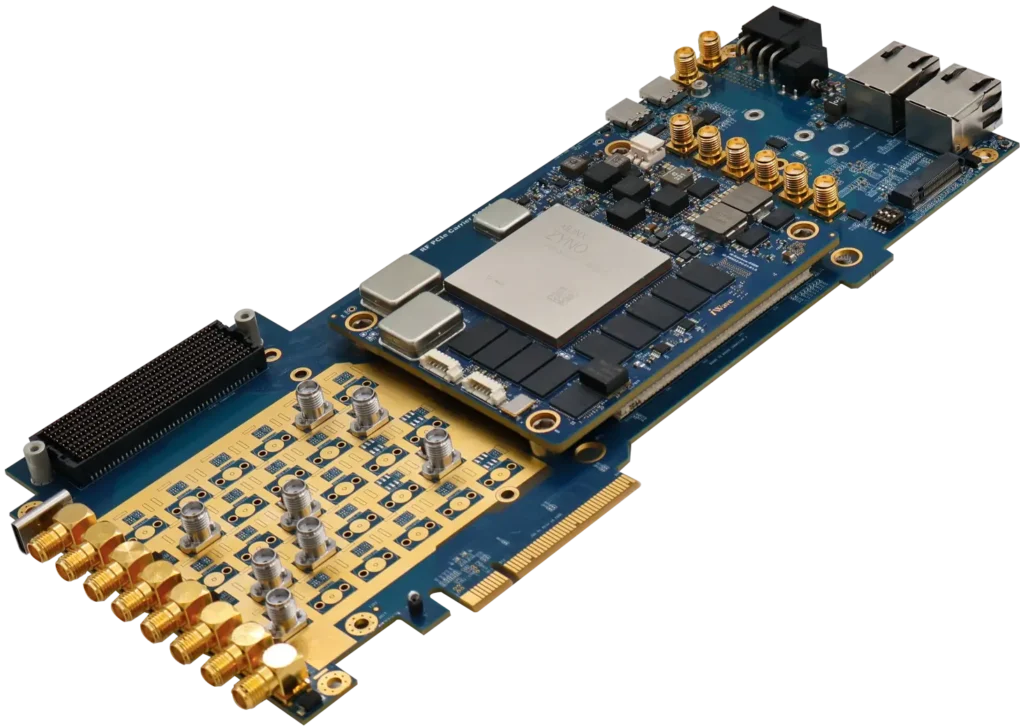
iWave provides RFSoC based System on Modules, PCIe cards, and 3U VPX platforms designed for high performance RF acquisition, processing, and data transport. These platforms can be considered for applications where RF conversion, FPGA processing, high speed connectivity, and external timing references need to be integrated into a compact system architecture.
- ZU49DR/ZU39DR/ZU29DR RFSoC SoM: suitable for high channel count RF systems that need RF conversion, FPGA processing, Arm control, high speed transceivers, and timing reference I/O such as 10 MHz and 1 PPS.
- RFSoC ADC DAC PCIe Card: Relevant for multi channel RF acquisition and generation where PCIe host integration, RF I/O, SyncE/PTP synchronization, and repeatable timing are important.
- RFSoC 3U VPX Platforms: Relevant for radar, EW, aerospace, defense, instrumentation, and deployed systems where compact form factor and deterministic timing are key requirements.
Key RFSoC Synchronization Design Considerations
- PTP timestamp location
- 10 MHz reference clock
- 1 PPS synchronization
- SyncE support
- GPS/GNSS or GPSDO reference
- RF ADC/DAC synchronization
- FPGA clock distribution
- Frame counter alignment
- Trigger synchronization
- Multi-board synchronization
- Timing diagnostics
- Clock phase and frequency correction
For next-generation RF systems, timing is part of the performance architecture. Hardware assisted IEEE 1588/PTP timestamping gives RFSoC platforms a more deterministic way to align network timing with RF conversion, DSP processing, and trigger generation.
For iWave RFSoC boards, this creates a clear product level value proposition: compact RF platforms that can support synchronized acquisition, processing, and transport for 5G, radar, EW, SDR, instrumentation, and scientific systems
To evaluate an iWave RFSoC board for synchronized radio, radar, SDR, instrumentation, or scientific acquisition designs, contact iWave for platform details, timing architecture options, customization support, and integration guidance.
Contact: mktg@iwave-global.com or www.iwave-global.com
