Implementing NCO Frequency Hopping with MATLAB on iWave Zynq™ UltraScale+™ RFSoC
September 18, 2026
Article
Modern RF applications such as Software Defined Radio (SDR), radar, and electronic warfare (EW) increasingly require fast and flexible signal processing with low latency. These applications also need the ability to change operating frequencies quickly and accurately to adapt to changing RF environments and reduce the impact of interference and jamming. RFSoC frequency hopping enables rapid and precise frequency switching directly within the RF processing platform, making it well suited for these demanding applications.
To address these challenges, iWave has enabled a model-based RF development workflow by combining its iG60M® Zynq™ UltraScale+™ RFSoC System on Module (SoM) with MATLAB®, Simulink®, and SoC Block set™ enabling a seamless path from algorithm development to real-time hardware implementation.
The capability is demonstrated through a real-time frequency hopping architecture, showcasing the iWave Zynq™ UltraScale+™ RFSoC platform ability to perform high speed signal processing and precise frequency control. By leveraging the integrated RF Data Converter (RFDC), the solution enables dynamic carrier frequency switching directly within the RFSoC, reducing the need for additional external RF hardware and simplifying the overall system architecture.
Challenges in Traditional RFSoC frequency hopping Systems:
Traditional frequency hopping systems often use an external processor and frequency synthesizer to manage each hop. The processor runs the hopping algorithm, generates the hop codes, and updates the synthesizer for every hop.
Although this approach is widely used, it can make the system more complex. It requires additional RF components and more time for integration and testing. Processor involvement can also limit the speed of frequency switching.
For applications that require fast hopping, accurate synchronization, and flexibility, these limitations can make system development more challenging and time consuming.
Solution Highlight:
- iG-G60M® ZynqTM Ultrascale+TM RFSoC ZU48/47/43/28/27/25DR devices
- Integrated SD-FEC IP Block
- Up to 930K Logic cells & 425K LUTs
- 8 ADC channels up to 5Gsps and 8 DAC Channels up to 9.85Gsps
- 16 x PL GTY High Speed Transceivers up to 28.21Gbps
- 4 x PS GTR High speed Transceivers up to 6Gbps
- Software features: PYNQ prototyping support, multi-tile sync & PCIe (XDMA) validated & MATLAB support
For frequency hopping applications, the iG-G60M ZU48DR platform takes advantage of the RF Data Converter (RFDC) real-time Numerically Controlled Oscillator (NCO) control capability. This allows carrier frequencies to be updated dynamically through the Programmable Logic (PL), enabling faster frequency transitions, accurate synchronization, and flexible frequency hopping while reducing the need for complex external synthesizer control. This makes the platform well suited for applications such as Software Defined Radio (SDR), electronic warfare (EW), radar, and secure communications
RFSoC frequency hopping Architecture
Frequency Hopping Spread Spectrum (FHSS) is a communication technique in which the carrier frequency rapidly changes according to a predefined hopping sequence shared between the transmitter and receiver.
By switching between multiple frequency channels, FHSS helps improve communication reliability and reduce the impact of interference, congestion, and intentional jamming. It is widely used in secure wireless communications, aerospace and defense, radar, avionics, and Software Defined Radio (SDR) applications.
In a traditional frequency hopping system, the processor executes the hopping algorithm and generates a hopping code for each hopping interval. This code determines the required frequency, which is then configured through an external frequency synthesizer. At the appropriate time, the synthesizer generates the required local oscillator frequency for modulation and data transmission.
The receive path follows a similar process, using the same hopping sequence to generate the corresponding local oscillator frequency. This enables the received signal to be down converted, demodulated, and decoded accurately.
By moving frequency control closer to the hardware, the architecture enables faster frequency switching, precise timing, and simpler system integration, providing a flexible foundation for high-performance frequency hopping and frequency agile RF applications.
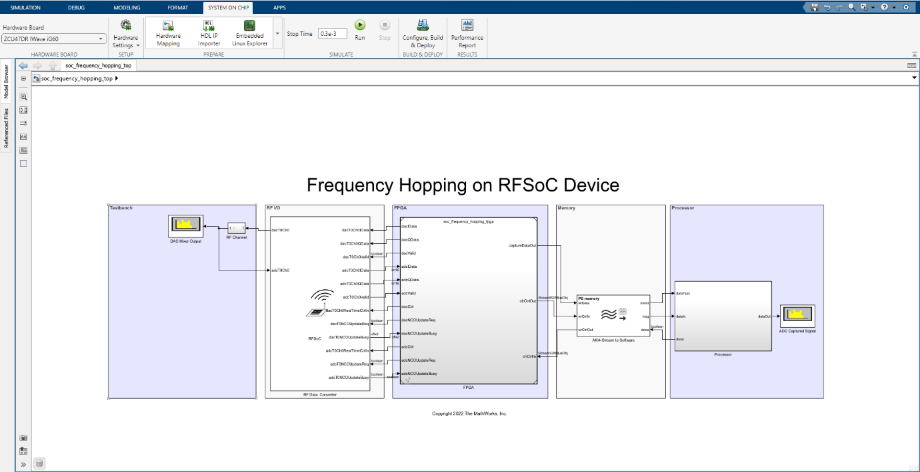
From Simulation to Hardware: Real-Time RF Validation on iWave RFSoC ZU48 DR SoMs
After simulation, the design will be deployed to the custom RFSoC 48DR platform using the SoC Builder workflow.
Hardware validation demonstrated successful frequency transitions on the transmit path while maintaining synchronization between transmitter and receiver. The receiver output consistently produced a stable 1 MHz tone, confirming that both paths were hopping together and remained time-aligned throughout operation.
The ability to validate the complete design in simulation before deployment greatly simplified integration and reduced debugging effort.
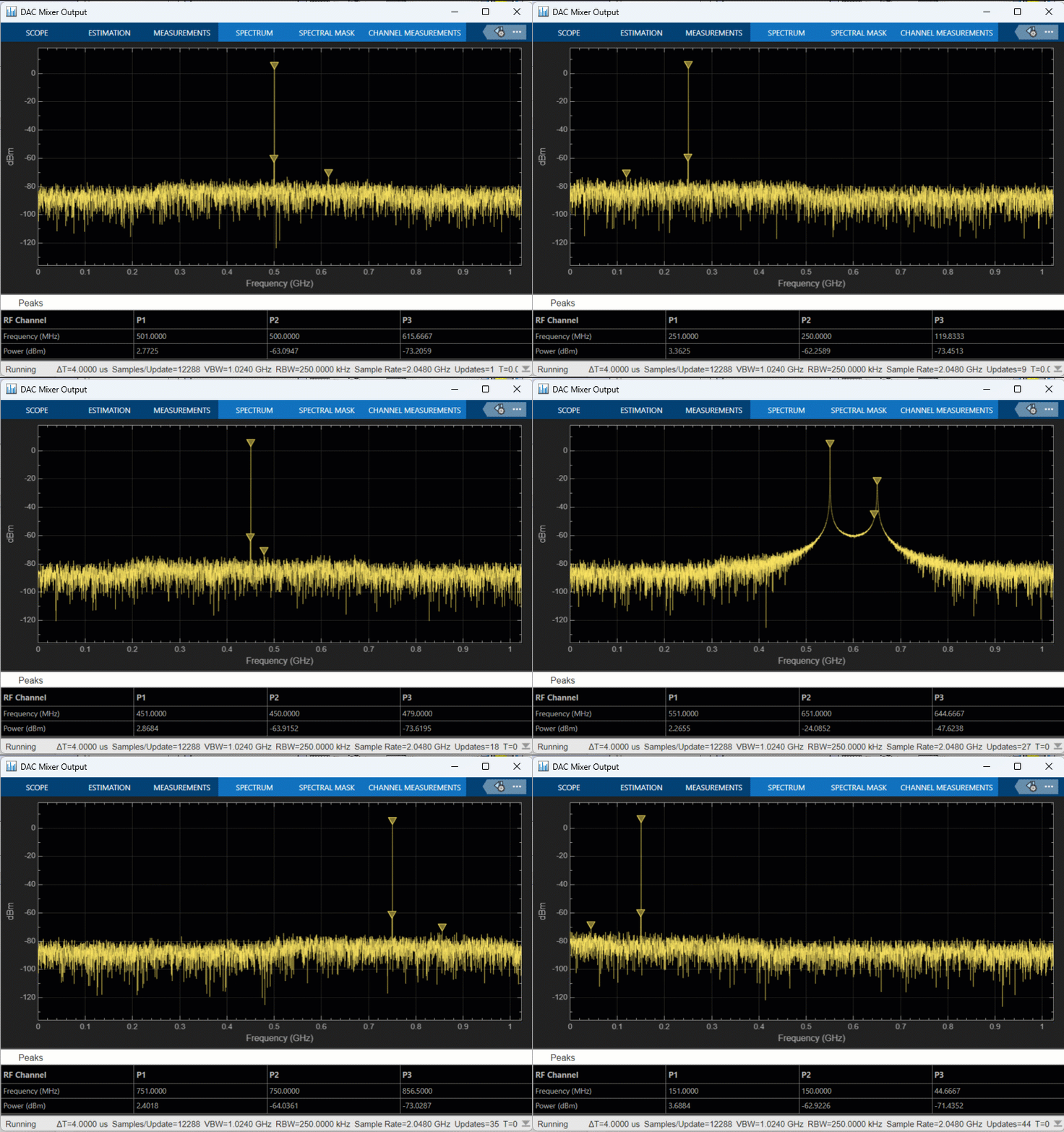
MATLAB®, Simulink®, and SoC Block set™ for Zynq™ UltraScale+™ RFSoC Development:
The combination of MATLAB®, Simulink®, and SoC Block set™, HDL Coder, and Embedded Coder provides a complete workflow ecosystem for developing and deploying advanced RF applications on iWave Zynq™ UltraScale+™ RFSoC platform.
Before deployment, the design can be validated entirely in simulation. A dedicated testbench enables visualization of the transmitter output spectrum, allowing to observe frequency transitions and verify hopping behaviour.
This workflow significantly reduces development time by enabling system-level verification prior to hardware deployment.
From frequency hopping and real-time signal processing to SDR, radar, and wireless communication systems, iWave RFSoC solutions enable flexible, high-performance RF development with reduced complexity and faster time-to-market.
iWave Global is a leading provider of embedded computing solutions specializing in System on Modules, FPGA platforms, and ODM services. With deep expertise in high-performance and RF systems, iWave enables customers to accelerate product development and time to market.
For more information, please write to mktg@iwave-global.com
