SD/SDIO Host Controller: Design, Features and Implementation
September 7, 2023
Article
SD/SDIO Host Controller technology enables embedded systems to communicate efficiently with SD memory cards and SDIO peripherals. SD cards remain widely used for removable storage because of their compact form factor, high capacity, low power consumption, and broad compatibility across embedded and portable devices.
For FPGA- and SoC-based systems, implementing SD communication from scratch can involve significant protocol, timing, and software development. A dedicated SD/SDIO Host Controller IP simplifies this process by managing command and data communication between the host processor and SD device.
iWave’s SD/SDIO Host Controller 3.0 IP Core complies with the SD Host Controller Specification 3.0 and Physical Layer Specification 3.0. It supports SD, microSD, SDHC, SDXC, and SDIO devices, providing a flexible solution for storage and peripheral connectivity.
SD/SDIO Host Controller: Architecture
The IP integrates multiple functional blocks to manage SD communication and data transfers.
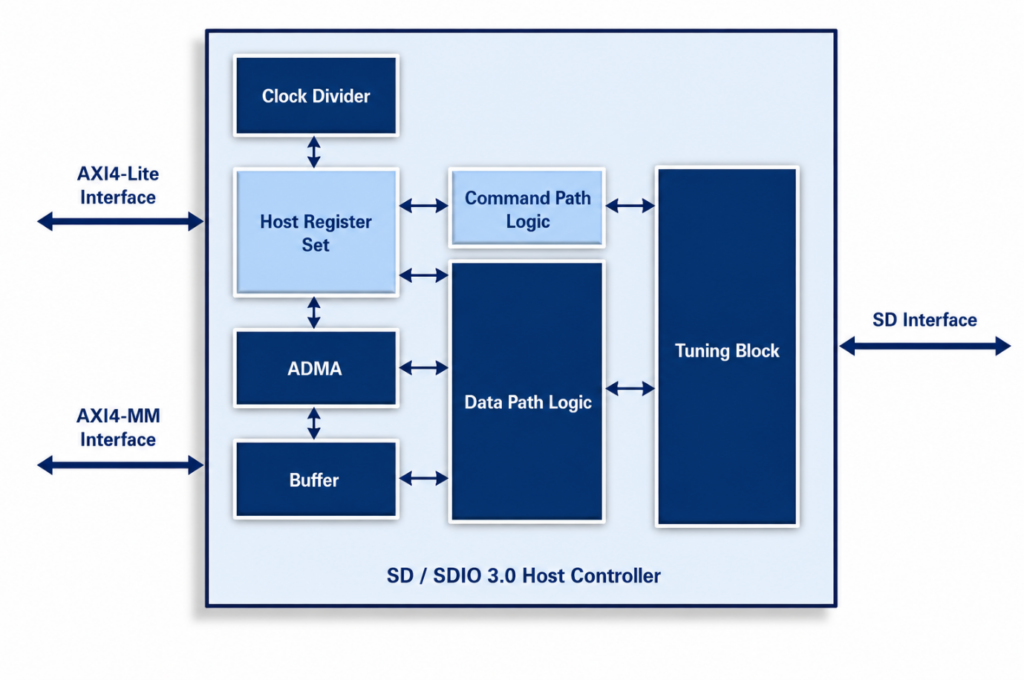
- Command Path: Handles commands transmitted to the SD card and processes the corresponding responses.
- Data Path: Manages read and write operations between the host and SD device with dedicated buffering.
- Host Register Set: Provides configuration, control, status, command, response, buffer, and interrupt registers.
- ADMA2 Engine: Manages DMA-based data movement between host memory and the SD card, reducing processor overhead.
- Tuning Logic: Performs interface tuning using FPGA-specific I/O resources to support reliable high-speed operation.
The IP incorporates up to 2 KB of FIFO buffering for read and write operations, helping maintain efficient communication with the host processor.
SD/SDIO Host Controller: Speed and Interface Support
The controller supports default-speed and high-speed SD operation along with UHS-I modes, providing flexibility for different performance requirements.
Supported modes include:
- SDR12 – Up to 25 MHz
- SDR25 – Up to 50 MHz
- SDR50 – Up to 100 MHz
- SDR104 – Up to 208 MHz
- DDR50
The controller supports configurable 1-bit and 4-bit bus widths, along with single-block and multi-block data transfers. CRC checking and timeout monitoring provide additional reliability during command and data communication.
Key Features
The IP is designed to simplify integration while providing the performance required for embedded storage applications.
Key features include:
- SD Host Controller Specification 3.0 compliance
- SD Physical Layer Specification 3.0 compliance
- SD, microSD, SDHC, SDXC, and SDIO support
- UHS-I operating modes
- ADMA2 scatter-gather engine
- 1-bit and 4-bit programmable bus width
- Single- and multi-block transfers
- 32-bit AXI4 memory-mapped interface
- 32-bit AXI4-Lite control interface
- CRC support for commands and data
- Timeout monitoring
- 2 KB data buffering
- Programmable SD clock generation
Benefits of SD/SDIO Host Controller
The IP offers several advantages for FPGA and SoC-based designs.
Faster Integration: A ready-to-integrate controller reduces the effort required to implement SD protocol functionality from the ground up.
High-Speed Data Transfer: Support for UHS-I modes and ADMA2 enables efficient movement of large amounts of data.
Reduced Processor Overhead: DMA-based transfers allow the processor to focus on application-level processing rather than managing every data transaction.
Design Flexibility: Support for multiple SD standards, bus widths, and operating modes enables integration across different embedded platforms.
Reduced Development Risk: A validated IP solution helps minimize protocol implementation and verification challenges.
FPGA and Software Support
Developed in Verilog HDL, the SD/SDIO Host Controller IP has been validated across FPGA platforms from vendors including AMD/Xilinx, Intel, Lattice, and Microchip.
iWave provides software support for both FPGA and SoC platforms.
For non-SoC FPGA systems, the bare-metal driver supports SD card initialization and basic read/write operations. The AXI4-Lite interface is used for controller configuration, while AXI4 supports DMA-based data transfers.
For SoC platforms, the Linux driver enables standard SD operations such as initialization, mounting, partition management, and file-system access.
SD/SDIO Host Controller: Applications
The flexible architecture makes the IP suitable for a wide range of embedded applications, including:
- Industrial embedded systems
- FPGA-based computing platforms
- Data acquisition systems
- Medical equipment
- Automotive electronics
- Networking and communication systems
- Aerospace and defence platforms
- Edge computing devices
SD/SDIO Host Controller: iWave Expertise
iWave provides a complete SD/SDIO Host Controller IP solution, including RTL or netlist, synthesis scripts, test environments, software drivers, technical documentation, and engineering support.
With expertise across FPGA, embedded hardware, software, and IP development, iWave helps customers integrate SD/SDIO functionality into application-specific platforms and accelerate product development.
The SD/SDIO Host Controller 3.0 IP Core provides a reliable and flexible approach to integrating SD and SDIO connectivity into FPGA- and SoC-based embedded systems. With SD 3.0 compliance, UHS-I support, ADMA2, AXI interfaces, configurable bus widths, and Linux and bare-metal software support, the IP simplifies implementation while enabling efficient data transfer.
For more information about the SD/SDIO Host Controller 3.0 IP Core, visit www.iwave-global.com or contact mktg@iwave-global.com
