Xen Hypervisor on i.MX 8QM SoM: Enabling Secure Virtualization for Embedded Systems
August 19, 2023
Article
Xen Hypervisor on i.MX 8QM SoM enables embedded systems to consolidate multiple operating systems or applications on a single hardware platform while maintaining isolation between workloads with different performance, safety, and security requirements. As embedded systems become increasingly complex, virtualization provides an effective approach to managing these diverse workloads while improving hardware utilization.
Xen Hypervisor is an open-source virtualization technology that enables multiple operating systems to run on the same hardware platform. When implemented on the i.MX 8QM System on Module (SoM), Xen provides a flexible platform for building secure and scalable embedded systems that require multi-OS support and efficient hardware utilization.
What is Xen Hypervisor?
Xen is a type-1 hypervisor designed to run directly on the system hardware and manage multiple virtual machines (VMs). Each VM can run its own operating system and applications while sharing the underlying processor, memory, and peripherals.
The hypervisor acts as an abstraction layer between the hardware and guest operating systems. It controls hardware resources and provides isolation between virtual machines, helping prevent failures or issues in one environment from affecting others.
This makes Xen Hypervisor suitable for embedded applications where different workloads need to coexist on the same hardware platform.
Why Use Xen Hypervisor on i.MX 8QM SoM?
The NXP i.MX 8QuadMax (i.MX 8QM) processor combines heterogeneous processing capabilities with a rich set of interfaces, making it suitable for demanding embedded applications.
An i.MX 8QM SoM with Xen Hypervisor can enable multiple software environments to operate on a single hardware platform. For example, a system can run a Linux-based application environment alongside another operating system or dedicated workload, with the hypervisor managing the available resources.
Key benefits include:
- Multi-OS support: Run multiple operating systems on a single SoM.
- Workload isolation: Separate critical and non-critical applications into independent virtual machines.
- Efficient hardware utilization: Share processor, memory, and peripherals between different workloads.
- System consolidation: Reduce the need for multiple processors or separate computing platforms.
- Scalability: Allocate hardware resources according to application requirements.
- Improved reliability: Isolate software failures to minimize their impact on other workloads.
How Xen Virtualization Works on i.MX 8QM
In a Xen-based architecture, the Xen Hypervisor operates as the virtualization layer between the hardware and guest operating systems.
The hypervisor manages CPU, memory, and peripheral resources and assigns them to individual virtual machines. Each guest OS operates within its own virtualized environment.
Depending on the system requirements, different workloads can be assigned to separate virtual machines. For example, one VM can handle a Linux-based application while another VM manages a dedicated real-time or application-specific workload.
This architecture allows developers to consolidate multiple functions onto a single embedded platform while maintaining logical separation between workloads.
i.MX 8QM SoM for Virtualized Embedded Applications
The i.MX 8QM SoM provides the processing capabilities and interfaces required to develop feature-rich embedded systems.
Its heterogeneous processing architecture can be leveraged for applications requiring a combination of high-performance application processing and real-time workloads. The platform also provides interfaces such as PCIe, Ethernet, CAN, USB, MIPI and LVDS for connecting external peripherals and subsystems.
When combined with Xen virtualization, these capabilities provide a flexible foundation for applications requiring:
- Multiple operating environments
- Secure workload isolation
- Real-time and general-purpose processing
- High-speed connectivity
- Graphics-intensive applications
- Hardware resource sharing
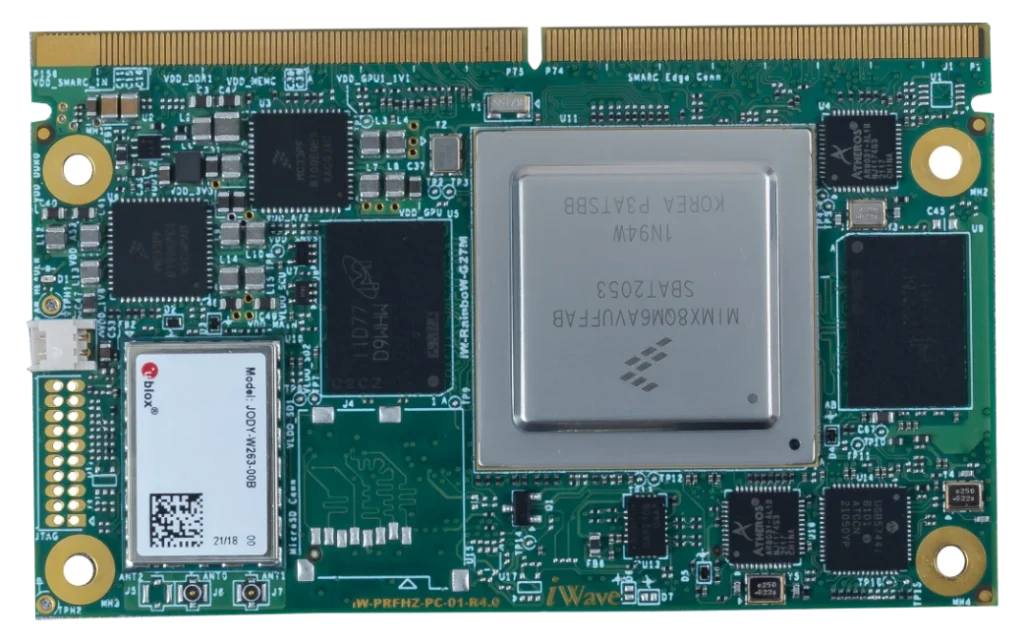
iWave has expertise in embedded Linux, BSP development, SoM platforms, and virtualization technologies. This enables iWave to support customers in integrating Xen Hypervisor with embedded hardware platforms.
The Xen virtualization solution can involve:
- Xen Hypervisor porting and configuration
- Guest OS integration
- Device and peripheral configuration
- Hardware resource allocation
- Virtual machine configuration
- Driver and BSP integration
- System-level validation
- Application-specific customization
iWave’s experience with i.MX-based SoMs allows customers to leverage a validated hardware platform while focusing their engineering resources on application development.
Applications of Xen Virtualization
Xen Hypervisor on an i.MX 8QM SoM can be considered for embedded applications where multiple workloads need to run independently on a shared computing platform.
Automotive
Virtualization can help consolidate infotainment, connectivity, diagnostics, and other software workloads on a common hardware platform while maintaining isolation between different environments.
Industrial Automation
Multiple control, monitoring, visualization, and communication workloads can be consolidated on a single embedded computing platform.
Medical Systems
Virtualized environments can help separate application workloads and provide controlled execution environments for different system functions.
HMI and Edge Computing
Linux-based HMI applications can coexist with other application or real-time workloads, helping reduce hardware complexity and system cost.
Why Choose an i.MX 8QM SoM-Based Xen Solution?
Developing a virtualization-enabled embedded product from the ground up can require significant hardware and software engineering effort. An SoM-based approach reduces this complexity by providing a pre-integrated computing platform.
Combining the i.MX 8QM SoM with Xen Hypervisor provides a scalable foundation for developing embedded systems that require multi-OS capability, workload isolation, hardware consolidation, and flexible resource management.
iWave can support customers across hardware, BSP, virtualization, driver, and application integration, helping accelerate development and reduce time to market.
As embedded applications continue to integrate multiple software functions, virtualization is becoming an important approach for improving hardware utilization, isolation, and system flexibility.
Xen Hypervisor on i.MX 8QM SoM provides a powerful platform for consolidating multiple workloads and operating systems on a single embedded system. With its heterogeneous processing architecture, extensive connectivity options, and virtualization capabilities, the i.MX 8QM platform is well suited for developing scalable embedded solutions.
With expertise in i.MX SoMs, BSP development, Xen integration, and embedded software, iWave can help customers build customized virtualization solutions for their specific application requirements.
For more information about iWave’s i.MX 8QM SoM and Xen virtualization solutions, visit www.iwave-global.com or contact mktg@iwave-global.com
