Zynq UltraScale+ MPSoC System on Modules for High-Performance LiDAR
August 18, 2023
Article
Zynq UltraScale+ MPSoC System on Modules combines high-performance processing with programmable logic, making it well suited for demanding LiDAR applications that require accurate distance measurement, 3D mapping, object detection, and environmental perception. LiDAR systems used in autonomous platforms, robotics, defence, and industrial applications must process large volumes of sensor data with low latency while maintaining power efficiency and design flexibility.
Building such high-performance systems requires more than a fast processor, as sensor interfacing, real-time signal processing, point-cloud processing, machine learning, and high-speed data transfer must work together within a compact and reliable embedded platform. Zynq UltraScale+ MPSoC System on Modules integrate processing and programmable logic in a single platform, enabling efficient and flexible LiDAR processing solutions.
Why Zynq UltraScale+ MPSoC SoMs for LiDAR?
The Zynq UltraScale+ MPSoC architecture integrates a processing system (PS) with programmable logic (PL), allowing developers to partition workloads between software and hardware according to application requirements.
The ARM processing system can handle application software, sensor management, communication, and system control, while the programmable logic can accelerate computationally intensive algorithms through parallel processing.
This heterogeneous architecture is particularly useful for LiDAR applications involving:
- High-speed sensor data acquisition
- Real-time signal and data processing
- Point-cloud pre-processing
- Object detection and classification
- Machine learning acceleration
- Sensor fusion
- High-speed data communication
The programmable logic also provides the flexibility to implement application-specific processing pipelines, helping developers optimize performance and latency.
Why Use a System on Module for LiDAR Development?
Developing a LiDAR processing platform from the ground up can involve complex hardware design, high-speed interfaces, memory architecture, power management, and thermal considerations.
A System on Module (SoM) integrates key processing, memory, storage, and power components into a compact, pre-engineered platform. This allows product developers to focus on application-specific software, algorithms, FPGA acceleration, and LiDAR system integration instead of developing the complete processing hardware from scratch.
A SoM-based approach can also provide:
- Reduced hardware development effort
- Faster time to market
- Lower development risk
- Hardware and software flexibility
- Scalable processing performance
- Easier migration between processor variants
For LiDAR products that evolve through multiple generations, SoM scalability can be particularly valuable.
Features of Zynq UltraScale+ MPSoC SoMs for LiDAR
iWave’s Zynq UltraScale+ MPSoC SoMs combine ARM processing capabilities with programmable logic to support high-performance embedded applications.
Heterogeneous ARM + FPGA Architecture
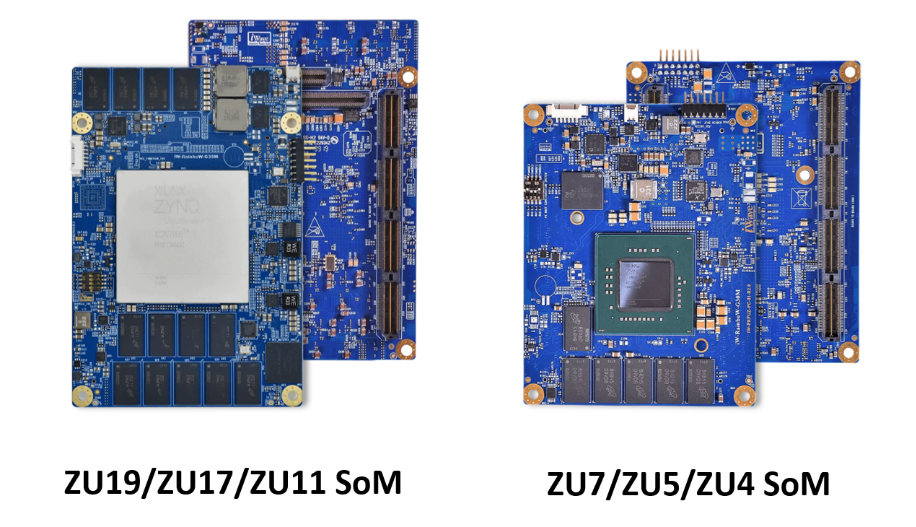
The ZU7/ZU5/ZU4 family integrates a quad-core ARM Cortex-A53 application processor with dual-core ARM Cortex-R5 real-time processing capability and programmable logic.
The combination allows developers to assign real-time and computationally intensive workloads to the most appropriate processing resource.
Flexible High-Speed Sensor Interfaces
LiDAR systems may require multiple interfaces depending on the sensor architecture and data throughput requirements. Zynq UltraScale+ MPSoC provides a flexible platform for implementing interfaces such as MIPI, LVDS, Gigabit Ethernet, CAN, SPI, I2C, and UART.
The programmable logic can also be customized to implement application-specific interfaces and processing pipelines.
This flexibility makes the platform suitable for systems integrating multiple sensors, including LiDAR, cameras, radar, and auxiliary sensors.
Hardware-Accelerated Processing
LiDAR applications generate significant amounts of sensor data that need to be processed in real time. Implementing computationally intensive algorithms in programmable logic can provide parallel processing and help reduce processing latency.
The FPGA fabric can therefore be used for functions such as:
- Sensor data pre-processing
- Filtering
- Feature extraction
- Point-cloud processing
- Data formatting
- Custom algorithm acceleration
Machine Learning Acceleration
Machine learning is increasingly used in perception systems for object detection, classification, and environmental understanding.
The Zynq UltraScale+ MPSoC ecosystem supports hardware acceleration of AI/ML workloads, allowing developers to deploy optimized neural-network models alongside conventional signal and point-cloud processing.
This combination of programmable logic, ARM processing, and AI acceleration provides a flexible architecture for developing intelligent LiDAR systems.
Software and FPGA Development Ecosystem
The AMD development ecosystem provides tools for both hardware and software development.
Vivado Design Suite enables FPGA design, synthesis, implementation, and hardware configuration, while Vitis supports application development and embedded software deployment.
Linux and real-time operating systems can be used depending on the system architecture and real-time requirements.
Security for LiDAR Systems
LiDAR systems used in defense, industrial, automotive, and other connected applications may require protection against unauthorized access and system tampering.
Zynq UltraScale+ MPSoC devices provide hardware-assisted security features, including secure boot and cryptographic capabilities. These features can help developers establish a trusted processing environment and protect sensitive application firmware and data.
Scalable LiDAR Platform with Zynq UltraScale+ MPSoC SoMs
A key advantage of the SoM approach is scalability. Different LiDAR products may require different levels of processing performance, programmable logic resources, memory, and high-speed I/O.
iWave’s offers Zynq UltraScale+ MPSoC-based platforms spanning different device variants, enabling developers to select a suitable processing platform for their application requirements.
For example, iWave’s ZU7/ZU5/ZU4 platform provides up to 504K logic cells, while higher-end ZU19/ZU17/ZU11 platforms provide up to 1.14 million logic cells on supported iWave’s platforms.
This scalability allows developers to retain a similar system architecture while moving to a higher-performance platform as application requirements evolve.
Accelerate Your LiDAR Product Development with iWave
Developing a LiDAR product requires expertise across high-speed hardware design, FPGA development, embedded software, sensor interfacing, and system integration.
iWave’s experience in Zynq UltraScale+ MPSoC SoMs, FPGA design, high-speed interfaces, embedded software, and custom product development enables customers to accelerate the development of LiDAR and other high-performance sensing platforms.
The Zynq UltraScale+ MPSoC SoM provides a flexible foundation for implementing real-time LiDAR processing, point-cloud analytics, AI/ML acceleration, and multi-sensor integration in compact embedded systems.
For more information, visit www.iwave-global.comor contact mktg@iwave-global.com
