Powering High-Speed Networking on Windows through iW-Fibre SmartNIC and OpenNIC DPDK
January 27, 2026
Article
Windows Networking, Supercharged
Windows Server continues to power a significant share of enterprise data centers, supporting workloads like Active Directory, SQL Server, .NET applications, and virtualization. However, traditional kernel-based networking stacks on Windows can limit throughput, and consume CPU resources, making high-performance networking a challenge. Industry data shows 9–10% of global data centers run Windows, highlighting the need for optimized solutions.
In our earlier articles, we demonstrated near line-rate DPDK performance on Linux using iW-Fibre SmartNIC. This article shifts the focus to Windows, highlighting OpenNIC-based iW-Fibre integration with DPDK on Windows, validated through PCI enumeration using RWEverything and packet forwarding with DPDK testpmd.
iW-Fibre SmartNIC with OpenNIC and DPDK on Windows
The iW-Fibre SmartNIC is a programmable FPGA-based network accelerator for Windows servers that offloads packet processing tasks such as L2/L3 forwarding, tunneling, ACLs, and traffic steering to hardware. Fully compliant with the OpenNIC, it integrates seamlessly with DPDK on Windows to enable poll-mode drivers, near line-rate performance, and reduced CPU load.
For more details, visit the official iWave website: iW-Fibre SmartNICs

iW-Fibre SmartNIC: Verified and Windows-Ready
The iW-Fibre SmartNIC is fully recognized in Windows Device Manager and verified for operation through PCI enumeration and user-space packet processing tests. This ensures the device is correctly mapped, registers are accessible, and the hardware can be fully utilized in Windows environments.
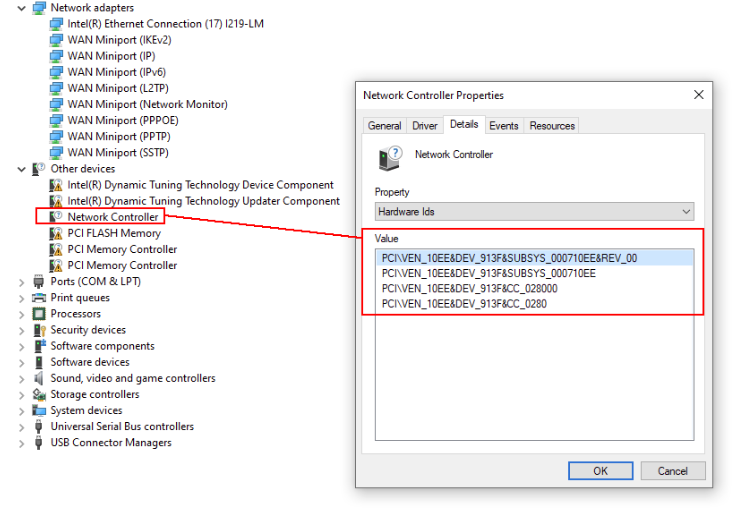
Windows Device Manager snapshot showing iW-Fibre Device Detection
RWEverything, a Windows utility for accessing PCIe configuration space and MMIO registers, is used to verify the iW-Fibre SmartNIC. The device is identified using its Vendor ID, Device ID, and PCI Bus Device Function, while BAR regions and OpenNIC control and status registers are read to confirm proper mapping and operation. The results show successful enumeration and register values consistent with the design

RWEverything snapshot showing register access of iW-Fibre SmartNIC
To validate data plane functionality, the DPDK testpmd application is executed on Windows. This ensures that RX/TX queues are correctly initialized, packets can be transmitted and received without kernel intervention, and stable throughput is achieved under sustained load. By binding the SmartNIC to the DPDK poll-mode driver and enabling forwarding mode, packet counters and statistics are monitored, confirming deterministic, high-speed packet processing. iW-Fibre SmartNIC receives packets from standard NIC at Port 0 and efficiently forwards them to destination NIC at Port 1.
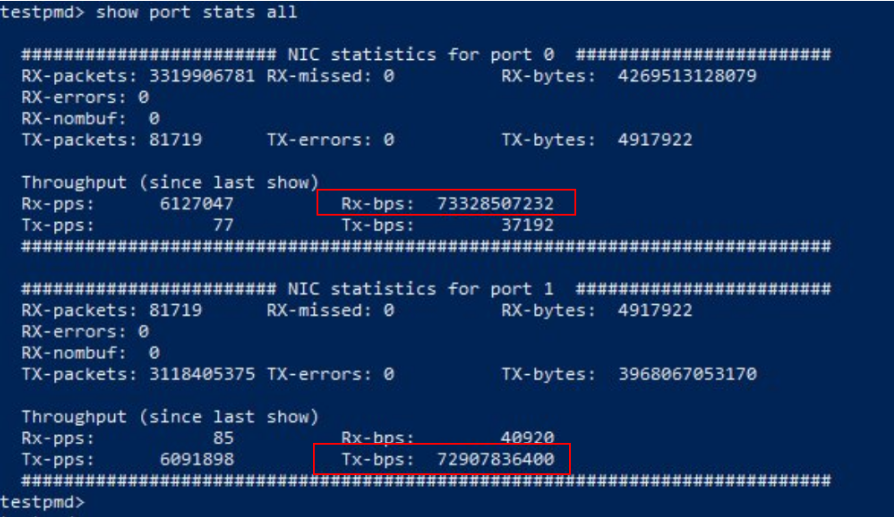
DPDK testpmd running on Windows showing RX/TX packet statistics for iW-Fibre SmartNIC
Measured throughput: 73.3 Gbps RX, 72.9 Gbps TX using iW-Fibre SmartNIC.
The Default Packet Size is 64 bytes.
Note : Throughput may vary depending on the Host PC/Server configuration with Windows 10 Pro. The reported statistics were obtained using Intel i7 7th-generation CPU configuration running at 3.60 GHz using G35-XFibre-100G iWave SmartNIC.
Overall, the combination of RWEverything for PCI enumeration and DPDK testpmd for functional verification provides complete end-to-end assurance that the iW-Fibre SmartNIC is fully operational and optimized for Windows-based data centers.
Windows Networking, Accelerated
The combination of iW-Fibre SmartNIC, OpenNIC, and DPDK on Windows enables enterprise data centers to achieve hardware-accelerated, deterministic networking with near line-rate performance. By offloading critical packet processing to FPGA hardware and enabling user-space networking, iW-Fibre removes conventional Windows networking bottlenecks while maintaining full compatibility, scalability, and adaptability for future workloads.
Enterprises can now deploy high-speed, and fully programmable networking directly in Windows Server environments, powering modern workloads across cloud, storage, AI/ML, and security applications.
For more information contact us at mktg@iwave-global.com and visit www.iwave-global.com.
