Telematics Control Unit Enabling Secure Edge Analytics for Fleet Management
August 12, 2023
Article
Telematics Control Unit (TCU) technology goes beyond basic vehicle tracking, providing fleet operators with real-time visibility into vehicle health, driver behaviour, location, fuel efficiency, and maintenance conditions. iWave’s Telematics Control Unit serves as an intelligent edge-computing platform that collects vehicle data, processes critical information in real time, and securely transfers relevant insights to cloud applications. With advanced connectivity, CAN interfaces, GNSS, sensors, and robust security features, the TCU enables smarter fleet management, improved operational efficiency, and reduced operating costs.
Telematics Control Unit for Smarter Fleet Management
The iWave Telematics Control Unit enables fleet operators to monitor vehicles remotely and make data-driven decisions. It supports real-time vehicle diagnostics, high-accuracy location tracking, driving behavior analysis, and enhanced vehicle security.
The platform can be customized to meet application-specific requirements and supports features such as CAN FD, SAE J1939, Secure FOTA, multi-cloud connectivity, and advanced security mechanisms.
Improve Vehicle Uptime with Real-Time Diagnostics
A Telematics Control Unit can collect diagnostic information from vehicle ECUs and make critical data available for analysis. Parameters related to engine performance, fuel efficiency, mileage, and vehicle health can be monitored to identify potential faults at an early stage.
By detecting abnormal conditions before they become major failures, fleet operators can plan preventive maintenance, reduce downtime, and improve overall vehicle availability.
Monitor Your Fleet Anytime, Anywhere
High-accuracy GNSS enables continuous tracking of vehicle location and fleet activity. Support for multiple GNSS constellations, including GPS, GLONASS, Galileo, and BeiDou, helps improve positioning accuracy.
Fleet managers can remotely monitor parameters such as vehicle location, speed, distance travelled, route, and idling time. This information helps optimize fleet utilization and improve operational efficiency.
Analyze Driver Behaviour for Improved Safety
Monitoring driving behaviour can help fleet operators identify unsafe driving patterns and improve driver safety. Integrated motion sensors can detect events such as harsh braking, rapid acceleration, excessive speeding, and other abnormal driving conditions.
These insights can be used to encourage safer driving practices, reduce accident risks, and improve fleet safety.
Enhance Vehicle Security
Vehicle and asset security is a major concern for fleet operators. A Telematics Control Unit can support security mechanisms such as geofencing, vehicle immobilization, and anti-theft alerts.
Geofencing allows fleet managers to define geographical boundaries and receive alerts when a vehicle enters or leaves a specified area. Additional security mechanisms can help detect unauthorized vehicle usage and respond quickly to potential theft or misuse.
Optimize Routes and Fleet Operations
Real-time vehicle information combined with location and traffic data can help fleet managers identify efficient routes and improve resource allocation.
Optimized routing can reduce unnecessary fuel consumption, minimize travel delays, and improve vehicle utilization, particularly for logistics, transportation, and last-mile delivery operations.
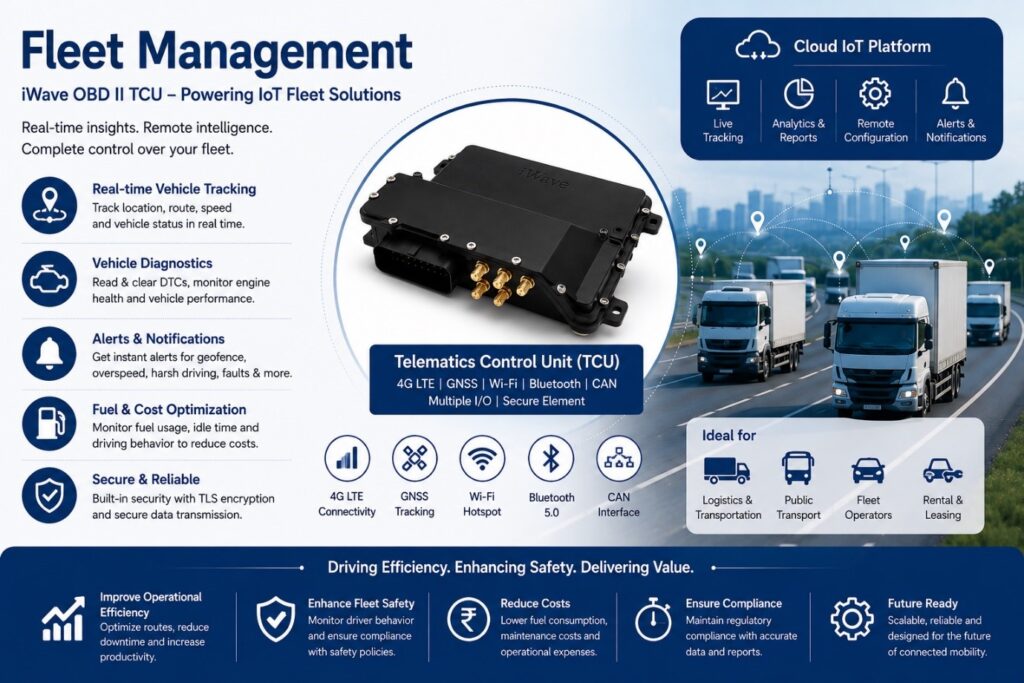
Key Capabilities of iWave Telematics Control Unit
The iWave TCU combines computing, connectivity, vehicle interfaces, sensors, and security into a compact embedded platform.
Key capabilities include:
- Advanced ARM-based processing for edge analytics
- Multiple CAN interfaces including CAN FD
- SAE J1939 support for heavy-duty vehicles
- High-accuracy multi-constellation GNSS
- 4G/LTE, Wi-Fi, and Bluetooth connectivity
- Support for application-specific sensors
- Secure firmware-over-the-air (FOTA) updates
- Hardware-based security and secure boot
- Multi-cloud integration
- Customizable hardware and software
iWave Expertise in Telematics Control Units
Intelligent Edge Computing
A modern fleet management system needs to balance real-time edge processing with cloud-based analytics. Critical vehicle parameters can be processed directly on the Telematics Control Unit, enabling faster responses while reducing unnecessary data transmission to the cloud.
The iWave platform combines powerful ARM-based processing with optimized software to support real-time analytics, secure communication, and application-specific processing at the edge.
End-to-End Security
Connected vehicles can become potential targets for cyberattacks without appropriate security mechanisms. iWave incorporates multiple layers of protection to help secure the device and its communications.
Security capabilities can include secure boot, secure storage, hardware security modules, authenticated software, cryptographic functions, and secure communication to establish a trusted environment from the device to the cloud.
Secure Firmware Over-the-Air Updates
Fleet vehicles are often deployed across large geographical areas, making manual firmware updates impractical. Secure FOTA enables firmware and software updates to be delivered remotely without physically accessing the vehicle.
iWave provides OTA update capabilities using technologies such as Mender, enabling secure and reliable software updates throughout the product lifecycle.
- Flexible CAN and Sensor Integration
Different vehicle platforms expose different types of data and interfaces. The iWave TCU supports multiple CAN configurations, including LS CAN, HS CAN, RAW CAN, and CAN FD, providing flexibility for different vehicle architectures.
SAE J1939 support enables communication with heavy-duty vehicle ECUs and access to real-time diagnostic information. The platform can also be customized with application-specific sensors such as temperature, humidity, and motion sensors.
Multi-Cloud Connectivity
The Telematics Control Unit can connect vehicle data to cloud and enterprise applications through commonly used communication protocols such as MQTT, HTTPS, and TCP/IP.
Its flexible architecture enables integration with different cloud platforms and customer-specific analytics systems, allowing organizations to build customized fleet management solutions.
Benefits of iWave Telematics Control Unit
- Real-time vehicle and fleet monitoring
- Improved predictive maintenance
- Enhanced driver and vehicle safety
- Reduced fleet operating costs
- Secure remote firmware updates
- Flexible CAN and sensor connectivity
- Cloud and application integration
- Hardware and software customization
- Support for automotive and heavy-duty vehicle applications
Build Your Connected Fleet with iWave
iWave’s Telematics Control Unit combines edge computing, vehicle connectivity, diagnostics, security, GNSS, and cloud integration into a flexible platform for connected mobility applications.
With expertise in embedded hardware, software, connectivity, and automotive solutions, iWave can support customers from platform customization through product development and deployment.
For more information, visit www.iwave-global.com or contact mktg@iwave-global.com
