DSRC and C-V2X: Enabling the Next Generation of Connected Mobility
September 18, 2023
Article
C-V2X is playing a key role in the automotive industry’s rapid shift toward connected and intelligent mobility. Vehicles are no longer isolated systems, they increasingly communicate with other vehicles, roadside infrastructure, pedestrians, and network services to improve safety, traffic efficiency, and the overall driving experience. At the centre of this transformation is Vehicle-to-Everything (V2X) communication.
V2X enables vehicles to exchange information with their surroundings and supports applications such as collision warnings, traffic management, emergency vehicle alerts, and vulnerable road-user detection. Two key communication technologies have emerged for V2X applications: Dedicated Short-Range Communications (DSRC) and Cellular Vehicle-to-Everything (C-V2X).
What is V2X Communication?
V2X enables communication between vehicles and different entities in the transportation ecosystem.
- V2V – Vehicle-to-Vehicle: Enables vehicles to exchange information such as speed, position, and braking status.
- V2I – Vehicle-to-Infrastructure: Enables communication between vehicles and infrastructure such as traffic signals, roadside units, and road management systems.
- V2P – Vehicle-to-Pedestrian: Enables vehicles to detect and communicate with pedestrians and other vulnerable road users.
- V2N – Vehicle-to-Network: Enables vehicles to communicate with cloud and cellular network services.
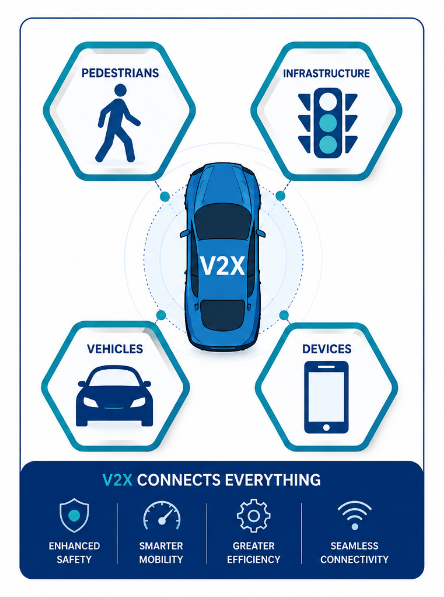
By combining these communication capabilities, V2X can provide vehicles with information beyond what conventional cameras, radar, and other onboard sensors can detect.
DSRC vs. C-V2X
DSRC and C-V2X are two technologies developed to enable V2X communication, but they use different communication architectures.
DSRC
Dedicated Short-Range Communications (DSRC) is based on IEEE 802.11p and was specifically designed for wireless communication between vehicles and roadside infrastructure.
DSRC enables direct communication without relying on cellular network infrastructure, making it suitable for low-latency safety applications.
Typical applications include:
- Collision warning
- Emergency braking alerts
- Traffic signal information
- Road hazard notifications
- Vehicle-to-infrastructure communication
C-V2X
Cellular Vehicle-to-Everything (C-V2X) uses cellular technology defined by 3GPP standards and provides both direct and network-based communication.
The PC5 interface enables direct communication between vehicles, infrastructure, and other road users without requiring a cellular network. The Uu interface uses cellular infrastructure for communication between vehicles and network services.
This combination allows C-V2X to support both localized safety applications and longer-range connected mobility applications.
Why V2X Matters for Connected Vehicles
A V2X Connectivity Hub can act as an important communication gateway within a connected vehicle architecture. By exchanging information with surrounding vehicles and infrastructure, it can extend the vehicle’s awareness beyond its onboard sensor range.
V2X can support several important use cases:
Improved Road Safety
Vehicles can receive warnings about hazards that may not yet be visible to the driver or onboard sensors. For example, an approaching emergency vehicle, sudden braking vehicle, road work zone, or vulnerable road user can trigger an early warning.
Intelligent Traffic Management
V2X communication allows traffic infrastructure and vehicles to exchange real-time information.
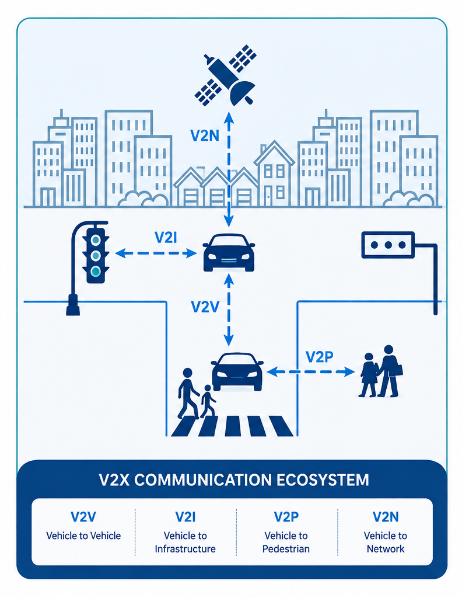
This can support adaptive traffic management, congestion monitoring, traffic signal optimization, and improved route planning.
Enhanced Driving Experience
Connected vehicles can receive information about road conditions, traffic, parking, tolling, and other services, helping drivers make better decisions and improving overall journey efficiency.
Foundation for Automated Driving
V2X can complement cameras, radar, and LiDAR by providing information from external sources. This additional data can contribute to improved situational awareness and support advanced driving and autonomous vehicle applications.
Building a Flexible V2X Connectivity Platform
Automotive OEMs need V2X platforms that can integrate into different vehicle architectures while supporting multiple communication and vehicle interfaces.
iWave’s V2X Connectivity Hub is designed as a scalable platform for connected mobility applications. The platform is based on the NXP i.MX 8XLite processor and supports C-V2X communication, along with multiple vehicle and wireless interfaces.
The platform supports V2V, V2I, and V2P applications and can be positioned for different deployment scenarios, including On-Board Unit (OBU) and Roadside Unit (RSU) applications.
The V2X Connectivity Hub also provides multiple CAN-FD interfaces, cellular connectivity, Wi-Fi, Bluetooth, GNSS, and security features such as an HSM and TPM, making it suitable for integrating V2X communication with broader vehicle systems.
The Road Ahead for Connected Mobility
The evolution of connected mobility will require vehicles, infrastructure, communication networks, and intelligent transportation systems to work together seamlessly. Both communication technology and the supporting hardware ecosystem will play an important role in enabling this transformation.
For automotive OEMs and Tier-1 suppliers, a flexible V2X Connectivity Hub can provide a foundation for developing next-generation connected vehicle platforms and implementing safety, traffic management, and advanced mobility applications.
iWave’s V2X Connectivity Hub provides a ready-to-integrate platform for developing connected mobility solutions, helping automotive developers accelerate the transition toward safer, smarter, and more connected vehicles.
For more information, visit www.iwave-global.com or contact mktg@iwave-global.com
Explore Related Content
- V2X Connectivity Hub: Enabling Safer and Smarter Connected Vehicles
- Telematics Control Unit for Electric Vehicles: Benefits, Features and Applications
