J1939 Protocol Stack for Heavy-Duty Vehicles: Enabling Vehicle Data Collection through FMS
August 20, 2023
Article
J1939 Protocol Stack for Heavy-Duty Vehicles enables reliable access to the large volumes of operational and diagnostic data generated by trucks, buses, construction equipment, and commercial vehicles. This data is essential for fleet management, vehicle diagnostics, predictive maintenance, fuel monitoring, and overall vehicle performance optimization.
However, extracting meaningful information from different electronic control units (ECUs) requires a reliable communication protocol and software interface. SAE J1939 is a widely adopted communication protocol for heavy-duty vehicles that enables ECUs to exchange information over a CAN-based network. By implementing a J1939 Protocol Stack, telematics devices and fleet management systems can access, interpret, and utilize vehicle data for connected vehicle applications.
What is SAE J1939?
SAE J1939 is a higher-layer protocol built on the Controller Area Network (CAN) standard and is widely used in commercial and heavy-duty vehicles.
The protocol defines how vehicle ECUs communicate by specifying message formats, parameter groups, addressing, data transmission, and diagnostic communication.
A J1939-enabled system can therefore retrieve information from different vehicle subsystems and make it available to an external telematics or fleet management application.
Typical parameters include:
- Engine speed
- Vehicle speed
- Fuel consumption
- Engine operating hours
- Coolant temperature
- Vehicle operating conditions
- Diagnostic information
- Transmission parameters
- Vehicle status
How the J1939 Protocol Stack Enables Vehicle Data Collection
A J1939 Protocol Stack acts as the software layer between the vehicle’s CAN network and the application running on a telematics device or embedded platform.
The stack receives J1939 messages from the vehicle network, interprets the message structure, and provides the required parameters to the application through software APIs.
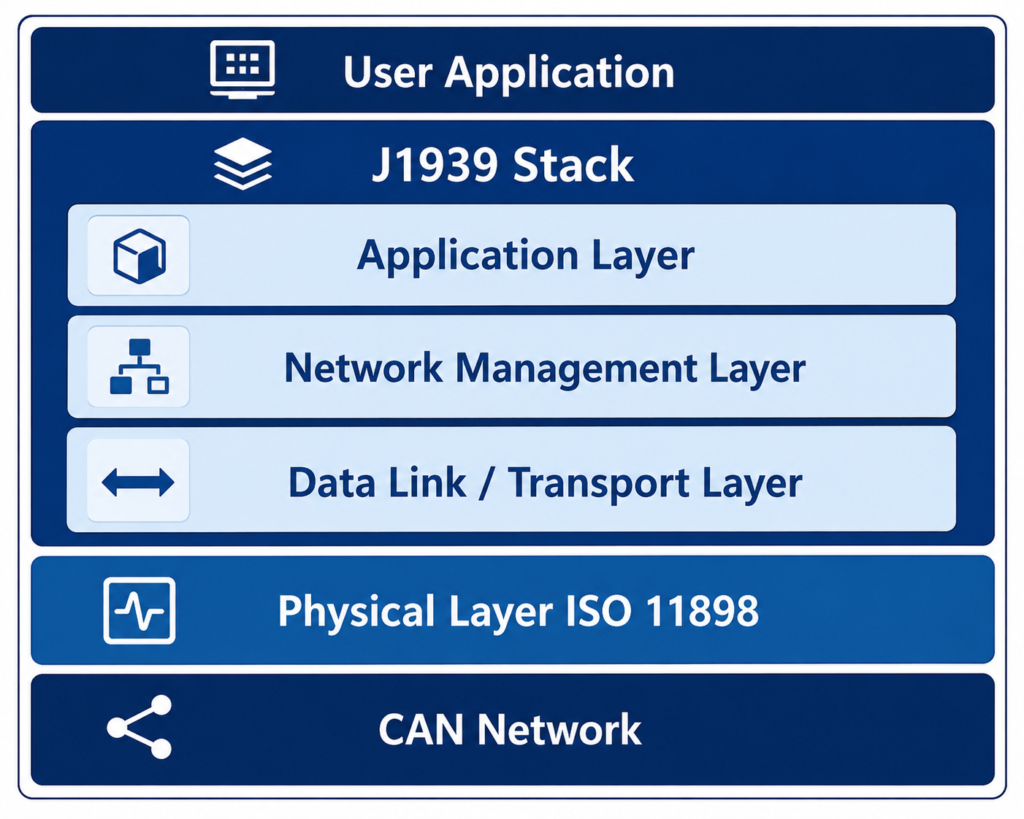
A J1939 Protocol Stack acts as the software layer between the vehicle’s CAN network and the application running on a telematics device or embedded platform.
The stack receives J1939 messages from the vehicle network, interprets the message structure, and provides the required parameters to the application through software APIs.
J1939 and the FMS Interface
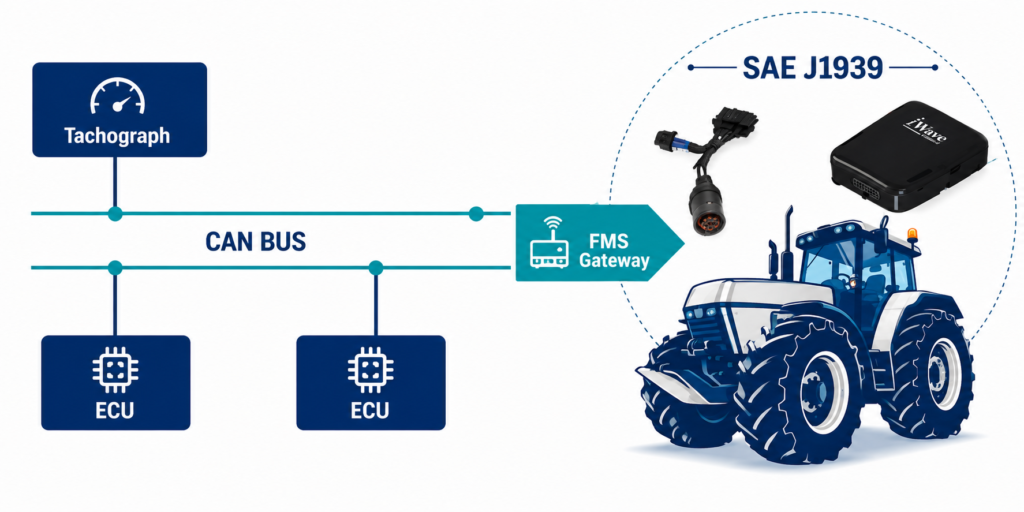
The Fleet Management System (FMS) interface provides standardized vehicle information that can be accessed by external fleet management and telematics systems.
By interfacing a telematics device with the vehicle through the FMS interface, vehicle operating parameters can be collected and transmitted to a fleet management platform.
The collected information can subsequently be used for:
- Fleet monitoring
- Driver behaviour analysis
- Fuel management
- Vehicle utilization analysis
- Preventive maintenance
- Predictive maintenance
- Vehicle diagnostics
- Operational efficiency analysis
Why J1939 is Important for Heavy-Duty Vehicle Telematics
Heavy-duty vehicles typically contain multiple ECUs responsible for functions such as engine control, transmission, braking, and other vehicle systems.
A telematics solution needs to communicate reliably with these systems to obtain meaningful vehicle information.
A J1939 software stack simplifies this integration by handling protocol-level communication and providing application-level access to vehicle parameters.
This makes J1939 particularly useful for:
Fleet Management
Vehicle parameters can be collected continuously and transmitted to a centralized fleet management platform, providing fleet operators with real-time visibility into vehicle performance and utilization.
Vehicle Diagnostics
Diagnostic information can be retrieved from the vehicle network to help identify potential faults and maintenance requirements.
Fuel and Efficiency Monitoring
Engine and fuel-related parameters can be analysed to understand fuel consumption, identify inefficient driving patterns, and optimize fleet operations.
Predictive Maintenance
Historical vehicle data can be analysed to identify abnormal operating conditions and potential failures before they result in significant downtime.
iWave J1939 Protocol Stack
iWave’s J1939 Protocol Stack is designed to enable communication with heavy-duty vehicle networks and simplify vehicle data collection for telematics applications.
The stack can be integrated into an embedded platform to receive and decode J1939 messages and provide relevant vehicle parameters to the application layer.
Its software-based architecture provides flexibility for customization based on the requirements of the target vehicle and telematics application.
The solution can therefore serve as a software foundation for applications such as fleet management, vehicle diagnostics, remote monitoring, and heavy-duty vehicle telematics.
Building Connected Heavy-Duty Vehicles with J1939
The combination of a J1939 Protocol Stack, telematics hardware, wireless connectivity, and cloud-based analytics creates a complete connected vehicle architecture.
Vehicle data collected through J1939 can be processed locally on the telematics device and transmitted to cloud platforms for further analysis.
This enables fleet operators to move from basic vehicle tracking toward data-driven fleet management, where vehicle health, efficiency, utilization, and maintenance can be monitored continuously.
For OEMs and telematics solution providers, a ready-to-integrate J1939 Protocol Stack can reduce software development effort and accelerate the deployment of connected heavy-duty vehicle solutions.
J1939 provides a standardized communication framework for exchanging information between ECUs in heavy-duty vehicles. When combined with a J1939 Protocol Stack, the vehicle’s operational and diagnostic data can be efficiently accessed by telematics applications.
iWave’s expertise in J1939 protocol stack development, embedded software, CAN-based communication, and telematics solutions provides a foundation for developing connected heavy-duty vehicle and fleet management applications.
By bridging the vehicle network and telematics application, a J1939 Protocol Stack enables the data required to build smarter, more efficient, and better-connected heavy-duty fleets.
For more information, visit www.iwave-global.com or contact mktg@iwave-global.com
