Inter-Process Communication in i.MX 8 Using RPMsg and OpenAMP
September 4, 2023
Article
Inter-Process Communication in i.MX 8 can use RPMsg and OpenAMP to facilitate communication between application processors and remote processing environments.
RPMsg provides a message-based communication mechanism between processors. OpenAMP provides a framework for managing communication and interaction between asymmetric processing environments.
This architecture can allow a Linux application to communicate with firmware running on a real-time processor without requiring both workloads to operate within the same operating environment.
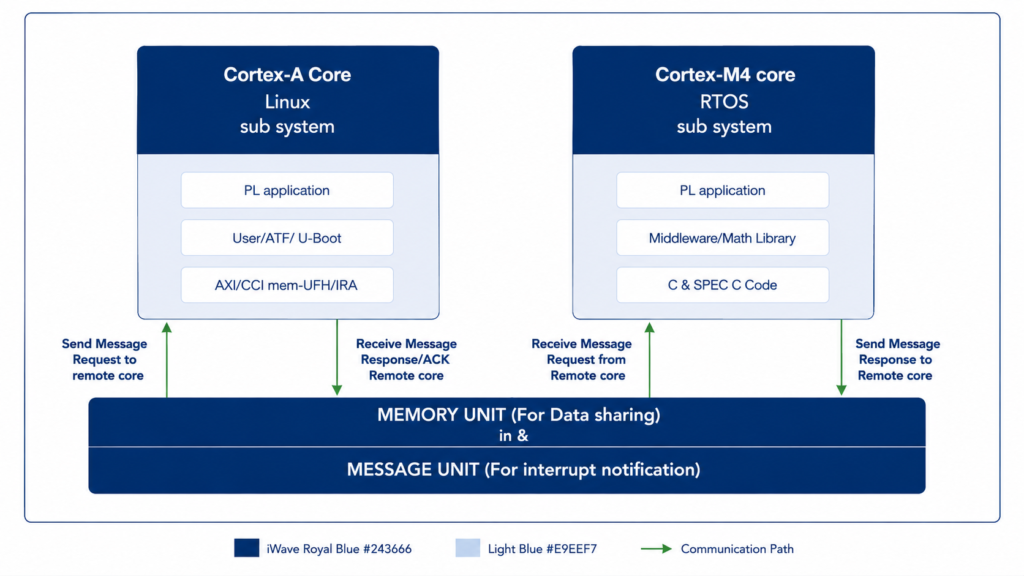
A typical implementation can involve:
- Linux application
- Remote processor framework
- RPMsg
- VirtIO
- Shared memory
- Remote firmware
This makes RPMsg and OpenAMP useful for applications that require Linux-based processing alongside deterministic real-time workloads.
Inter-Process Communication in i.MX 8 for Real-Time Applications
Inter-Process Communication in i.MX 8 is particularly useful when an application combines high-level computing with time-sensitive control.
For example, an industrial system can use the application processor for:
- Linux operating system
- Graphical user interface
- Networking
- Data logging
- Application software
At the same time, a real-time processor can handle:
- Sensor processing
- Control algorithms
- Time-critical I/O
- Motor or machine control
- Real-time communication
IPC connects these processing domains, allowing each processor to focus on the workload for which it is best suited.
Inter-Process Communication in i.MX 8 Using Shared Memory
Inter-Process Communication in i.MX 8 can also leverage shared memory for applications that require efficient exchange of larger data sets.
Instead of transferring large amounts of information through individual messages, processors can use a shared memory region to exchange data while IPC mechanisms handle synchronization and control information.
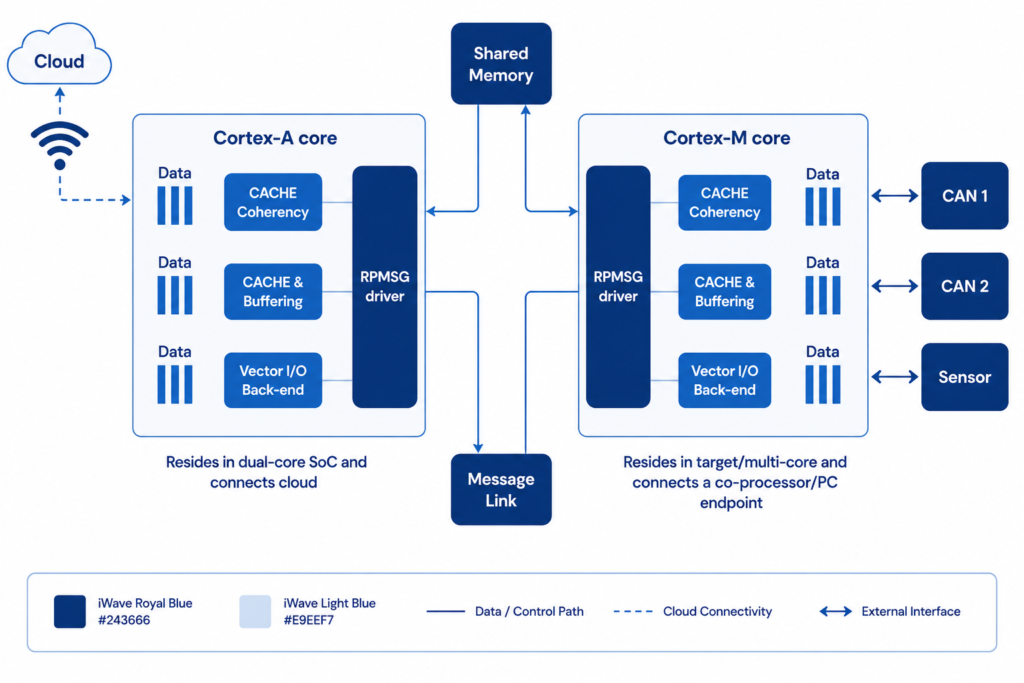
This approach can be useful for:
- Audio data
- Video frames
- Sensor data
- Image processing
- Industrial data
- Multimedia applications
The combination of shared memory and message-based communication can provide an efficient architecture for applications requiring both high data throughput and processor coordination.
Inter-Process Communication in i.MX 8 for Embedded Applications
Inter-Process Communication in i.MX 8 can support a broad range of embedded applications where multiple processing environments need to operate together.
Industrial Systems
Industrial applications can combine Linux-based HMIs, networking, data processing, and cloud connectivity with real-time control. IPC enables these workloads to communicate while maintaining separation between high-level applications and time-critical functions.
Automotive Systems
Automotive applications such as gateways, infotainment systems, HMIs, telematics, and vehicle interfaces can benefit from heterogeneous processing. IPC can connect Linux-based applications with real-time communication and control functions.
Multimedia Systems
Multimedia platforms may need to coordinate audio, video, display, application, and connectivity workloads. IPC provides a mechanism for exchanging control information and data between these processing environments.
Benefits of Inter-Process Communication in i.MX 8
Implementing Inter-Process Communication in i.MX 8 solutions can provide several benefits:
Efficient Workload Distribution: Processing tasks can be assigned to different cores based on their requirements.
Real-Time Performance: Time-critical workloads can run independently on real-time processing cores.
Improved Responsiveness: High-level applications and real-time functions can operate concurrently.
Flexible Software Architecture: Linux applications and real-time firmware can be developed separately while maintaining communication.
Efficient Data Exchange: Message-based IPC and shared memory can support different communication requirements.
Scalable System Design: Developers can build application architectures around the heterogeneous processing resources available in the i.MX 8 family.
Inter-Process Communication in i.MX 8 with iWave Solutions
iWave offers a portfolio of i.MX 8-based System-on-Modules and development platforms for industrial, automotive, multimedia, and other embedded applications. Its i.MX 8 portfolio includes solutions based on processors such as the i.MX 8QuadMax/QuadPlus and i.MX 8M Mini/Nano families.
These platforms provide the processing resources and interfaces required to build heterogeneous embedded systems. iWave’s embedded software expertise, including BSP and Linux development, can further support application-specific implementation of multi-processor communication architectures.
Inter-Process Communication in i.MX 8 provides an effective way to connect application and real-time processing environments within heterogeneous embedded systems. By combining technologies such as RPMsg, OpenAMP, and shared memory, developers can distribute workloads while maintaining efficient communication between processors.
This architecture is valuable for industrial, automotive, multimedia, HMI, and other applications that require both high-level computing and real-time processing. With i.MX 8-based SoMs and embedded software expertise, iWave enables developers to build flexible and application-specific embedded platforms.
For more information, visit www.iwave-global.com or contact mktg@iwave-global.com
Explore Related Content
- Enabling Native RTOS on Cortex-A for Real-Time Edge Performance
- Enabling Jailhouse on NXP SoM from iWave for Real-Time Embedded Systems
