eMMC 5.1: Achieving High-Speed Storage Performance up to 3.2 Gbps
September 2, 2023
Article
eMMC 5.1 is designed to meet the growing storage demands of modern embedded systems, which handle increasing volumes of operating system files, application software, multimedia content, AI workloads, and system logs. As embedded platforms become more powerful, storage performance plays a critical role in overall system responsiveness, reliability, and efficiency.
With support for the HS400 operating mode, eMMC 5.1 offers interface bandwidth of up to 3.2 Gbps (400 MB/s), making it well suited for embedded applications that require fast, reliable, and efficient storage.
Unlike removable storage solutions, eMMC combines NAND flash memory and a dedicated controller in a single package. This integrated architecture simplifies system design and reduces implementation complexity while providing a standardized storage interface for a wide range of embedded platforms.
Why eMMC 5.1 Is Important for Embedded Systems
Embedded systems often operate under strict requirements for size, power consumption, reliability, and performance. Storage must therefore deliver sufficient throughput while occupying minimal board space and requiring limited design effort.
eMMC 5.1 provides an integrated storage solution that combines NAND flash memory with an embedded controller. This reduces the complexity associated with managing raw NAND while offering standardized communication between the processor and storage device.
The compact form factor and integrated architecture make eMMC 5.1 particularly suitable for:
- System-on-Modules (SoMs)
- Single Board Computers (SBCs)
- Industrial embedded systems
- Automotive electronics
- Human-machine interfaces (HMIs)
- Edge computing platforms
- Robotics systems
- Portable devices
- AI and vision platforms
How eMMC 5.1 Achieves High-Speed Data Transfer
A key feature of eMMC 5.1 is its support for the HS400 high-speed operating mode.
HS400 uses an 8-bit data bus and operates at a clock frequency of up to 200 MHz with double data rate signaling. This enables a theoretical interface bandwidth of up to 400 MB/s or 3.2 Gbps.
This increased bandwidth can improve data transfer between the processor and embedded storage, particularly in applications that frequently read or write large volumes of data.
The actual performance achieved by an embedded system depends on several factors, including:
- eMMC device capabilities
- Host controller implementation
- PCB layout and signal integrity
- Operating system and driver stack
- File-system performance
- Read/write workload
- Processor and memory architecture
Therefore, the 3.2 Gbps figure should be viewed as the interface’s theoretical maximum rather than a guaranteed application-level throughput.
eMMC 5.1 HS400 Mode for High-Performance Storage
The HS400 mode is one of the key performance enhancements associated with eMMC 5.1.
With HS400, data is transferred using an 8-bit DDR interface at up to 200 MHz. This allows the interface to achieve a theoretical bandwidth of 400 MB/s.
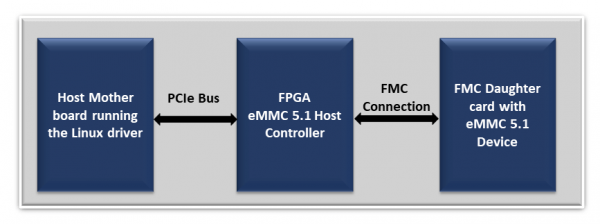
For embedded applications, higher storage bandwidth can help reduce data-transfer bottlenecks and improve system responsiveness when handling:
- Large application files
- Operating system images
- Multimedia data
- Sensor data
- AI and machine-learning datasets
- Video recordings
- Application logs
- Firmware images
eMMC 5.1 Command Queuing for Efficient Data Access
Another important capability of eMMC 5.1 is command queuing.
Command queuing allows multiple data operations to be organized and processed more efficiently, helping reduce software overhead and improve storage utilization in suitable workloads. eMMC 5.1 also introduced features intended to improve storage-management efficiency compared with earlier generations.
This can be beneficial for embedded systems running multiple applications or handling concurrent storage operations.
eMMC 5.1 Reliability and Embedded Storage Management
Storage reliability is particularly important in embedded products that may operate continuously for extended periods.
eMMC 5.1 integrates a flash memory controller within the package, allowing the device to handle several low-level NAND management functions internally. This reduces the burden on the host processor and simplifies software development compared with directly interfacing the processor with raw NAND flash.
Depending on the device implementation, eMMC solutions can also provide capabilities such as:
- Bad-block management
- Wear levelling
- Error correction
- Boot partitions
- Secure data handling
- Device health information
- Firmware update support
These capabilities help make eMMC a practical storage technology for long-life embedded products.
eMMC 5.1 Boot Support for Embedded Platforms
Embedded processors frequently require non-volatile storage for boot firmware, operating systems, and application software.
eMMC 5.1 provides dedicated boot-related capabilities that allow embedded platforms to store and access boot information directly from the eMMC device. This can simplify system architecture by combining boot storage and application storage within a single device.
For System-on-Modules and embedded computing platforms, this can help reduce the number of external storage components required on the carrier board.
eMMC 5.1 vs Earlier eMMC Generations
The evolution of eMMC technology has progressively increased storage performance and added new capabilities.
Compared with earlier generations, eMMC 5.1 provides higher-performance operating modes and additional features aimed at improving storage efficiency. The HS400 mode is particularly significant because it enables theoretical interface bandwidth of up to 400 MB/s.
eMMC 5.1 also maintains backward compatibility with earlier eMMC generations, supporting migration and integration across different embedded platforms.
eMMC 5.1 for System-on-Modules
System-on-Modules require compact, reliable, and high-performance storage solutions without significantly increasing board complexity.
eMMC 5.1 is well suited to SoM designs because the memory and controller are integrated into a single package. This allows the storage subsystem to be implemented directly on the module while leaving the carrier board available for application-specific interfaces and peripherals.
For SoM-based designs, eMMC 5.1 can provide:
- Compact storage implementation
- High-speed data transfer
- Simplified hardware integration
- Reduced external component count
- Boot and operating-system storage
- Reliable embedded storage
- Scalable storage capacity options
eMMC 5.1 for Industrial and Embedded Applications
The combination of performance, compactness, and integration makes eMMC 5.1 suitable for a broad range of embedded applications.
Typical applications include:
Industrial Automation with eMMC 5.1
Industrial controllers, gateways, HMIs, and edge devices can use eMMC 5.1 to store operating systems, applications, configuration data, and system logs.
Automotive Systems with eMMC 5.1
Automotive computing platforms can use eMMC 5.1 for storing software, maps, system data, infotainment content, and other embedded applications where compact storage is required.
Edge Computing with eMMC 5.1
Edge devices increasingly process data locally rather than transmitting everything to the cloud. eMMC 5.1 can provide local storage for operating systems, applications, AI models, sensor data, and system logs.
Vision and Multimedia Systems with eMMC 5.1
Embedded vision systems can generate significant quantities of image and video data. High-speed eMMC 5.1 storage can support local data storage in compact vision platforms.
Designing a High-Performance eMMC 5.1 Interface
Achieving the maximum benefits of eMMC 5.1 requires careful attention to hardware and software design.
At high data rates, PCB design and signal integrity become particularly important. Designers need to consider:
- Controlled impedance routing
- Signal trace lengths
- Clock and data timing
- Power integrity
- Proper termination and layout practices
- High-speed PCB design guidelines
- Host-controller compatibility
- Software and driver configuration
The storage device, processor, and PCB implementation must work together to achieve reliable high-speed operation.
Benefits of eMMC 5.1 for Embedded System Design
eMMC 5.1 provides several advantages for embedded product developers:
High-Speed Performance: HS400 enables theoretical interface bandwidth of up to 3.2 Gbps.
Compact Integration: NAND flash and the controller are integrated into a single package.
Simplified Design: The integrated controller reduces the complexity of managing raw NAND flash.
Boot Support: Dedicated boot functionality supports embedded processor boot requirements.
Reliable Storage: Integrated flash-management capabilities help improve storage reliability.
Lower Board Complexity: Integrating storage on the module can reduce the number of external components required.
Wide Application Support: eMMC 5.1 can be used across industrial, automotive, multimedia, edge computing, and other embedded applications.
eMMC 5.1 for Next-Generation Embedded Systems
As embedded platforms continue to process more data locally, storage performance is becoming increasingly important. From edge AI and industrial automation to automotive electronics and embedded vision, systems require storage solutions that balance speed, reliability, size, and integration.
eMMC 5.1 provides a practical high-speed embedded storage solution with support for HS400 and theoretical interface bandwidth of up to 3.2 Gbps. Its integrated controller, compact implementation, and embedded storage capabilities make it a strong option for space-constrained and performance-oriented embedded designs.
For developers building next-generation embedded platforms, integrating eMMC 5.1 at the SoM or system level can provide the storage performance and integration required for increasingly data-intensive applications.
For more information, visit www.iwave-global.com or contact mktg@iwave-global.com
