Event Data Retrieval for Automotive EDR Systems: Simplifying Access to Critical Vehicle Data
October 13, 2026
Article
Event Data Retrieval is essential for understanding what happens during a vehicle incident. Imagine a sudden collision on a busy highway. In a matter of seconds, everything changes but what if the vehicle could tell us the story behind those critical moments? How fast was it moving? Were the brakes applied? What happened just before the impact?
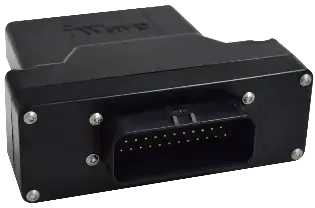
An iG-G26I®-EDR Event Data Recorder (EDR) helps answer these questions by capturing and storing key vehicle and sensor data surrounding a triggered event. Much like a digital witness, it provides valuable insights into vehicle behavior before, during, and after an incident, supporting accident investigation, vehicle safety analysis, and engineering validation.
At iWave, we offer an EDR solution designed to support reliable vehicle event recording and efficient Event Data Retrieval. By simplifying access to critical vehicle data, the iWave EDR helps engineers transform recorded events into actionable insights for enhanced vehicle safety, smarter diagnostics, and informed engineering decisions.
Solution Highlights:
- UNECE R169 compliance for M2, M3, N2, and N3 vehicle categories
- UNECE R160 compliance for M1 and N1 vehicle categories
- Crash detection & event logging in accordance with UNECE R169 & R160
- Capture of critical vehicle data before, during, and after a crash event
- Crash test validation in accordance with UNECE R100 requirements
- E-mark certification for automotive regulatory compliance
- Compliance with UNECE R10 electromagnetic compatibility (EMC) requirements
- Cybersecurity compliance aligned with UNECE R155, UNECE R156, and ISO/SAE 21434 requirements
Efficient EDR Event Data Retrieval Approaches
Once an event is recorded, retrieving the stored data is essential to understanding vehicle behavior and analyzing the moments surrounding an incident. iWave iG-G26I®-EDR offers two data retrieval methods USB-based and CAN-based giving engineers flexibility in accessing critical event data according to their application and diagnostic requirements.
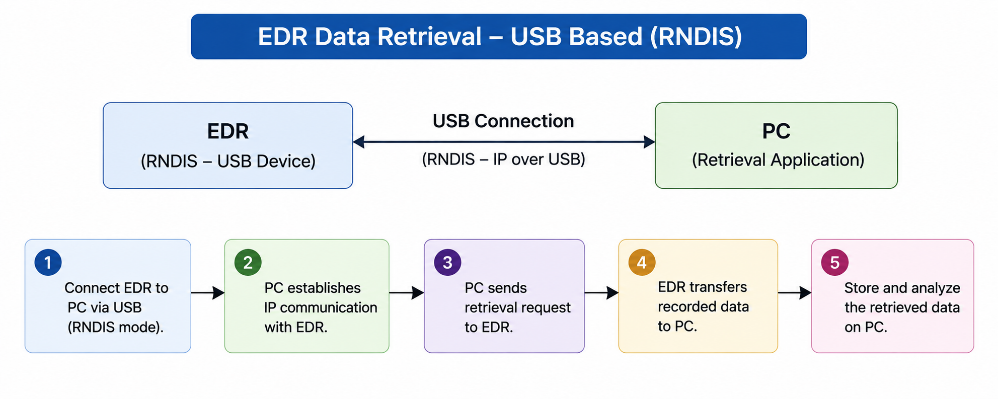
1. USB-Based Data Retrieval:
Designed for convenient access, USB-based retrieval enables engineers to connect the iWave iG-G26I®-EDR directly to a PC without requiring a separate vehicle-level retrieval tool.
The connection uses Remote Network Driver Interface Specification (RNDIS) technology to establish a network link between the EDR and the PC. Once connected, the PC can request the recorded event data, which is transferred in a password-protected ZIP file for subsequent analysis.
By combining direct connectivity with a straightforward data transfer process, this approach reduces hardware dependencies and simplifies access to stored event information. It is particularly useful in engineering and testing environments where recorded data needs to be retrieved efficiently for investigation, validation, and analysis.
Key benefits:
- Direct PC connectivity: Access recorded event data through a USB connection.
- Simplified communication: Establish a network link between the EDR and PC using RNDIS.
- Protected data transfer: Retrieve event data in a password-protected ZIP file.
- Streamlined workflow: Reduce the need for additional retrieval hardware and simplify engineering data access.
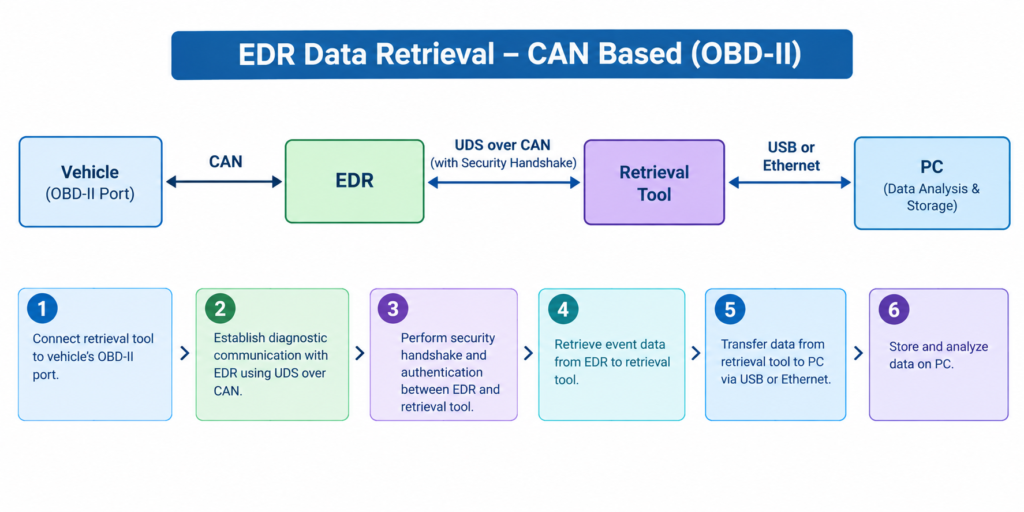
2. CAN-Based Data Retrieval: Flexible, Secure, and Diagnostic-Ready
For applications that require access through the vehicle’s diagnostic interface, the iWave iG-G26I®-EDR supports CAN-based data retrieval using a dedicated retrieval tool connected through the vehicle’s OBD-II interface.
The retrieval tool communicates with the EDR over the Controller Area Network (CAN) bus using Unified Diagnostic Services (UDS). The process incorporates the necessary security procedures to enable authorized access to recorded event data, supporting a controlled and structured retrieval workflow.
Following successful retrieval, the event data is transferred to a PC through a supported USB or Ethernet connection, where it can be examined for incident investigation, diagnostic assessment, and engineering analysis.
By leveraging established automotive diagnostic communication, this approach provides a practical alternative to direct USB access, particularly when retrieval is performed at the vehicle level or as part of a diagnostic workflow.
Key benefits:
- Vehicle-level access: Retrieve event data through the vehicle’s OBD-II diagnostic interface.
- Standardized communication: Use CAN-based communication and UDS for data retrieval.
- Controlled data access: Incorporate security procedures to support authorized retrieval.
- Flexible data transfer: Transfer retrieved information to a PC through supported USB or Ethernet connectivity.
Engineering ready analysis: Make recorded event data available for further investigation and diagnostics.
Retrieved Event Data and Event Log Format
The iWave iG-G26I®-EDR stores recorded data on an event by event basis, with each triggered event saved as a separate Excel file. Each file contains relevant vehicle data and sensor readings captured before, during, and after the event.
The recorded information includes vehicle data received through CAN and sensor data from the integrated Inertial Measurement Unit (IMU). Each data sample is associated with its corresponding timestamp relative to the event trigger, helping engineers understand vehicle behavior and correlate information from different data sources.
The retrieved event files can be transferred to a PC for viewing, analysis, and reporting. This allows engineers to review recorded events and better understand vehicle and sensor responses during an incident.
Turning Recorded Events into Actionable Insights
With flexible USB & CAN based data retrieval, iWave EDR helps user access critical event information for detailed analysis and informed decision making. By simplifying access to recorded vehicle data, the solution supports accident investigation, vehicle diagnostics, safety analysis, and engineering validation. iWave EDR bridges the gap between vehicle event recording and actionable engineering insights, helping advance smarter diagnostics and safer vehicle development.
