Choosing the Right Telematics Gateway for Connected Vehicles
August 6, 2023
Article
The rapid evolution of connected mobility is transforming the automotive industry. Modern vehicles are no longer standalone machines—they continuously exchange data with cloud platforms, infrastructure, fleet management systems, and other vehicles to improve safety, efficiency, and user experience.
At the heart of this connected ecosystem is the telematics gateway, an intelligent in-vehicle computing platform that securely collects, processes, and transmits vehicle data in real time. Selecting the right gateway is essential for building reliable, scalable, and future-ready connected vehicle solutions.
This article explores the key capabilities of a telematics gateway, the factors to consider when choosing one, and how iWave’s telematics solutions simplify connected vehicle development.
What is a Telematics Gateway?
A telematics gateway acts as the central communication hub within a vehicle. It gathers data from multiple Electronic Control Units (ECUs), onboard sensors, and communication interfaces, processes the information locally, and securely exchanges it with cloud platforms and backend applications.
Beyond data collection, a modern gateway enables remote diagnostics, predictive maintenance, fleet management, over-the-air (OTA) software updates, vehicle health monitoring, and advanced connected services.
Essential Features of a Modern Telematics Gateway
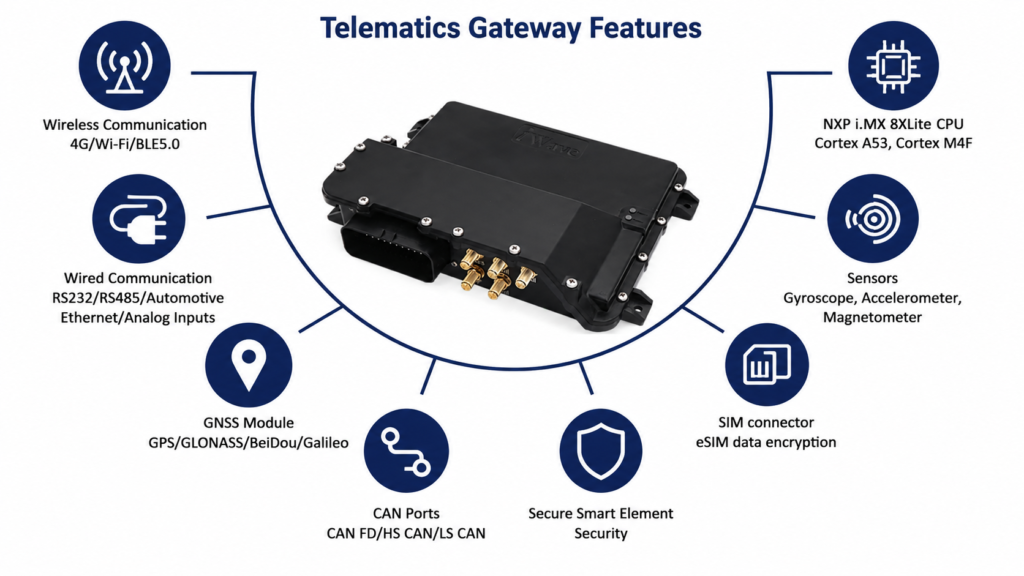
High-Speed Wireless Connectivity
Reliable wireless communication is fundamental to connected vehicles. A telematics gateway should support multiple communication technologies to ensure uninterrupted connectivity across different deployment environments.
Typical connectivity options include:
- 4G LTE Cat 4 and Cat M1
- Wi-Fi (802.11 a/b/g/n/ac with optional Wi-Fi 6 support)
- Bluetooth® Low Energy (BLE) 5.0
- Ultra-Wideband (UWB)
These technologies enable seamless communication between the vehicle, cloud platforms, mobile applications, and remote servers.
Comprehensive Wired Interfaces
Modern vehicles require communication with numerous onboard systems. A feature-rich gateway should provide multiple wired interfaces, including:
- CAN and CAN-FD
- Automotive Ethernet
- RS232
- RS485
- Analog Inputs
These interfaces enable reliable communication with ECUs, sensors, ADAS components, industrial equipment, and external peripherals.
High-Performance Embedded Processing
An automotive-grade processor forms the foundation of a telematics gateway. Multi-core processing architectures with application and real-time cores enable simultaneous execution of vehicle control, communication, edge analytics, and security functions.
For example, gateways based on the NXP i.MX 8 DualXLite processor combine 64-bit ARM processing with low-power operation, making them suitable for advanced fleet management and connected mobility applications.
Accurate Global Positioning
Location intelligence is essential for fleet operations, navigation, asset tracking, and emergency response.
Support for multiple Global Navigation Satellite Systems (GNSS), including GPS, GLONASS, Galileo, and BeiDou, delivers accurate positioning across different geographic regions.
Real-Time Vehicle Diagnostics
A telematics gateway should support multiple CAN-FD interfaces capable of high-speed communication with vehicle ECUs.
Support for industry-standard protocols such as:
- SAE J1939
- ISO 15765
- ISO 11898
- CANopen
- CiA 447
enables real-time diagnostics, vehicle health monitoring, and predictive maintenance for passenger vehicles, commercial fleets, agricultural equipment, and heavy-duty machinery.
Integrated Motion Sensors
Built-in inertial sensors—including accelerometers, gyroscopes, and magnetometers—enable continuous monitoring of vehicle movement and operating conditions.
These sensors support:
- Driver behaviour analysis
- Crash detection
- Motion tracking
- Vehicle orientation
- Automatic calibration
Flexible SIM and Cellular Connectivity
Support for embedded SIM (eSIM) technology simplifies global deployment while improving network flexibility.
Features such as multiple IMSI support and remote SIM profile management allow seamless operator switching and secure connectivity across regions.
Advanced Security Architecture
Cybersecurity is a critical requirement for connected vehicles. A secure telematics gateway should incorporate hardware- and software-based security mechanisms that protect both the device and vehicle data.
Essential security features include:
- Hardware Secure Element
- Secure Boot
- Secure Storage
- Trusted Application Execution
- Encrypted Communication
- Wi-Fi Security
These capabilities help prevent unauthorized access while ensuring data confidentiality and system integrity.
Factors to Consider When Selecting a Telematics Gateway
Choosing the right gateway depends on the application, deployment environment, and future scalability requirements.
Connectivity Requirements
Different vehicle platforms demand different communication technologies. Select a gateway that supports a wide range of wireless and wired interfaces to accommodate evolving connectivity needs and future upgrades.
Data Acquisition Capabilities
Vehicles generate large volumes of information from ECUs, sensors, cameras, and onboard networks. A modular gateway with support for multiple industrial and automotive interfaces ensures compatibility across different vehicle architectures.
Software Scalability
A robust software platform reduces development effort while enabling remote device management, diagnostics, firmware updates, and fleet-wide monitoring.
Look for gateways that support scalable middleware, cloud integration, and customizable software frameworks.
Deployment Environment
Vehicles operating in industrial sites, agriculture, mining, logistics, or construction often experience harsh environmental conditions. Rugged hardware with reliable thermal performance and vibration resistance improves long-term system reliability.
Why Choose iWave Telematics Solutions?
iWave develops automotive-grade telematics gateways that combine robust hardware, flexible software, and extensive customization capabilities.
Certified for Global Deployment
iWave telematics gateways comply with major international certification requirements, including FCC, CE, and ISED. Support for region-specific certifications such as E-Mark and KOMINFO is also available to accelerate global product deployment.
Accelerated Development
Well-documented APIs and software development support simplify application integration, reducing development complexity and shortening time-to-market.
Flexible Customization
To address diverse customer requirements, iWave offers hardware and software customization services, including:
- Interface modifications
- Custom enclosure design
- Branding options
- Feature enhancements
- Project-specific configurations
Built-In Security
Security is integrated throughout the platform, with support for secure boot, secure storage, encrypted communication, and hardware-assisted protection against unauthorized access.
Real-World Applications
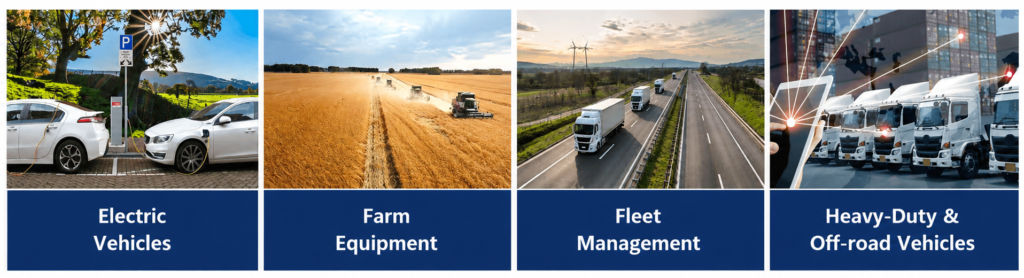
Electric Vehicles
Telematics gateways continuously collect battery status, charging information, and vehicle diagnostics, enabling predictive maintenance and optimized energy management for electric vehicles.
Farm Equipment
Agricultural machinery equipped with telematics gateways can transmit operational data, equipment health, fuel consumption, and location information, helping improve productivity and resource utilization.
Fleet Management
Fleet operators benefit from real-time vehicle monitoring, route optimization, remote diagnostics, maintenance scheduling, and driver behaviour analysis, resulting in improved operational efficiency and reduced downtime.
Heavy-Duty & Off-road Vehicles
Construction equipment, mining vehicles, forklifts, buses, and heavy-duty trucks rely on J1939-based diagnostics to monitor engine performance, identify faults, and improve vehicle availability through predictive maintenance.
As connected vehicle technologies continue to evolve, telematics gateways have become an essential component for enabling secure communication, intelligent diagnostics, fleet optimization, and cloud connectivity.
By combining powerful processing, comprehensive connectivity, robust security, and flexible customization, iWave’s telematics gateways help OEMs and solution providers accelerate the development of reliable, scalable, and future-ready connected mobility solutions.
For more information, visit www.iwave-global.com or contact mktg@iwave-global.com
Explore Related Content
- Deterministic In-Vehicle Networking: TSN and gPTP for Telematics Gateways
- Understanding 100BASE-T1 & 1000BASE-T1: The Ethernet Backbone of Modern Telematics Gateways
- Enabling Secure OTA Updates and Smart Telematics for Electric Vehicles with iWave’s Telematics Gateways
