Accelerating iW-Fibre Cards with DPDK with IP Flow Classification, Firewalling and Segmentation
July 29, 2025
Article
The demand for ultra-fast, secure and intelligent networking has never been greater. With skyrocketing data traffic across hyperscale data centers and edge computing platforms, networks must now support deterministic performance, fine-grained traffic control and robust security all without introducing bottlenecks. iWave’s latest advancement integrating the Data Plane Development Kit (DPDK) into the iW-Fibre SmartNIC platform, supercharges packet processing with IP Flow Classification, Firewalling and Segmentation at line rate.
Designed for next-generation networking workloads, this platform combines DPDK’s high-speed user-space packet processing capabilities with iW-Fibre’s flexible FPGA-powered SmartNIC architecture. The result is a programmable, scalable and secure network acceleration solution tailored for industrial and enterprise applications.
Industry Challenges in Network Processing
Today’s networking workloads extend far beyond traditional data transfer. Tasks like deep packet inspection (DPI), stateful firewalling, microsegmentation and intelligent flow classification require compute-intensive operations on a per-packet basis at different line rates. Conventional server-based NICs or fixed-function ASICs struggle to meet these evolving demands, facing major challenges such as:
- Excessive CPU overhead from kernel-based packet processing and interrupt storms.
- Latency spikes due to context switches and inefficient memory copies
- Static functionality limiting adaptability to new protocols and security threats.
- Lack of fine-grained flow control for policy-based routing and segmentation
To address this, operators are turning toward SmartNICs—network interface cards equipped with programmable logic and dedicated data-plane engines. Yet even many commercial SmartNICs fall short in adaptability and openness. That’s where iW-Fibre with DPDK sets a new standard.
IP Firewalling with DPDK on iWave SmartNICs
As part of our evaluation of the iW-Fibre SmartNIC cards, we tested and validated IP-level firewalling using the DPDK framework.
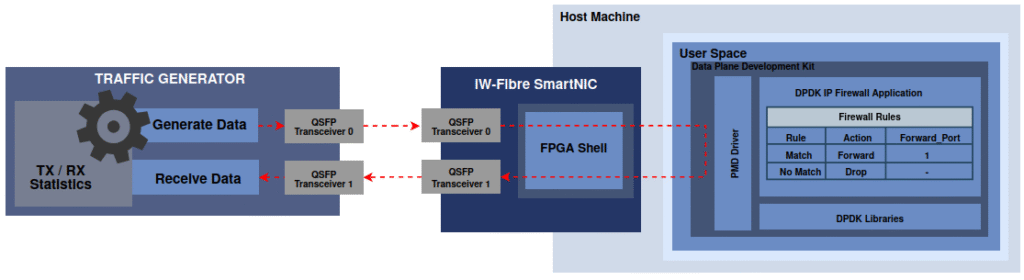
IP Firewall
The above figure shows the test setup involved a Traffic Generator using DPDK’s pktgen to send packets the Host Machine equipped with an iW-Fibre SmartNIC and running a DPDK-based IP firewall application. The applied rule-based filtering logic to incoming packets based on configured firewall policies, either forwarding or dropping them accordingly. The DPDK firewall functionality supported L3/L4 filtering using source/destination IP addresses, protocols (TCP/UDP) and ports; enforced a default drop policy for unmatched traffic; and forwarded matching packets to designated output ports. In this setup, forwarded packets were looped back to Traffic Generator for traffic validation using packet capture and performance monitoring tools.
Achieved high throughput, typically reaching line rate, confirming its suitability for high-performance network functions. Packet drops for unmatched flows remained consistent and performance was unaffected by the number of filtering rules due to optimized lookup structures.
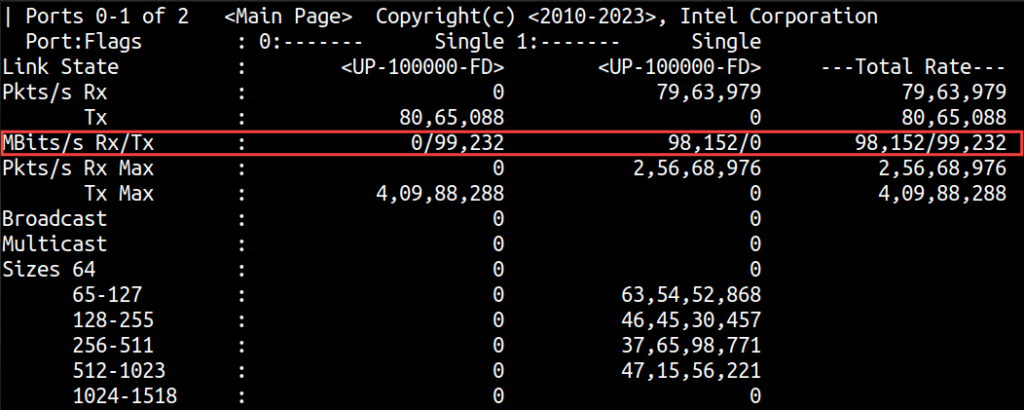
Firewall test result
Above Figures showcase the test results from the IP firewall application, highlighting the G35-XFibre-100G SmartNIC with DPDK ability to sustain line rate throughput for permitted flows while consistently enforcing drop policies for unmatched traffic—all with no performance degradation, even under complex rule sets.
IP Flow Classification with DPDK on iWave SmartNICs
As part of our evaluation, the iWave iW-Fibre SmartNIC was tested with DPDK-based IP Flow Classification—essential for advanced tasks like QoS enforcement, traffic shaping and service chaining.
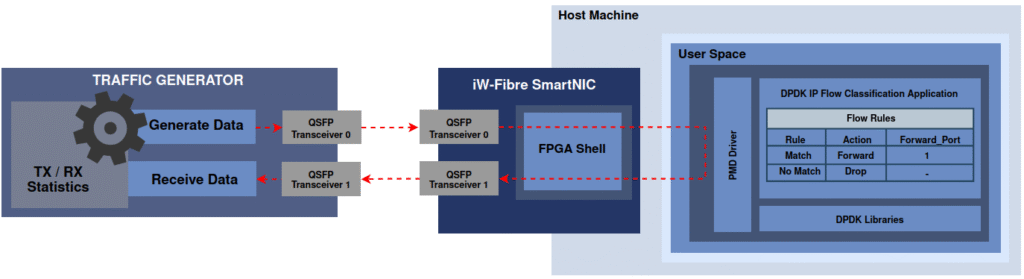
IP Flow Classification
The Figure shows test setup involved a Traffic Generator using DPDK’s pktgen to send packets to a Host Machine equipped with iW-Fibre SmartNIC and DPDK-based IP Flow Classification application. The incoming packets classified into predefined flows based on Layer 3 and Layer 4 parameters, using DPDK’s libraries. This functionality enabled real-time identification and categorization of packets through multi-field matching on IP addresses, ports and protocols, routing them to appropriate ports and prioritizing flow rules to ensure efficient and accurate traffic handling.
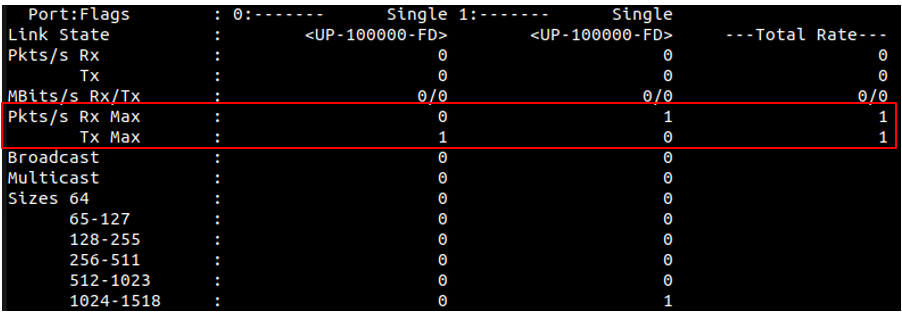
Achieved high-speed classification at line rate under heavy traffic, confirming the SmartNIC’s capability for real-time flow processing. Maintained low-latency decisions and consistent performance even with diverse and concurrent flow rules, demonstrating scalability and flexibility.

IP Flow Classification test result
Figure highlight the test results from the IP flow classification application, demonstrating the G35-XFibre-100G SmartNIC with DPDK’s ability to accurately classify flows at line rate, while consistently enforcing policies across diverse and complex classification rules—without any performance degradation.
IP Segmentation: Fragmentation and Reassembly with DPDK on iWave SmartNICs
Efficient handling of IP packet fragmentation and reassembly is critical for networks supporting diverse MTU sizes. The iW-Fibre SmartNIC, combined with the DPDK framework, enables accelerated IP segmentation tasks, ensuring minimal latency and high throughput. This section describes our testing methodology and key findings regarding IP fragmentation and reassembly.

IP Segmentation
Above Figure shows the test setup involved a Traffic Generator using DPDK’s pktgen to send large packets to Host Machine-1 equipped with iW-Fibre SmartNIC and DPDK-based IP fragmentation application. This application split oversized IP packets (Jumbo packets) into smaller fragments to comply with MTU limits, a critical step for routing across networks with lower MTUs. The fragmented packets were then transmitted to Host Machine-2, which is equipped with an iW-Fibre SmartNIC and DPDK-based reassembly application efficiently reconstructed the original packets, handling out-of-order delivery and delays. Once reassembled, the complete packets were sent back to the Traffic Generator for validation.
IP Segmentation Test Validation
Above Figure highlights the test results from the IP segmentation application, demonstrating the G35-XFibre-100G SmartNIC with DPDK’s ability to fragment and reassemble IP packets efficiently at line rate. The test uses one packets of 1500 bytes (application supports packet sizes up to 9600 bytes) with a MTU size of 500 bytes as fragment size. The same packet is recieved at Traffic Generator after fragmentation and reassembly. The system consistently handled out-of-order fragments and concurrent flows without packet loss or performance degradation.
The SmartNIC efficiently processing fragmented packets, including out-of-order and delayed arrivals. The fragment buffers were optimized to support several concurrent fragmented flows without exhaustion.
The results were obtained from Dell PowerEdge R760 server as Host Machine and Traffic Generator with Mellanox ConnectX5.
The integration of DPDK with iW-Fibre SmartNIC platform enhances overall system performance, enabling efficient IP flow classification, firewalling and packet segmentation at various line rates. This combination ensures deterministic traffic processing, scalable rule handling and reliable support for advanced networking features—making it an ideal solution for data centers, edge deployments and enterprise networks.
For platform evaluation or additional information, contact mktg@iwave-global.com
