In-Line Data Compression: Maximizing Performance within iW-Fibre SmartNIC
August 20, 2026
Article
iW-Fibre SmartNIC enables high-performance in-line compression by offloading data reduction directly to the FPGA-based network datapath, minimizing CPU overhead while sustaining line-rate throughput. As data-intensive workloads continue to grow, system optimization has shifted from pure compute acceleration to efficient data movement. Modern applications exchange massive volumes of information between servers, storage systems, accelerators, and edge devices, placing significant pressure on network bandwidth and host resources. By integrating FPGA acceleration with programmable packet processing pipelines, the iW-Fibre SmartNIC provides a flexible platform for implementing deterministic, high-speed in-line compression solutions.
The Growing Challenge of Data Movement in High-Speed Networks
In conventional systems, compression is typically performed in software by host CPUs before data transmission. Although compression reduces payload size, the software implementation itself becomes a bottleneck at higher data rates.
This creates several key infrastructure challenges like:
- Network congestion due to increased traffic
- High PCIe and memory bandwidth utilization
- Increased CPU overhead for packet processing
- Higher latency caused by software-based networking stacks
- Inefficient utilization of expensive high-speed Ethernet links
As networks scale toward 400G/800G architectures, there is a growing need for hardware-accelerated in-line processing solutions capable of operating at line rate.
iW-Fibre SmartNIC: Enabling Hardware-Based In-Line Compression
iW-Fibre SmartNIC In-line Compression architecture
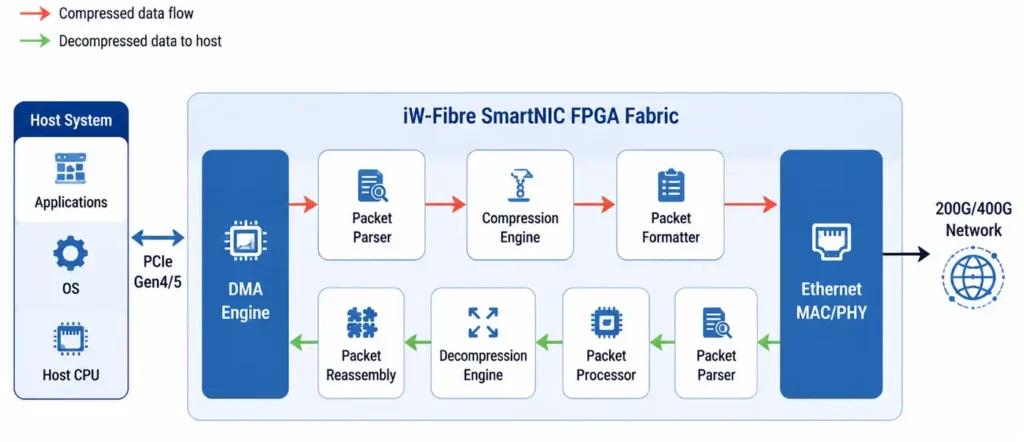
The iW-Fibre SmartNIC is built on Intel Agilex 7 FPGA technology and provides a programmable acceleration platform for implementing custom networking and data processing workloads directly in hardware.
The platform integrates several high-performance building blocks that can be leveraged to implement in-line data compression solutions including:
- Multi channel PCIe Gen4/Gen5 DMA subsystem for high throughput host to card data movement.
- FPGA based packet processing pipeline capable of line-rate packet inspection and manipulation.
- High-speed Ethernet subsystem supporting 100G/200G/400G/800G networking interfaces.
- Hardware flow classification and traffic steering engines.
- On-board memory interfaces for buffering and context management.
- FPGA fabric for integrating custom acceleration functions such as compression, encryption, telemetry, and packet analytics.
Compression flow
The compression engine operates as a streaming hardware accelerator within the SmartNIC datapath. As packets traverse the pipeline, the engine continuously analyzes payload data, detects repeating byte sequences, and generates a compressed representation before forwarding the packet to the network interface. Since the processing is fully pipelined in hardware, packets continue flowing at line rate without involving the host CPU.
The compression pipeline is generally implemented in the following steps:
1.Payload Extraction – the packet parser extracts the headers from the packet and delivers the payload to the compression engine
2.Pattern Discovery – the compression engine searches the incoming payload for patterns or repetition of byte sequences that can be effectively encoded
3.Dictionary/History Lookup – the compression engine looks for previously occurring patterns in the history buffer/dictionary and replaces pattern occurrences with references to the matching patterns
4.Compression Engine Encoding – the detected patterns are encoded using the selected hardware compression algorithm while the non-occurring patterns are encoded as literal data
5.Metadata Generation – the compression metadata along with the compressed payload length information and integrity data are generated to allow for proper decompression on the receiver’s end
6.Packet Reconstruction – the packet headers are reattached to the compressed payload forming a packet that is then passed to the Ethernet subsystem for transmission
7.Hardware Decompression – the decompression engine on the receiver’s end utilizes the compression metadata to decompress the payload which is then delivered to the host application
With all compression related operations performed in the FPGA datapath, the compression and decompression processes are transparent to the host application without any modifications to the data or additional CPU overhead incurred.
Performance Advantages of In-line Compression
The table given below provides a feature comparison between SmartNIC based In-line compression and a software based approach:
| Parameter | SmartNIC Based In-Line Compression | Software Based Compression |
|---|---|---|
| Processing Location | FPGA hardware datapath | Host CPU cores |
| Host CPU Utilization | Near-zero compression overhead | Significant CPU consumption during compression/decompression |
| Network Throughput | Capable of operating at network line rate | Limited by available CPU resources |
| Latency | Deterministic hardware processing | Variable due to OS scheduling and software stack overhead |
| Scalability | Scales with FPGA resources and network bandwidth | Increasingly difficult to sustain at higher speeds |
| Memory Bandwidth usage | Reduced data movement through hardware offload | Multiple memory copies between application, kernel, and compression layers |
| Power Efficiency | Better performance-per-watt through dedicated hardware | Higher power consumption due to CPU utilization |
| Infrastructure Utilization | Frees CPU resources for application workloads | Compute resources shared between applications and compression tasks |
Key Use Cases
SmartNIC based in-line compression can benefit a wide range of data intensive applications, including AI/ML training clusters, cloud and virtualized infrastructure, edge computing platforms, distributed storage systems, and cybersecurity monitoring solutions. The ability to perform compression directly within the FPGA datapath makes it particularly attractive for next-generation 200G, 400G, and 800G networking environments where traditional software-based approaches can become a performance bottleneck.
What Data Can Be Compressed?
The effectiveness of in-line compression depends primarily on the characteristics of the data rather than the application generating it. Lossless compression algorithms achieve the highest compression ratios on data containing repetitive patterns, redundant information, or structured content.
Typical data that benefits from hardware-based in-line compression includes:
- Text-based files and log streams
- JSON, XML, CSV and structured datasets
- Database records and transaction logs
- Storage replication traffic
- Memory pages during VM migration
- Sensor and telemetry data
- Raw image data
- Scientific and engineering datasets
Since compression is performed on packet payloads rather than files, applications remain completely unaware of the compression process. The original data format and file names remain unchanged from the application’s perspective.
Conclusion
As modern data centers continue evolving toward higher bandwidth and lower latency requirements, efficient data movement becomes critical for achieving scalable infrastructure performance.The iW-Fibre SmartNIC enables intelligent hardware-accelerated in-line compression directly within the network datapath, significantly reducing CPU overhead while optimizing bandwidth utilization and throughput efficiency.
Explore Related Content
- Enabling 400G/800G Ethernet Acceleration with iWave’s Agilex™ 7 SmartNIC
- https://iwave-global.com/articles/iw-fibre-smartnic-vpp-networking/
