Fusion of Vector Packet Processing (VPP) and iW-Fibre SmartNIC for Deterministic Networking
August 5, 2026
Article
The Rise of Software-Defined Packet Processing
iW-Fibre SmartNIC is transforming software-defined networking by accelerating packet processing and enabling deterministic network performance. As networking functions continue to migrate from dedicated appliances to software-defined platforms, organizations are gaining unprecedented flexibility in deploying and scaling network services. However, this transition also places greater demands on the underlying packet processing infrastructure, particularly in applications where latency consistency, traffic prioritization, and predictable packet handling are critical.
Developed as part of the FD.io (Fast Data Project) – Universal Data plane initiative, Vector Packet Processing (VPP) has become a widely adopted open-source software data plane for cloud, telecom and edge networking. Its vectorized packet processing architecture enables millions of packets per second while overcoming many of the limitations associated with traditional kernel based networking. Yet, as packet rates increase and networking workloads become more sophisticated, maintaining deterministic network behavior remains an ongoing challenge.
The Quest for Predictable Packet Processing
Traditional networking stacks have successfully supported a wide range of applications for decades. However, as network speeds continue to scale and workloads become increasingly latency sensitive, factors such as interrupt handling, context switching and kernel processing overhead can introduce variations in packet-processing performance.
VPP addresses many of these challenges through its vectorized packet processing architecture, delivering a more efficient and predictable software data plane. The key improvements over conventional packet processing are summarized below.
| Conventional Networking Challenge | VPP Advantage |
|---|---|
| Interrupt overhead | Poll-mode packet processing |
| Context switching | User-space packet processing |
| Cache inefficiencies | Vector-based batch processing |
| High instruction overhead | SIMD-optimized processing |
| Kernel bottlenecks | Streamlined dataplane architecture |
| Limited throughput scalability | Multi-core packet processing |
| Latency variability | Reduced software-induced latency variation |
By processing packets in vectors rather than individually, VPP significantly improves packet processing efficiency and has become a widely adopted software data plane for applications such as virtual routing, service chaining, cloud networking and 5G user plane functions.
While VPP addresses many of the limitations associated with conventional networking stacks, packet-intensive operations such as traffic classification, encryption, checksum processing and flow management still rely on host CPU resources. As traffic rates increase and networking functions become more sophisticated, these workloads can place additional demands on the software data plane, creating opportunities for hardware-assisted acceleration.
Understanding VPP’s Graph-Based Processing Model
At the heart of VPP is a graph based packet processing architecture that organizes networking functions into interconnected nodes. Each node performs a specific task such as packet parsing, classification, routing, filtering, or forwarding and packets are processed by traversing these nodes through an optimized execution path.
Unlike conventional packet-processing pipelines that handle process packets individually through multiple software layers, VPP processes vectors of packets through the graph. This approach improves cache efficiency, reduces instruction overhead and enables higher packet-processing performance.
The graph-based model also provides significant flexibility. New networking functions can be introduced as additional nodes, allowing developers to extend packet processing pipelines without redesigning the entire data plane. This makes VPP particularly well suited for software-defined networking, network function virtualization (NFV), cloud networking and 5G infrastructure deployments.
VPP’s Graph based processing model
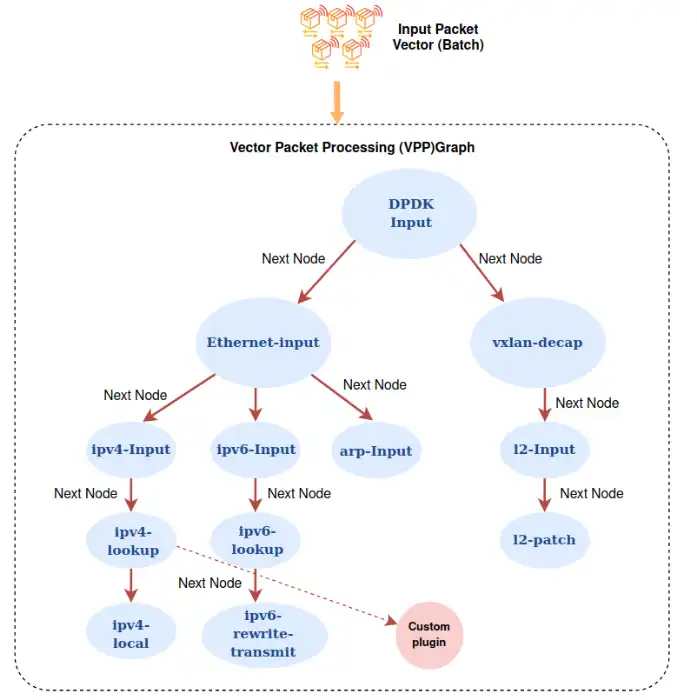
By combining vectorized packet processing with a modular graph architecture, VPP provides a highly scalable software data plane capable of adapting to evolving networking requirements.
Extending VPP with iW-Fibre SmartNIC Acceleration
While VPP provides a high-performance software data plane for routing, service chaining, policy enforcement and other networking functions, packet-intensive operations continue to consume valuable host CPU resources. Integrating the iW-Fibre Accelerator with VPP enables selected networking functions to be accelerated in hardware, reducing processing overhead while preserving the flexibility of software-defined packet processing.
The below Figure illustrates a typical deployment in which the iW-Fibre Accelerator complements the VPP data plane by providing high-speed packet I/O and hardware-assisted packet processing. This collaborative software–hardware architecture helps improve CPU efficiency, scalability and traffic predictability for deterministic networking applications.
Software–Hardware Architecture Combining VPP with the iW-Fibre SmartNIC
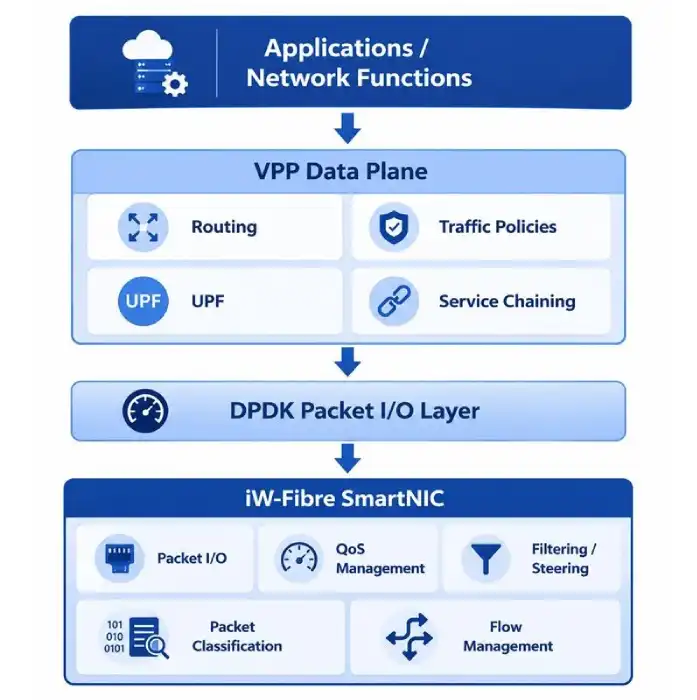
As illustrated in the above Figure, VPP leverages the DPDK packet I/O framework to communicate efficiently with the iW-Fibre SmartNIC. (For more information on DPDK integration and performance with the iW-Fibre Accelerator , refer to our article “Accelerating iW-Fibre Cards with DPDK”.)
The Accelerator complements the VPP data plane by accelerating packet-processing functions such as:
- Packet classification and flow steering
- Checksum processing
- Quality of Service (QoS) enforcement
- Packet filtering
- Security processing and encryption
- Flow monitoring and telemetry
By distributing packet-processing responsibilities between software and hardware, organizations can reduce CPU overhead, improve scalability and create a more deterministic networking environment while retaining the flexibility of software-defined packet processing.
Building a Deterministic Networking Platform with VPP and iW-Fibre SmartNIC
The combination of VPP and the iW-Fibre Accelerator creates a hybrid packet-processing architecture that leverages the strengths of both software and hardware. VPP provides a flexible and high-performance software data plane capable of supporting routing, service chaining, policy enforcement and other network functions, while the iW-Fibre Accelerator delivers high-speed packet I/O and hardware-assisted packet processing.
The below figure llustrates how VPP, DPDK and the iW-Fibre Accelerator work together to build a deterministic networking platform.
VPP Intergrated with iW-Fibre SmartNIC
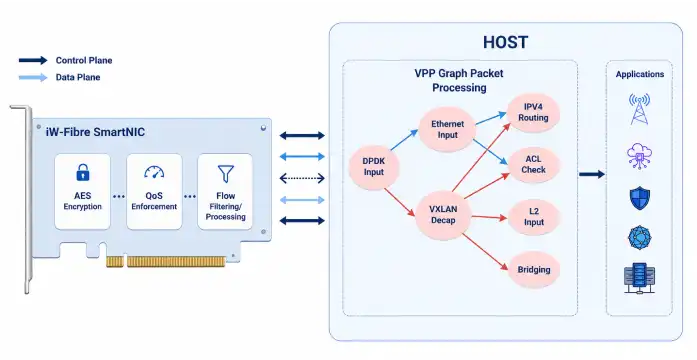
Within this architecture, VPP continues to manage higher-layer networking services while the iW-Fibre SmartNIC accelerates packet-intensive operations closer to the network interface. This balanced software–hardware approach reduces CPU overhead, improves scalability and supports the predictable packet processing required for deterministic networking deployments
Realizing Deterministic Networking
Building on the software–hardware architecture described earlier, the combination of VPP and the iW-Fibre Accelerator enables organizations to deploy scalable networking platforms that balance software flexibility with FPGA-assisted packet processing.
As networking workloads continue to grow in complexity, this hybrid approach provides a practical foundation for deploying deterministic networking solutions across cloud, telecom, industrial and edge environments.
Explore Related Content
- Adaptive Network Virtualization with Open vSwitch on iW-Fibre SmartNIC
- Enabling 400G/800G Ethernet Acceleration with iWave’s Agilex™ 7 SmartNIC
