SmartNIC-Accelerated NAT64: Enabling IPv6-only clients to communicate with IPv4-only servers with iW-Fibre
June 25, 2026
Article
As networks increasingly adopt IPv6 due to the limitations of IPv4 address availability, many legacy services and devices still operate on IPv4 and cannot be directly reached from IPv6 environments. This creates a compatibility gap. NAT64 addresses this need by providing a translation mechanism that allows IPv6 devices to access IPv4 resources seamlessly, ensuring continued connectivity and interoperability during the transition from IPv4 to IPv6.
Need for NAT64 in IPv4–IPv6 Coexistence
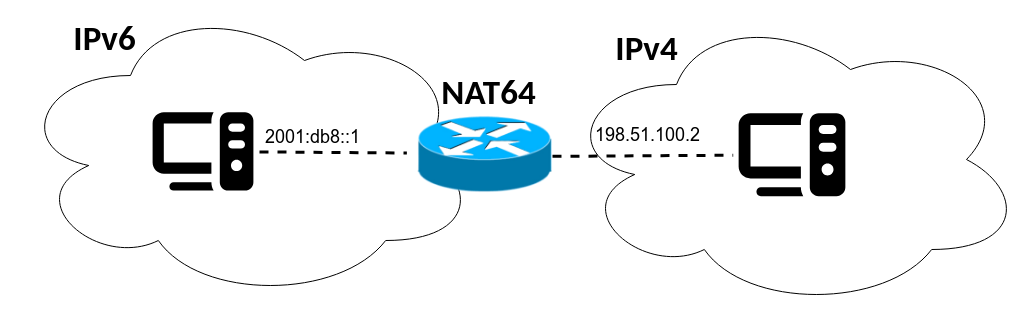
- IPv4 uses 32-bit addresses (limited address space), while IPv6 uses 128-bit addresses with a much larger address space and improved features like simplified headers and better scalability.
- It is needed to enable IPv6-only clients to access IPv4-only services, since a large amount of existing internet infrastructure still runs on IPv4.
- NAT64 translates packets between IPv6 and IPv4 networks by converting headers and mapping addresses so IPv6 clients can communicate with IPv4 servers, with reverse translation for return traffic.
iW-Fibre SmartNIC Architecture for NAT 64
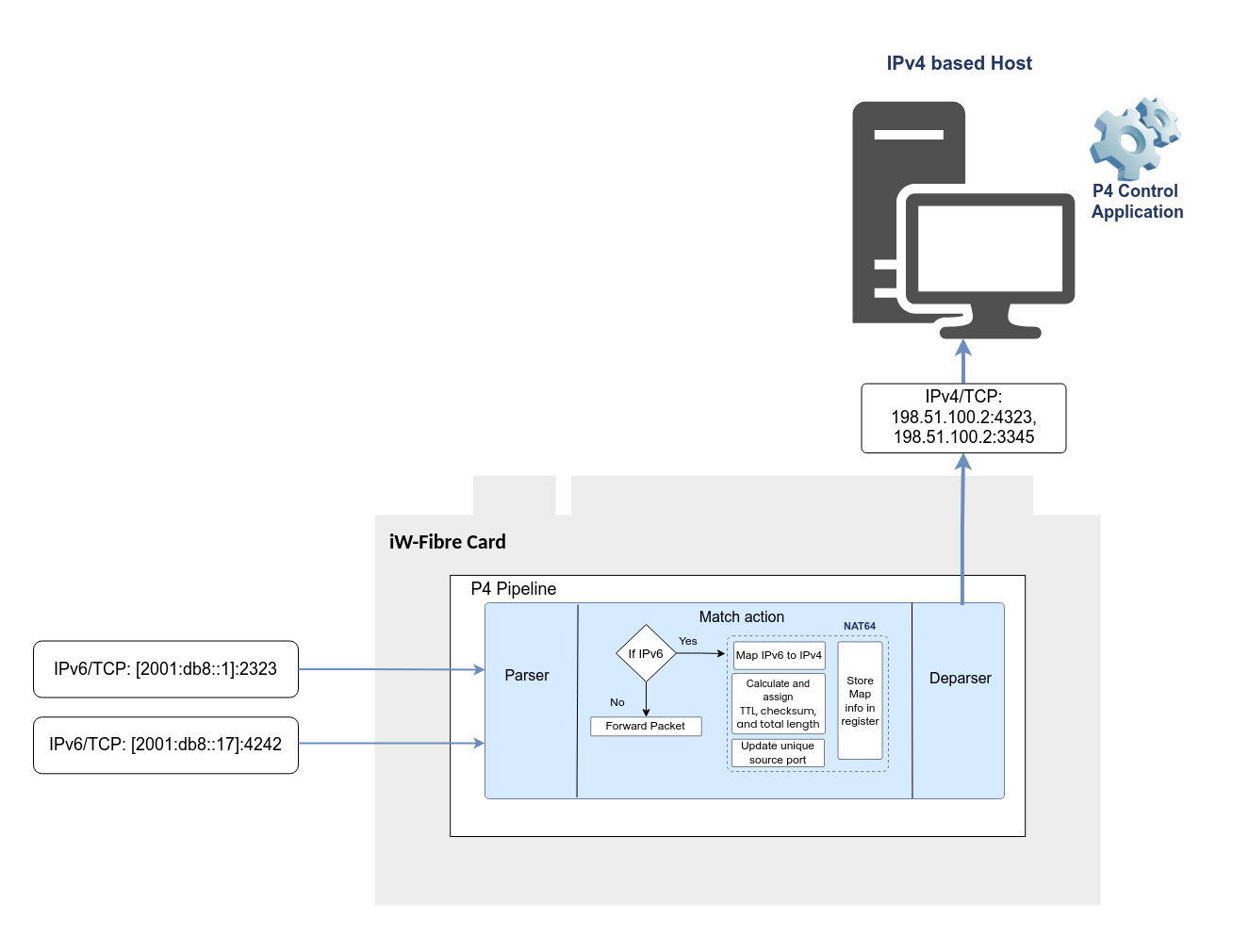
P4-Based NAT64 Pipeline Design
The iW-Fibre SmartNIC leverages a P4-based packet processing pipeline to implement NAT64 functionality. The processing flow is structured as follows:
Parser
- The parser extracts and interprets the incoming packet headers, specifically identifying the IP layer fields.
Match-Action Stage
Step 1 : Pipeline Determines Packet Type
- Incoming packet headers are parsed to identify the IP version field
- If version = 6 → IPv6 packet, proceed to NAT64 translation
- If version = 4 → IPv4 packet, forward normally without translation
Step 3 : NAT64 IP Mapping
- The IPv6 header is translated into an IPv4 header using lookup table (LUT) entries.
| IPv6 Fields | IPv4 Fields | Map functions |
|---|---|---|
| Version (6) | Version (4) | Directly set to 4 |
| Traffic Class | DSCP/ECN | Copied as it is |
| Flow Label | Not present | Discarded |
| Next Header | Protocol | Copied as it is |
| Hop Limit | TTL | Copied and decremented by 1 |
| Source Address | Source IP | Replaced with P4 LUT entries |
| Destination Address | Destination IP | Last 32 bits extracted as IPv4 Destination address |
- Relevant IPv4 fields such as TTL, checksum, and total length (including L4 headers) are calculated and updated.
- Total Length — Recalculated as IPv4 header (20 bytes) + L4 header + payload length, since IPv6 header (40 bytes) is larger than IPv4 header (20 bytes)
- TTL — Copied directly from IPv6 Hop Limit field and decremented by 1
- Checksum — Recalculated fresh since IPv6 has no header checksum but IPv4 requires one
- L4 Checksum (TCP/UDP) — Updated because source/destination IP addresses changed, which affects the pseudo-header checksum calculation
- Relevant IPv4 fields such as TTL, checksum, and total length (including L4 headers) are calculated and updated.
Step 4 : Port Pooling
- A port pool (typically 1024–65535, ~64K ports) is maintained per IPv4 address
- Each new IPv6 session gets a unique port assigned via a hash of the 5-tuple (src IP, dst IP, src port, dst port, protocol)
- The mapping IPv6 src and IPv6 dst to IPv4 + NAT port is stored in stateful registers
- On return traffic, the NAT port is used to reverse-lookup the original IPv6 addresses
Deparser
The modified headers are reassembled with the payload, and the translated packet is forwarded to the host or next processing stage.
Performance Benefits
- In-Network Translation Advantage – Unlike traditional software NAT64, which relies on routing packets to a separate translation node, P4-based NAT64 performs translation directly within the data plane (SmartNIC/switch).This eliminates the need for additional routing hops.
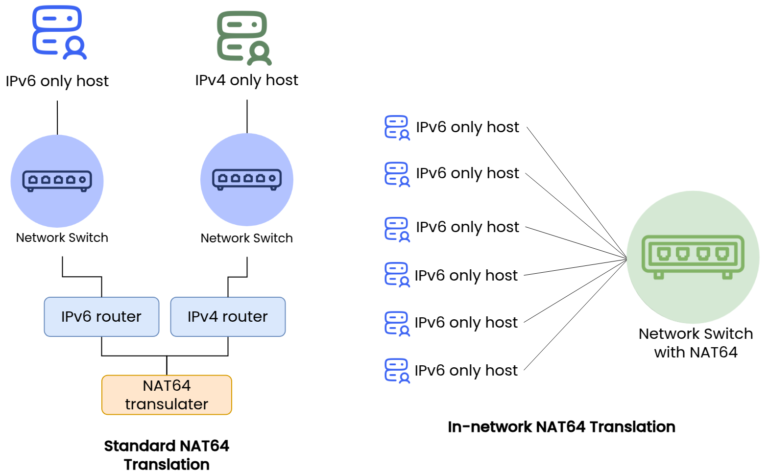
- Low Latency – In-line processing within the iW-Fibre SmartNIC reduces packet traversal time compared to software-based NAT64 running on CPUs.
- Programmable Data Plane – P4-enabled iW-Fibre SmartNICs can execute custom packet processing logic inline, allowing NAT64 translation to occur as packets traverse the pipeline without leaving the device.
- Flexible Control Plane Communication – The iW-Fibre SmartNIC communicates with the controller over a standard interface (e.g., Ethernet), enabling dynamic configuration and scalability.
SmartNIC-accelerated NAT64 using a P4-based pipeline with iW-Fibre cards provides an efficient and scalable solution for enabling communication between IPv6-only clients and IPv4-only servers. By performing translation directly in the data plane, it reduces latency, improves throughput, and offloads processing from the host CPU. This approach simplifies network design while delivering high-performance packet processing, making it a practical solution for modern IPv6-driven environments transitioning from legacy IPv4 infrastructure.
For platform evaluation or additional information, contact mktg@iwave-global.com
