V2X Connectivity Hub: Enabling Safer and Smarter Connected Vehicles
August 14, 2023
Article
V2X Connectivity Hub technology is transforming the automotive industry by enabling vehicles to communicate with surrounding vehicles, infrastructure, pedestrians, and network systems. As the industry moves from conventional vehicles toward connected, intelligent, and increasingly autonomous mobility, technologies such as telematics, advanced driver assistance systems (ADAS), and vehicle connectivity are becoming increasingly important. By enabling seamless communication across the connected transportation ecosystem, a V2X Connectivity Hub supports safer, smarter, and more efficient mobility.
V2X Connectivity Hub and Connected Mobility
Vehicle-to-Everything (V2X) communication enables vehicles to exchange information with their surroundings in real time. Unlike conventional sensors and cameras that have limitations in range and field of view, V2X enables vehicles to receive information beyond their direct line of sight.
V2X communication includes:
- V2V – Vehicle-to-Vehicle: Enables vehicles to exchange information such as speed, position, and sudden braking events.
- V2I – Vehicle-to-Infrastructure: Enables communication between vehicles and infrastructure such as traffic signals, roadwork systems, and roadside units.
- V2P – Vehicle-to-Pedestrian: Enables vehicles to identify and communicate with vulnerable road users such as pedestrians and cyclists.
A V2X Connectivity Hub can combine these communication capabilities with vehicle interfaces, positioning systems, sensors, and security technologies to provide enhanced situational awareness.
V2X Connectivity Hub for Improved Vehicle Safety
Road safety is one of the most important applications of V2X technology. Vehicles can receive warnings about hazards that may not yet be visible to the driver or detected by onboard sensors.
Potential applications include:
- Forward collision and emergency braking warnings
- Blind intersection and curve warnings
- Roadwork and hazardous-location alerts
- Pedestrian and vulnerable road-user warnings
- Emergency vehicle notifications
- Wrong-way and stationary vehicle alerts
By providing additional information about the surrounding environment, V2X can complement existing ADAS technologies and contribute to safer connected and automated vehicles.
V2X Connectivity Hub for Traffic and Vehicle Efficiency
V2X communication can also improve traffic management and vehicle efficiency. Real-time information from vehicles and infrastructure can help identify congestion, optimize routes, and improve traffic flow.
Connected vehicles can receive information about traffic conditions, road closures, signal timing, parking availability, and other infrastructure-related events. This enables OEMs and mobility providers to develop intelligent transportation solutions that can reduce travel delays, fuel consumption, and unnecessary emissions.
C-V2X and DSRC Technologies
Two major communication technologies have been used for V2X applications: C-V2X and Dedicated Short-Range Communications (DSRC).
DSRC is based on IEEE 802.11p/WAVE technology and enables direct communication between vehicles and infrastructure. C-V2X, standardized through 3GPP, uses cellular technology and supports both network-based and direct communication.
C-V2X provides two key communication modes:
- Network Mode (Uu): Uses cellular networks for long-range communication and cloud-connected applications.
- Direct Mode (PC5): Enables direct communication between vehicles, infrastructure, and other road users without relying on cellular network coverage.
The choice of technology depends on the target market, infrastructure, regulatory environment, and application requirements. A flexible V2X platform can therefore provide OEMs with greater freedom when developing connected mobility solutions.
V2X Connectivity Hub for Automotive OEMs
For automotive OEMs, implementing V2X requires more than simply adding a wireless communication module. The platform needs to integrate multiple communication interfaces, vehicle networks, positioning technologies, processing capabilities, and security mechanisms within a reliable automotive-grade system.
A V2X Connectivity Hub can serve as a central platform for integrating:
- C-V2X and/or DSRC communication
- Cellular connectivity
- GNSS positioning
- CAN/CAN-FD interfaces
- Ethernet connectivity
- Wi-Fi and Bluetooth
- Secure processing and hardware security
- Edge computing and data processing
This integrated approach can simplify system development and enable OEMs to build scalable V2X solutions across different vehicle platforms.
iWave’s V2X Connectivity Hub
iWave’s V2X Connectivity Hub is designed as a scalable platform for connected mobility applications. Powered by the NXP i.MX 8XLite processor, the platform combines V2X communication with vehicle connectivity, processing, positioning, and security features.
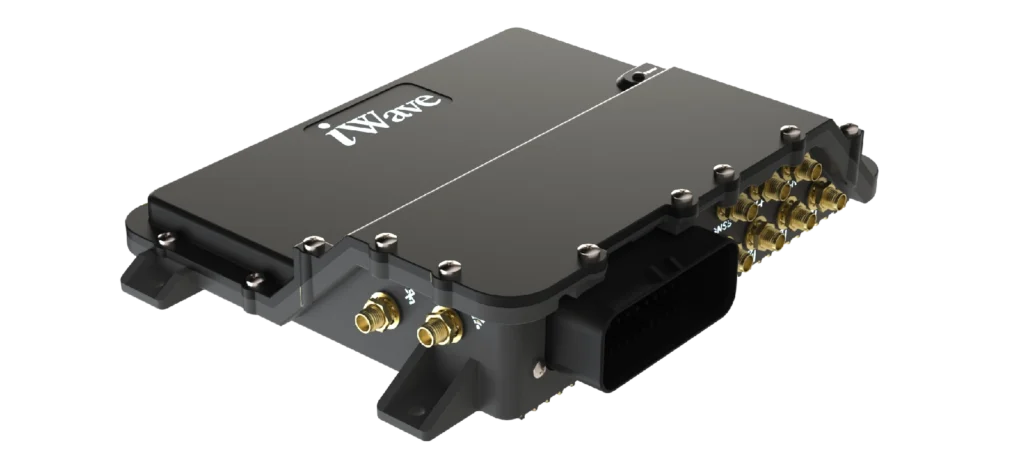
The platform supports C-V2X and DSRC, enabling deployment across different V2X use cases. It can also be configured with multiple CAN-FD interfaces, cellular connectivity, Wi-Fi, Bluetooth, GNSS, Ethernet, and hardware security features.
The V2X Connectivity Hub can be positioned as both an On-Board Unit (OBU) and a Roadside Unit (RSU), providing flexibility for vehicle and infrastructure deployments.
The evolution toward connected and automated vehicles requires technologies that enable vehicles to understand and respond to their surrounding environment. V2X provides an important communication layer by extending vehicle awareness beyond the capabilities of conventional sensors.
For automotive OEMs, a scalable V2X Connectivity Hub can accelerate the development of connected vehicle platforms while supporting applications ranging from road safety and traffic management to autonomous driving and intelligent transportation systems.
With its expertise in embedded hardware and software development, iWave provides V2X platforms that can be customized to meet specific automotive connectivity and deployment requirements.
For more information, visit www.iwave-global.com or contact mktg@iwave-global.com
